



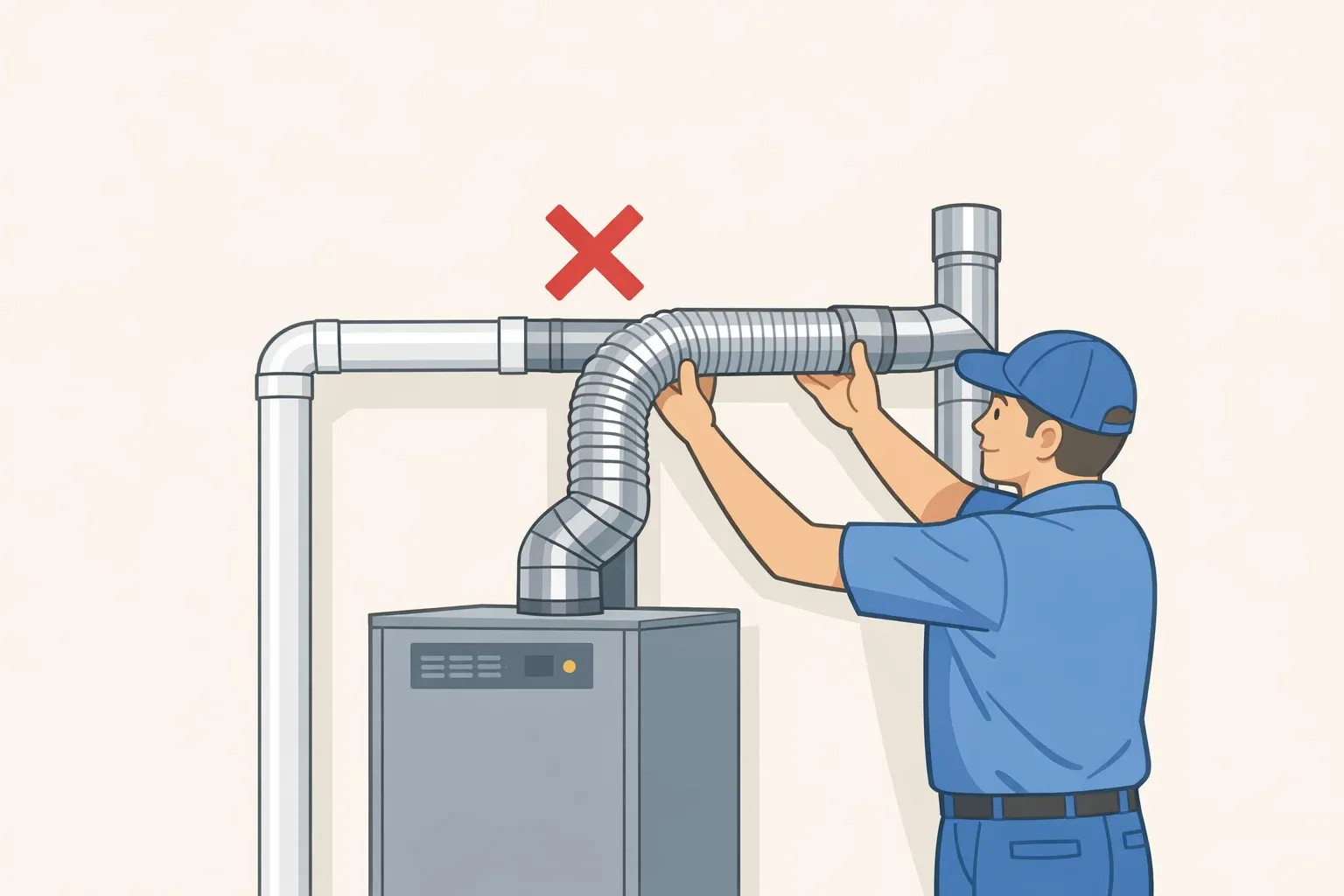
A homeowner replaces a 20-year-old gas furnace with a modern high-efficiency unit. The contractor swaps the equipment, reconnects the old silver metal flue, and the system runs fine. No alarm sounds. No inspector shows up. Over the following months, acidic condensate eats through the metal from the inside, and combustion gases begin finding their way into the utility room.
That scenario is the subject of this article. Using the wrong furnace vent pipe after a high-efficiency furnace upgrade is a code violation that creates conditions for carbon monoxide exposure, and it happens quietly, without any obvious warning sign that something has gone wrong.
Carbon monoxide is colorless and odorless. At elevated concentrations, it causes serious illness and death; it accounts for more than 400 residential deaths per year in the United States, per IRC 2024 venting guidance published by Jaspector earlier this year. The EPA is direct on this point: CO detectors are a backup measure, not a substitute for appliances that are properly installed in the first place.
The risk here isn't a furnace defect. Condensing furnaces are well-engineered, efficient, and code-compliant when installed correctly. The hazard is specific to the transition when an older atmospheric-vent furnace is replaced with a 90%+ condensing unit, and the vent system doesn't change with it.
Wrong furnace vent pipe: B-vent vs PVC furnace vent
The number printed on a furnace's yellow EnergyGuide label, the AFUE rating, looks like a marketing figure. It's actually a code classification that determines vent category, pipe material, and pressure direction all at once.
AFUE stands for Annual Fuel Utilization Efficiency: the percentage of fuel that actually becomes heat in the home. Furnaces rated at 80% AFUE or below are classified as Category I appliances. Their exhaust exits hot enough to rise naturally through a flue without condensing, and they operate at negative vent pressure, meaning the system draws gases upward and out by draft.
IRC 2024 requires a Type B double-wall metal pipe for these systems: an inner aluminum liner inside a galvanized steel jacket, with an insulating air gap that keeps flue gases warm enough to maintain that draft, per Jaspector's IRC 2024 analysis.
Condensing furnaces rated 90% and above are a fundamentally different animal. Because they extract far more heat from combustion before exhaust leaves the unit, flue gases exit at only 100°F to 130°F. That's cool enough to condense into liquid inside any vent material, and that condensate is mildly acidic, running at roughly pH 3 to 5.
Metal pipe exposed to it corrodes rapidly from the inside, eventually developing holes that allow combustion gases to leak into wall cavities or utility rooms. Schedule 40 PVC or CPVC plastic resists that acid where metal cannot. These units are also Category IV appliances: they push exhaust out mechanically under positive pressure rather than relying on draft. That detail matters for how joint failures behave, which comes up shortly.
Think of connecting a metal B-vent to a condensing furnace the way you'd think of running a weak acid through a copper pipe. The failure isn't immediate or obvious, but it's predictable, progressive, and guaranteed.
The pipe category is also not a simple either/or choice between PVC and CPVC. The furnace manufacturer's installation manual specifies which plastic materials are approved for that specific appliance listing. Using the right general category but the wrong product for that unit can still void the warranty and fail inspection, as IRC 2024 guidance makes clear. An inspector reviewing a condensing furnace connected to a metal B-vent will reject the installation at rough-in. The code violation is immediate; so is the warranty void.
The mismatch runs in both directions. Installing PVC on an atmospheric-vent furnace, or using single-wall sheet metal where Type B double-wall is required, are also gas furnace venting code violations that inspectors catch at rough-in and that homeowners purchasing existing homes may inherit without knowing it.
How one furnace replacement can leave three things wrong
The metal-vent-on-condensing-furnace problem is the most common mistake, but a properly vented new furnace can still leave the rest of the system in a dangerous configuration. A typical upgrade touches three distinct components, each a separate failure point.
The reused B-vent. When a condensing furnace is connected to an existing metal B-vent, the acidic condensate begins corroding the pipe from the inside. Over time, the metal develops holes, and combustion gases, including CO, escape into whatever space surrounds the pipe. This is the long-fuse version of the problem; it develops over a heating season rather than immediately.
There's also an immediate version. PVC joints on condensing furnace vent runs must be solvent-cemented per the manufacturer's instructions. Because these systems operate at positive pressure, a friction-fit joint that looks fully assembled can separate during normal operation, releasing combustion gases directly into the structure. No corrosion required; no time delay. The joint simply pushes apart under pressure, per IRC 2024 venting requirements.
The orphaned water heater vent. In a typical older home, the furnace and water heater shared a common vent sized for two appliances operating together. When the condensing furnace is replaced, it leaves the common vent entirely and gets its own dedicated PVC run. The water heater is now the only appliance on a system that was never sized for solo use.
The old common vent size may no longer be adequate for a single-appliance configuration, which can cause backdrafting combustion gases to reverse direction and enter the living space. Per IRC 2024 guidance, the contractor must re-evaluate the water heater vent and resize it if needed as part of the same job. This isn't an optional follow-up task.
It's like removing one car from a two-car counterweight system: everything still moves, but it's no longer balanced for the load it's actually carrying.
The masonry chimney. Routing a condensing furnace into an existing masonry chimney is the single most dangerous furnace venting mistake in this category, per Jaspector's IRC 2024 analysis. The acidic condensate saturates the mortar and causes spalling, destroying the chimney structure from the inside and creating a CO hazard as deteriorating masonry compromises the flue.
Connecting a condensing furnace to an unlined masonry chimney is a code violation under IRC 2024. If the chimney must remain in the system, a Category IV-rated liner specifically listed for positive-pressure, condensing applications is required. Standard chimney liners are not rated for this use. Several municipalities in the northeastern U.S. already require professional chimney inspection and certification before any new appliance can connect to an existing masonry system.
What homeowners can check, and what requires a pro
Some venting problems are visible to anyone with a flashlight. Others require code knowledge, system geometry, and professional credentials. Knowing which is which is the practical value here.
What's visible without expertise. A condensing furnace will have white or gray plastic pipe running from the unit to an exterior wall or through the roof. A silver metal pipe connected to a high-efficiency unit is the wrong material. Full stop. If the AFUE rating isn't visible, it's printed on the yellow EnergyGuide label attached to the unit anything 90% or above requires PVC or CPVC vent pipe.
A few other things worth noting during a visual check: rust staining on the vent pipe, white mineral deposits around joints, visible sags in horizontal PVC runs (which should be supported every 4 to 6 feet per the manufacturer's specs), and couplings that don't appear fully seated. None of these confirms a problem individually, but any of them warrants a call to a licensed contractor.
What requires a professional. Vent pipe sizing must be calculated from the NFPA 54 Appendix B tables using the full system geometry: total vertical height, total horizontal run, number of elbows, and appliance BTU input. Matching pipe diameter to the flue collar by eye is not an acceptable method; it produces both oversized and undersized results, per IRC 2024 requirements. Common-vent recalculation, chimney liner specification, and Category IV listing verification all require professional credentials and, in many jurisdictions, a permit.
Five questions worth asking before any furnace replacement begins:
What vent category is this new furnace, and what pipe material does the manufacturer's installation manual specify?
Will the entire vent system be replaced, or is any existing pipe being reused?
What happens to the water heater vent? Will you re-evaluate it and resize it if needed as a single-appliance system per NFPA 54?
Are you pulling a permit and scheduling a rough-in inspection?
If the vent runs through or connects to a masonry chimney, has a chimney professional inspected it and confirmed it's suitable for the new appliance?
A contractor who can't answer questions 1, 3, and 4 without hesitation is worth paying attention to in the wrong direction.
The permit and inspection process is the primary mechanism that catches wrong pipe material, uncemented joints, incorrect slope, and chimney misuse before the furnace runs through a full season. Skipping it removes the only independent check on work that directly affects life safety, per the IRC 2024 condensing furnace venting code.
The vent system deserves the same attention as the furnace
Condensing furnaces aren't the problem. The problem is the transition when every element of the old atmospheric venting system becomes wrong for the new appliance, and only the furnace gets replaced.
The EPA is clear that CO detectors are a backup for a system that shouldn't be leaking, not a primary safeguard. A CO alarm in the utility room is genuinely useful. It is not a substitute for correct pipe material, cemented joints, a recalculated water heater vent, and an inspected chimney.
Furnace efficiency standards in the U.S. continue to rise, meaning more homes will cycle through this exact transition over the coming years. The gap between what a new condensing furnace requires and what's already in the wall is predictable. So is the fix: treat the vent system as part of the replacement job, pull the permit, and schedule the inspection.
IRC 2024 Section M1801 and NFPA 54 Appendix B are the authoritative references. A licensed HVAC contractor or gas fitter should be the first call for anyone uncertain about what's currently installed.



Comments
Be the first, drop a comment!