Header Banner
WonderHowTo Logo
WonderHowTo
Home & Garden
wonderhowto.mark.png
Gadget Hacks Next Reality Food Hacks Null Byte The Secret Yumiverse Invisiverse Macgyverisms Mind Hacks Mad Science Lock Picking Driverless

Inverter vs Non-Inverter Air Conditioner: Key Differences

"Inverter vs Non-Inverter Air Conditioner: Key Differences" cover image

Inverter vs non-inverter air conditioner: key differences

Two air conditioners with the same cooling capacity, placed in the same room, don't have to draw the same amount of power. In a six-week office comparison, an inverter unit used about 35% less electricity than a same-capacity fixed-speed unit, 8.7 kWh versus 13.5 kWh over an eight-hour day, with the two units run on alternating days rather than simultaneously, according to a 2019 study comparing standard and inverter-type air conditioners. That gap sits at the center of every inverter vs non-inverter air conditioner comparison, and it traces back to one part: the compressor.

Here's the plain-language version. A non-inverter AC's compressor works like a light switch, either fully on or fully off. An inverter AC's compressor works more like a dimmer, speeding up or slowing down to match exactly how much cooling the room needs at that moment.

This isn't a niche distinction. Worldwide demand for air conditioners has grown sharply over the last few years, and inverter compressors, once reserved for premium models, now show up standard on midrange units too (Consumer Reports, in 2022). Europe had already settled on variable-speed split systems as its best available AC technology by 2012, according to that same 2019 study. A two-month field test in Cairo later found a variable-speed unit cut electricity use by 41% while keeping the space just as comfortable, per a 2023 comparison of fixed-speed and variable-speed room air conditioners in high-heat climates.

What follows covers how these two compressor types actually work, what independent research says about energy use, comfort, and noise, the real costs and repair trade-offs, and how to figure out which one fits a given room, without assuming the pricier option automatically wins.

What is the difference between an inverter and non-inverter AC?

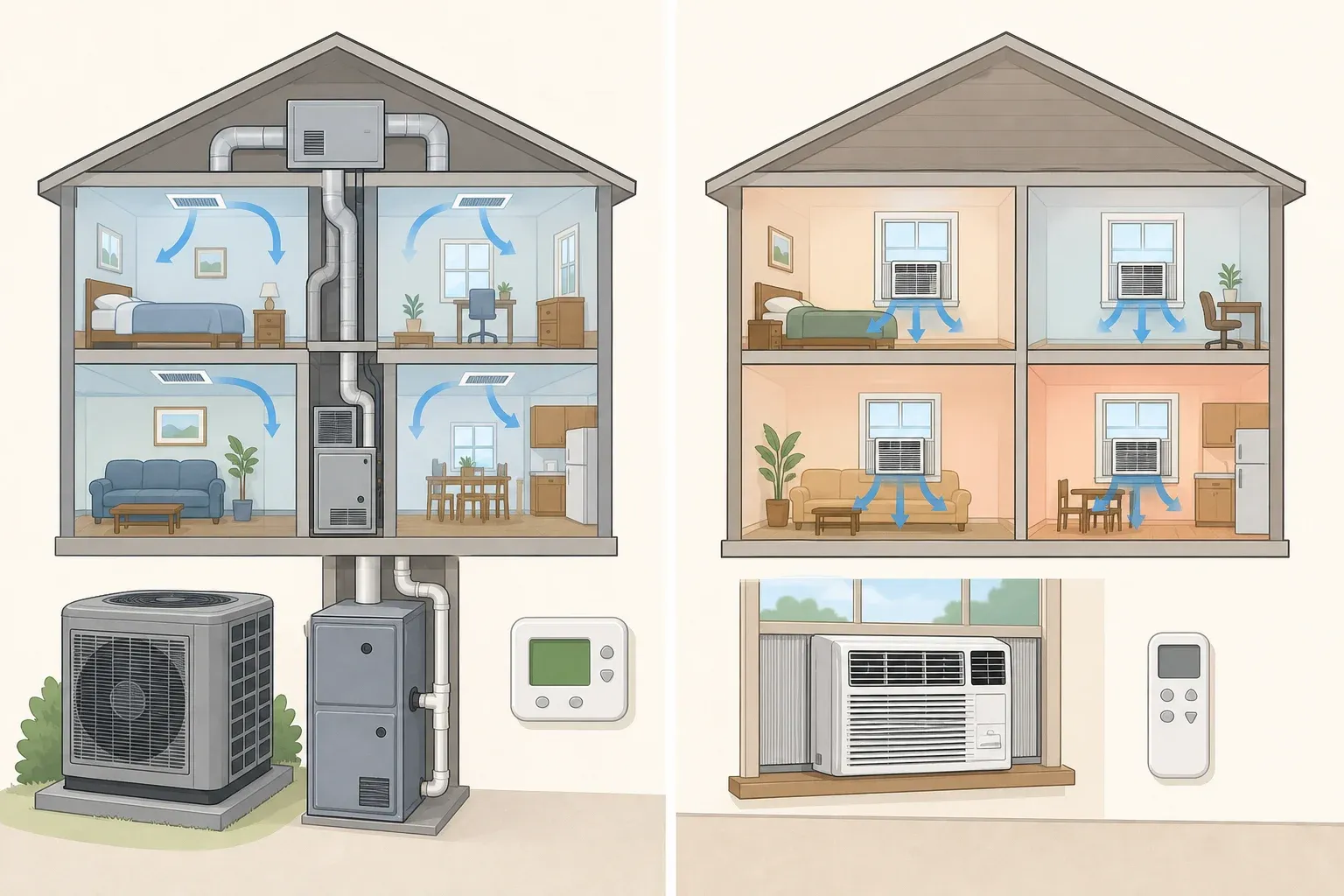
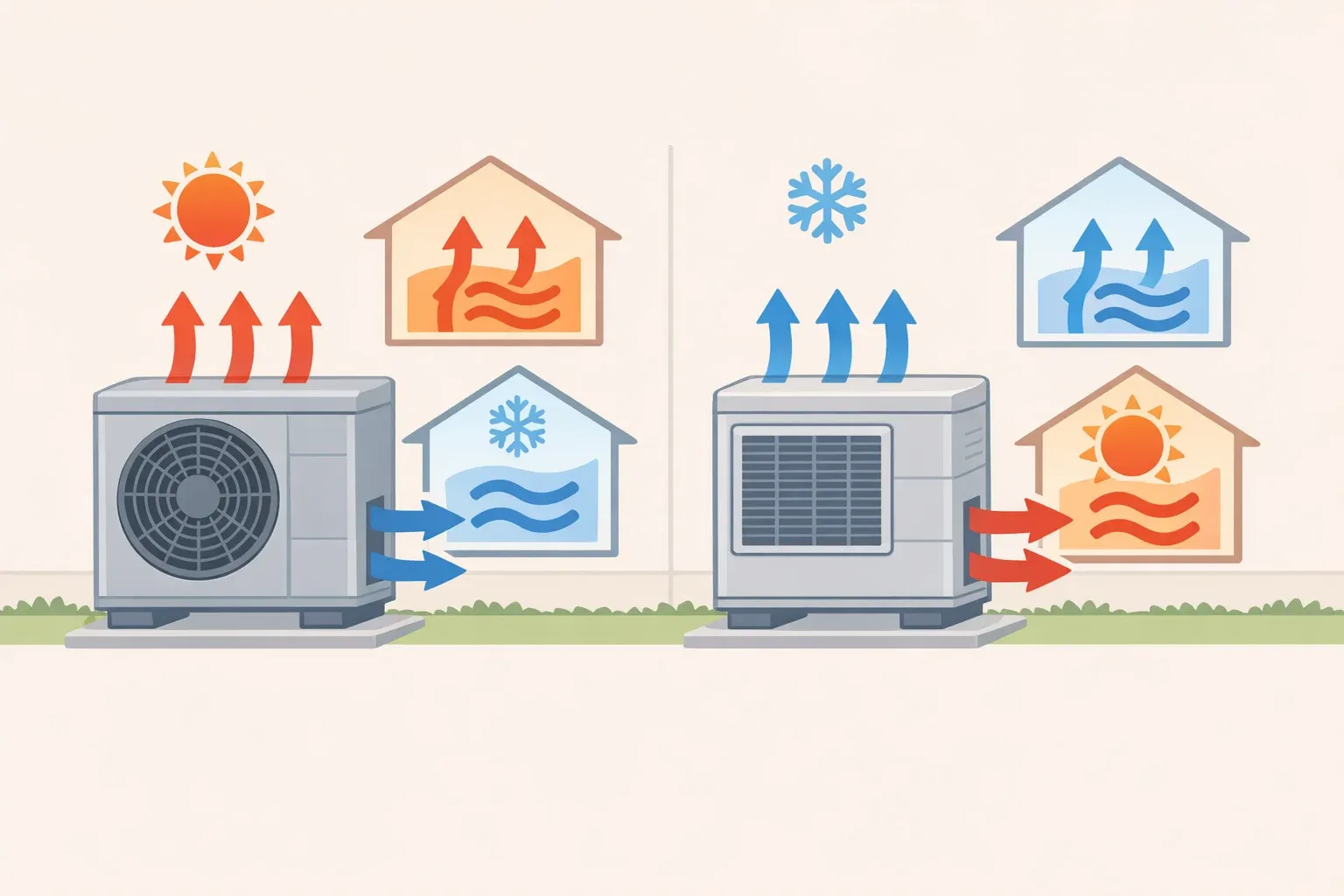
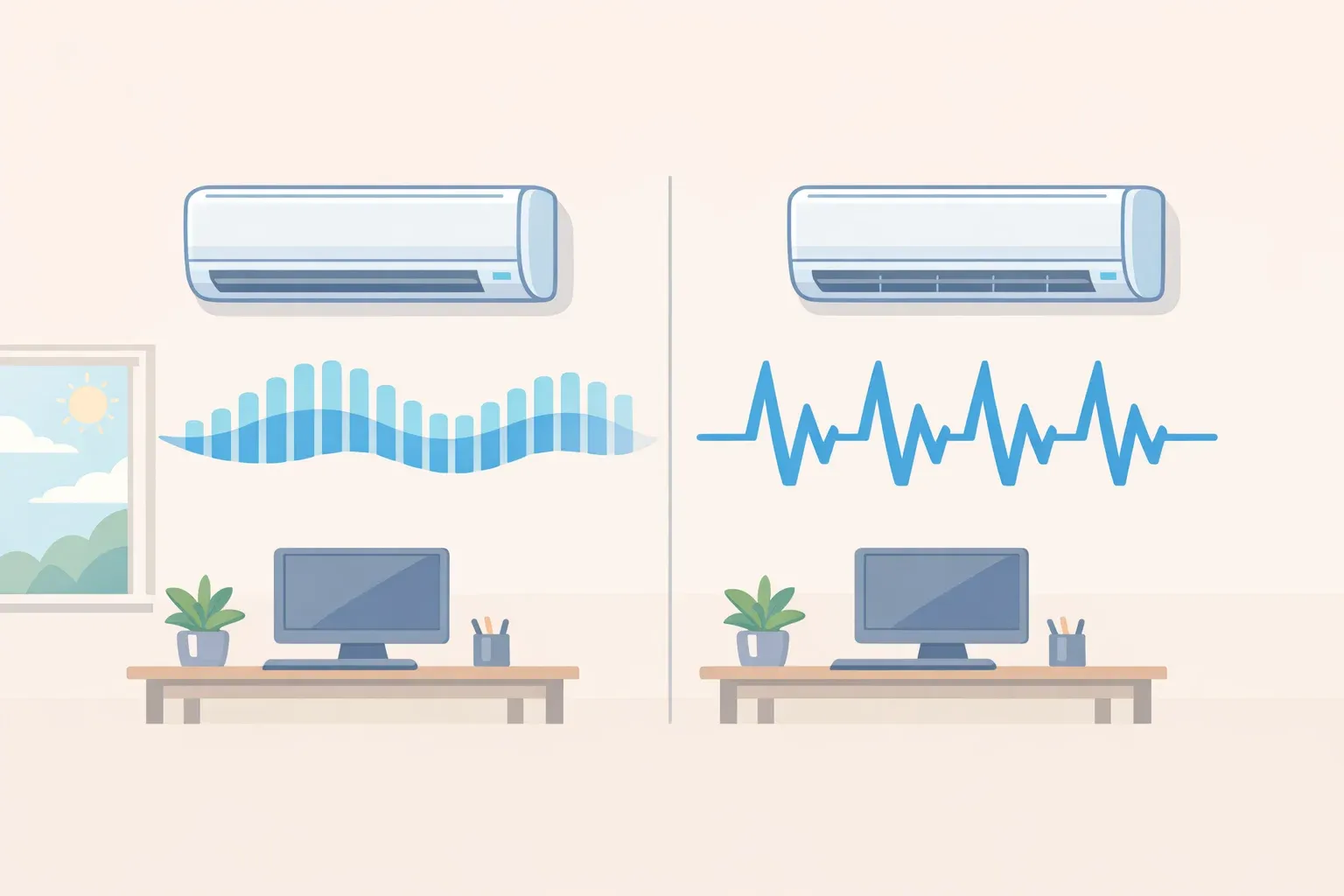
Diagram comparing non-inverter vs inverter air conditioner compressor operation: fixed-speed cycles fully on/off while inverter modulates motor speed and refrigerant flow continuously

A non-inverter, or fixed-speed, compressor runs at one constant speed. When the room drifts above the thermostat setting, it switches on at full power; once the target temperature is reached, it shuts off completely. That cycle repeats for as long as the unit is running (Hitachi Cooling & Heating).

An inverter compressor works differently. It uses electronic controls to vary motor speed and refrigerant flow continuously, adjusting output in real time to match whatever cooling the room actually needs rather than switching fully on and off, per that 2019 office study.

Think of it this way: a fixed-speed AC is a single-speed fan, full blast or nothing. An inverter is a fan with a dial, running just fast enough to hold the room steady.

One nuance worth flagging: calling an inverter compressor "always on" oversimplifies things slightly. It keeps running rather than shutting off, but the amount of power it draws scales with demand. The real distinction from a fixed-speed unit isn't nonstop full-power operation, it's the degree of control the system has over its own speed. That control is what produces every measurable difference in energy use, comfort, and price covered below.

Inverter vs non-inverter air conditioner electricity consumption

Bar chart illustrating inverter vs non-inverter air conditioner electricity use in an office test (about 8.7 kWh vs 13.5 kWh over eight hours)

The office comparison already described found the inverter unit using about 35% less power than its fixed-speed twin under matched conditions. That's one data point, not the whole picture, and the rest of the research lands in a similar neighborhood for reasons worth unpacking.

The 2023 Cairo field study went further, modeling annual savings of 473 kWh per year, a 30.5% reduction, on top of the 41% cut measured during its two-month test window. It also projected that if variable-speed units reached 60% market penetration, the resulting savings could hit 1.33 TWh and cut CO2 emissions by 2.64 million metric tons by 2032. Those estimates apply to Cairo's climate and the study's own assumptions, so they aren't a household savings forecast for anyone reading this elsewhere.

A 2024 classroom study in Mexico added a wrinkle. Inverter units there consumed markedly less energy than on/off systems, especially as outdoor temperatures climbed, but the comparison also involved different refrigerants: R-32 versus R-410A. That substitution alone could account for roughly a 5% efficiency difference, depending on the equipment's specific operating conditions (Journal of Energy and Applications). Refrigerant choice and compressor type aren't the same lever, and folding them together overstates what inverter technology alone delivers.

One number worth treating carefully: Hitachi's own marketing claims inverter units can save "up to 44% energy" over time (Hitachi). That figure comes from a company selling inverter units, and "up to" is doing a lot of work in that sentence. The independent studies above land closer to 30% in modeled projections and 35 to 41% in direct measurements, so treat the manufacturer number as an upper bound rather than an expectation.

Read together, none of this adds up to a single tidy percentage. The office test measured about 35% savings under moderate conditions, the Cairo study projected 30.5% with a 41% peak during its hottest stretch, and the Mexico comparison folded a refrigerant swap on top of the compressor difference. Inverter technology reliably saves energy; how much depends on climate, sizing, and how the unit gets used.

Inverter air conditioner pros and cons

Infographic summary of inverter vs non-inverter AC benefits: steadier temperature and quieter operation for inverter units compared with noticeable cycling swings for fixed-speed units

Energy use is the headline, but comfort, noise, cost, and durability shift in tandem with how the compressor runs.

Factor Non-inverter (fixed-speed) Inverter
Comfort Noticeable temperature swings as the compressor cycles on and off (Hitachi) Steadier temperature since output throttles up and down instead of stopping (Hitachi; 2019 study)
Noise Louder, especially when the compressor kicks back in (Hitachi) Among the quietest options on the market, per Consumer Reports' buying guide (Consumer Reports, 2022)
Humidity control Less effective in hot climates due to repeated cycling (2023 study) More consistent, since the compressor doesn't fully shut off between cycles
Upfront cost Lower purchase price Higher purchase price due to added electronic controls and circuitry (2019 study)
Running cost Higher electricity bills over time (Hitachi) Lower electricity bills over time, offsetting the higher purchase price (2019 study)
Repairs Simpler design, generally cheaper fixes More complex components can mean pricier repairs; some models offset this with five-year compressor warranties (Consumer Reports; Hitachi)

Humidity control deserves a second look beyond the table. Fixed-speed units struggle here because repeated compressor cycling interrupts moisture removal, which matters even when the thermostat reads correctly. A room can feel damp and uncomfortable despite hitting the target temperature.

Maintenance works a little differently across the two types, though the basics apply to both. Clean filters regularly regardless of which unit is installed; that's routine upkeep, not a symptom of a problem. If cooling performance drops off, that's the signal to call a technician and have refrigerant levels checked, rather than assuming a top-up is due on some fixed schedule (Hitachi).

None of the inverter advantages come free. They arrive bundled with a price premium and, in some cases, a repair-complexity trade-off, and how much that trade-off matters depends entirely on how many hours a day the unit actually runs.

Which is better: inverter or non-inverter air conditioner?

Decision flowchart using questions like daily runtime, local electricity rate, price gap, and noise needs to choose between inverter and non-inverter air conditioning

How the unit gets used matters as much as which technology sits inside it. Inverter efficiency is largest at part load, meaning when the room needs less cooling than the unit's full rated output (per the 2019 and 2023 studies). A room rarely needs full cooling output for the entire time an AC runs, so part-load conditions describe ordinary daily use more often than they describe a single heat-wave afternoon.

Habits matter almost as much. A 2024 study found that running an inverter unit at medium fan speed used meaningfully less energy than running it at high speed, and that a common habit, cranking the unit to maximum on startup and dialing it back later, actively undercuts the efficiency the technology is designed to deliver (Journal of Energy and Applications). Buying inverter technology and then operating it like a fixed-speed unit leaves most of the savings on the table.

A more useful way to weigh the choice than staring at a price tag is to run through a few questions first:

  • How many hours a day will it run? A bedroom AC running eight hours overnight accumulates savings a lot faster than a guest-room unit used twice a month.
  • What does electricity cost locally? The same efficiency gap translates into very different dollar savings depending on the rate per kWh, so the payback period isn't a fixed number anyone can quote in the abstract.
  • How big is the price gap between the specific models being compared? A narrow gap tips the decision toward inverter almost automatically; a wide one means the running-hours math needs to actually pencil out first.
  • Does noise matter for this room? Bedrooms and home offices benefit more from quieter, steadier operation than a garage or an occasional-use space does.
  • Is a technician who services this brand nearby? Inverter repairs can be more involved, so parts and service availability are worth checking before buying, not after something breaks.

With that framework in mind:

  • Inverter tends to make sense for rooms used many hours a day or overnight, such as bedrooms, home offices, or spaces in genuinely hot climates, where the efficiency and noise advantages compound over months of continuous use.
  • Non-inverter can still make sense for occasional-use spaces or tighter budgets, as long as the buyer accepts higher running costs and less steady comfort as the trade-off.
  • Regardless of type, confirm the unit is properly sized for the room and compare its actual efficiency rating rather than trusting the inverter label alone. Even a well-built AC underperforms if it's oversized, undersized, or neglected (Hitachi).

Actual payback still depends on local electricity rates and the efficiency rating printed on the specific model, not the inverter label by itself. Those numbers are worth checking before signing off on a purchase.

What actually decides the electricity bill

The compressor explains why one AC pulls more power than another with identical cooling capacity: cycle fully on and off, or modulate continuously. That single mechanical choice cascades into everything else covered here, from the size of the utility bill to how much the room's temperature drifts between cycles.

None of that erases the trade-off. Inverter units cost more upfront and can cost more to fix, so whether the investment pays off comes down to hours of use, local power rates, and the price gap on the specific models being compared.

Inverter compressors already show up on midrange units rather than staying a premium feature (Consumer Reports), which means the harder decision for most buyers isn't inverter versus non-inverter at all. It's sorting out which efficiency rating, refrigerant, and warranty terms actually hold up on the model sitting in front of them.

Apple's iOS 26 and iPadOS 26 updates are packed with new features, and you can try them before almost everyone else. First, check Gadget Hacks' list of supported iPhone and iPad models, then follow the step-by-step guide to install the iOS/iPadOS 26 beta — no paid developer account required.

Sponsored

Related Articles

Comments

No Comments Exist

Be the first, drop a comment!