




The choice between a window air conditioner and a ductless mini-split gets framed as a head-to-head competition, which leads people to buy the wrong thing. A renter drops $4,000 on a permanent installation they'll leave behind when they move. A homeowner in a humid climate buys a window unit that cools the air but never quite fixes the clamminess. Both made a reasonable-sounding decision and got a bad outcome.
The window AC vs mini-split comparison isn't really about which system is technically superior. It's about which one fits your situation. For most people who can choose either option, four questions settle it: how long you're staying, how many rooms you're cooling, how often you'll use the space, and what climate you're in.
Two constraints worth knowing before the framework. Window ACs require a vertically opening double-hung window; there are no mainstream improved designs, like inverter or U-shaped models, for casement windows or horizontal sliders, though through-the-wall units and portable options exist for those situations. Mini-splits require EPA-certified refrigerant handling that cannot be legally DIY-installed by most homeowners. If either constraint eliminates your preferred option, the decision is already made. For everyone else, here's how to think through it.
Four questions that settle the decision
Question 1: Do you own the home and plan to stay?
This is the heaviest variable in the analysis.
Everything that favors a mini split, including lower operating costs, longer service life, and better humidity control, takes time and consistent use to accumulate into real value. A single-zone mini-split installation runs $2,000–$5,500 all-in; a window unit runs $150–$600 and goes up in under an hour. That gap only closes if you own the home long enough to recover the difference. Mini-splits last 15–20 years; window units last 5–10. The lifespan advantage matters only to someone who's staying.
Renters have a clean answer. A mini-split requires a permanent wall penetration, landlord approval, and installation costs that stay with the building at move-out. As HVAC Manager Dale Chason put it in an AOL, "Renters usually choose window units because they don't require any permanent modifications and can be removed." For homeowners, The HVAC Journal frames it directly: "Window AC vs. ductless usually breaks along one line: how long the system has to pay for itself."
Payback depends heavily on local electricity rates, usage patterns, and installation cost. The HVAC Journal specifically notes that Florida homeowners running cooling eight to ten months a year who plan to stay more than three years often come out ahead with a mini-split. In milder climates with shorter seasons, that math stretches considerably, and the threshold shifts with it.
Question 2: How many rooms and what layout?
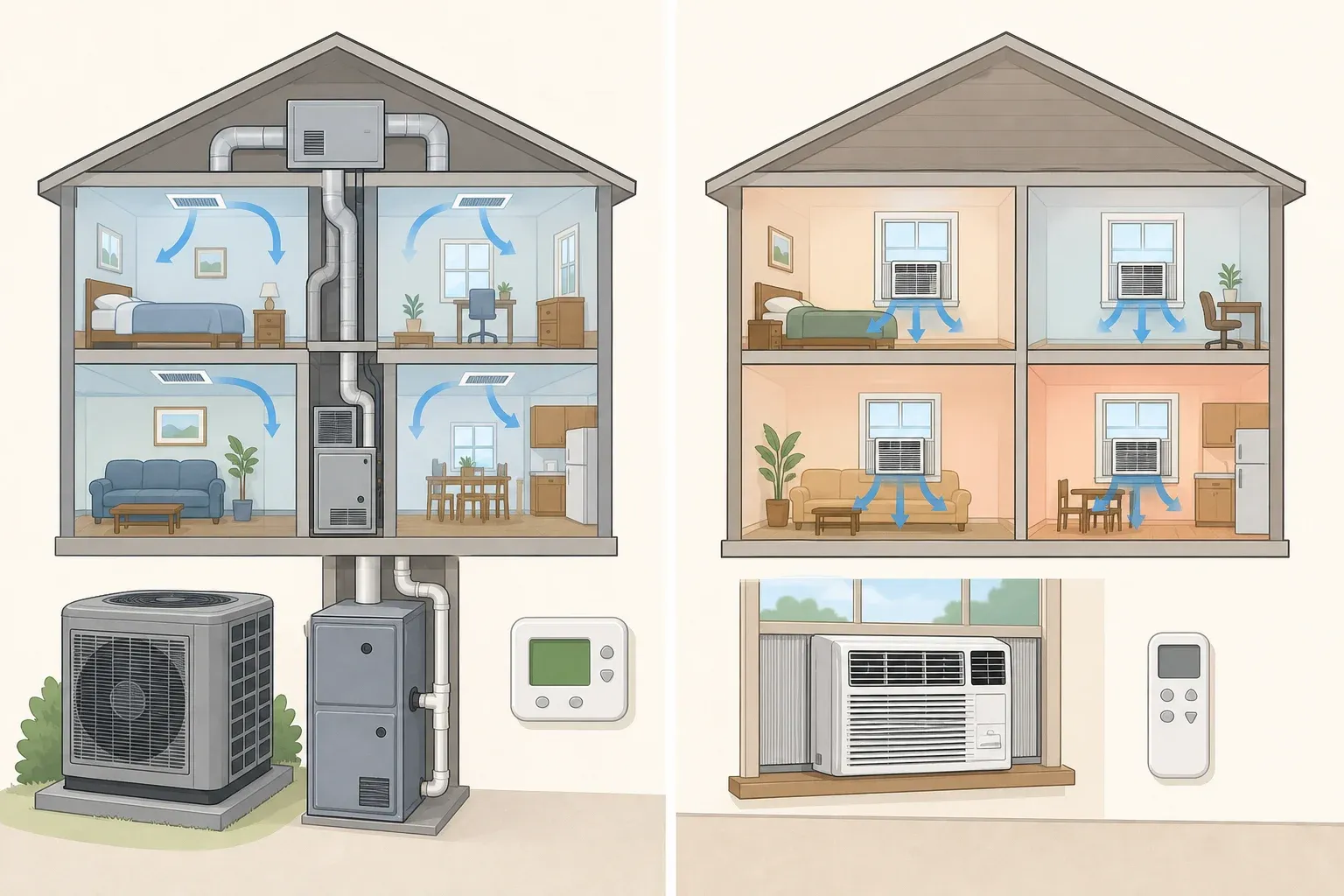
Small, single-floor homes, including studios, bungalows, and one-floor condos, are generally good window-unit territory. As a directional rule, two bedrooms or fewer and window units typically suffice; three or more bedrooms and a mini-split tends to make more sense, according to AOL. Room count matters less than layout, though. A single window unit placed in one part of a chopped-up floor plan won't reach rooms it doesn't connect to.
Mini splits address this with zoning: one outdoor condenser can support up to eight independently controlled indoor air handlers, so you cool only the rooms you're actually using. Multi-story homes with high ceilings and significant sun exposure present a similar case. As Chason observed, "Multi-story homes with high ceilings that get a lot of natural light also need more strategic cooling than a single window unit can provide."
Running multiple window units to cover a larger home is worth comparing on cost. Chason estimates the approach can add up to $100 per month versus a zoned system, though that figure comes from one professional's experience rather than a broad dataset; treat it as directional. Garage conversions and room additions without ductwork default to mini-split territory regardless of room count. They lack the infrastructure for any built-in alternative and often require year-round conditioning.
Question 3: How often will you use the space?
For occasional-use rooms, a guest bedroom, vacation cottage, or a space you cool for six or eight weeks a year, the economics of a permanent installation simply don't apply. A window unit is the obvious call.
Chason's formulation is useful here: "How often are you going to use your space? If it's daily, mini-splits win on comfort and efficiency. If it's occasional or seasonal use, a window unit will make more sense." For daily-use spaces, bedrooms and home offices especially, the calculation shifts. That shift connects directly to the fourth question.
Question 4: How humid is your climate?
Humidity is where window units quietly lose the comfort argument, even for homeowners who might otherwise justify one.
Standard window units cycle between full blast and off. That pattern cools the air but doesn't extract enough moisture; rooms end up cold and clammy rather than genuinely comfortable. An oversized unit makes this worse by dropping temperature quickly before dehumidification can keep up. Mini-split inverter compressors run continuously at lower speeds, drawing humidity out steadily rather than in bursts.
The practical difference is measurable in high-humidity climates. According to The HVAC Journal's Florida installation experience, swapping a window unit for a mini-split typically drops bedroom humidity from the high 60s to a steady 50 percent, a comfort change homeowners feel within the first week, before any energy savings appear on the bill. That's a specific, long-season example; in drier climates, the dehumidification gap between systems narrows considerably.
Mini-split vs window unit cost: where the gap matters
The long-term case for a mini split is strong. The tradeoffs belong in the same conversation.
The upfront cost is the primary barrier. At $2,000–$5,500 for a single zone, a mini-split costs roughly five to ten times a comparable window unit before any savings begin. Installation requires a licensed HVAC professional; refrigerant handling is federally regulated, and while DIY pre-charged kits exist, they typically void manufacturer warranties.
The indoor air handler mounts permanently on the wall, and most units use basic mesh filters with low MERV ratings, so homes with allergy concerns may still need a standalone air purifier alongside the system.
Installation may also require a dedicated 220V circuit. Homes with electrical panels under 100 amps could need an upgrade, though Rewiring America notes most homeowners can proceed without one.
On incentives: the federal heat pump tax credit expired after 2025, but nearly every state maintains its own rebates that can knock thousands of dollars off installation costs, per EnergySage. State and utility-level programs vary significantly; check your state energy office or provider before committing to a price rather than assuming any particular credit applies.
One broader point neither system can fix: a poorly insulated space. If a room runs hot regardless of cooling capacity, the building envelope deserves attention before the equipment gets upgraded, as The HVAC Journal notes.
Mini-split vs window AC efficiency in real use: the gray area
The framework handles clear cases well. The harder call belongs to a specific reader: a homeowner with one primary room to cool, a three-to-five-year horizon, and a climate that's warm but not especially humid. This is where the mini split's case weakens, and a modern window unit becomes a genuinely rational choice, not a consolation prize.
Mini-split efficiency runs roughly 1.5 to 2 times better than a standard window unit, thanks to inverter compressors that adjust speed rather than cycling on and off. But that efficiency advantage compounds into real savings only with daily use over a long cooling season.
Shorten either variable and the payback math gets thin on a three-to-five-year timeline. The dehumidification argument matters less when humidity isn't the primary problem.
This is where a sharper decision lens helps. Before defaulting to a mini split quote, consider these four conditions:
Upfront budget: Can you absorb $2,000–$5,500 in year one, or does that constraint settle the question?
Expected years in home: Under five years with a short cooling season, the payback rarely materializes regardless of efficiency gains.
Daily hours of use: A bedroom or home office used eight or more hours a day shifts the math faster than a room used for two.
Humidity and noise sensitivity: In a dry climate, the dehumidification edge shrinks. If noise is a concern for sleep or work, the gap between a 19–35 dB mini split indoor head and even a quiet window unit still matters.
If three or more of those conditions favor a window unit, a modern inverter or U-shaped model is the financially defensible call. If the timeline or humidity load tips the other way, get a mini split quote.
The window unit category has changed enough to make this a real choice rather than a default. Inverter-driven compressors, previously limited to premium models, are now common across mid-range units, Consumer Reports confirms.
Newer inverter window models reach 14–15 CEER, compared to 10–15 CEER for standard window units, and run meaningfully quieter than traditional cycling designs. U-shaped models, more common since 2022, allow the window sash to close between the indoor and outdoor sections, and Consumer Reports consistently ranks them among the quietest window units in testing.
These improvements haven't closed the full gap. Mini-split indoor heads operate at 19–35 dB; even improved window units typically run 50+ dB indoors. For a three-to-five-year situation in a moderate climate, that tradeoff is manageable. If the timeline extends beyond five years with daily use in a warm or humid climate, get a mini-split quote and run the actual numbers with a local contractor. The improved window unit is not a substitute for that analysis.
Quick decision and next steps
The short version:
Renter, occasional use, or short timeline: window unit, ideally a modern inverter or U-shaped model
Homeowner, daily use, humid climate, or multi-room need: mini split
Homeowner, one room, moderate climate, 3–5 year horizon: run through the four conditions above; a modern window unit is often the right answer
If you're buying a window unit, sizing matters more than brand. An oversized unit short-cycles before pulling enough moisture from the air, which is exactly the comfort problem you're trying to solve. Use these BTU guidelines from Consumer Reports as a starting point:
5,000–6,500 BTU for 100–250 sq ft
7,000–8,500 BTU for 250–350 sq ft
9,800–12,500 BTU for 350–550 sq ft
Adjust upward by 10 percent for sunny rooms, downward by 10 percent for shaded ones. For a bedroom or home office, pay the premium for an inverter or U-shaped model. One practical check before you buy: confirm your window opens vertically. Casement and horizontal sliders rule out the improved designs, though through-the-wall units are an option worth considering in those situations.
If you're buying a mini split, get two or three contractor quotes and ask each to run a Manual J load calculation. A rough rule of 20 BTU per square foot is a starting point, not a substitute for actual sizing. Check your electrical panel capacity before the first call.
Consumer Reports confirms that mini splits "do an excellent job cooling and are much quieter both indoors and out than window ACs." Verify available state and utility incentives before locking in a price; they vary significantly by location and can shift the math meaningfully.
The clearest next step is also the most concrete one: price an inverter window unit and a mini-split installation side by side, then weigh expected years of daily use against the cost gap. That number, not the spec sheet, is where the decision actually lives.















Comments
Be the first, drop a comment!