



A house can photograph beautifully and still be a money pit. It can also look dated, dark, and worn around the edges and still be worth every dollar. The difference isn't a vibe you pick up walking through the front door. It comes down to five specific, checkable signs a house has good bones, not a feeling you either get or don't.
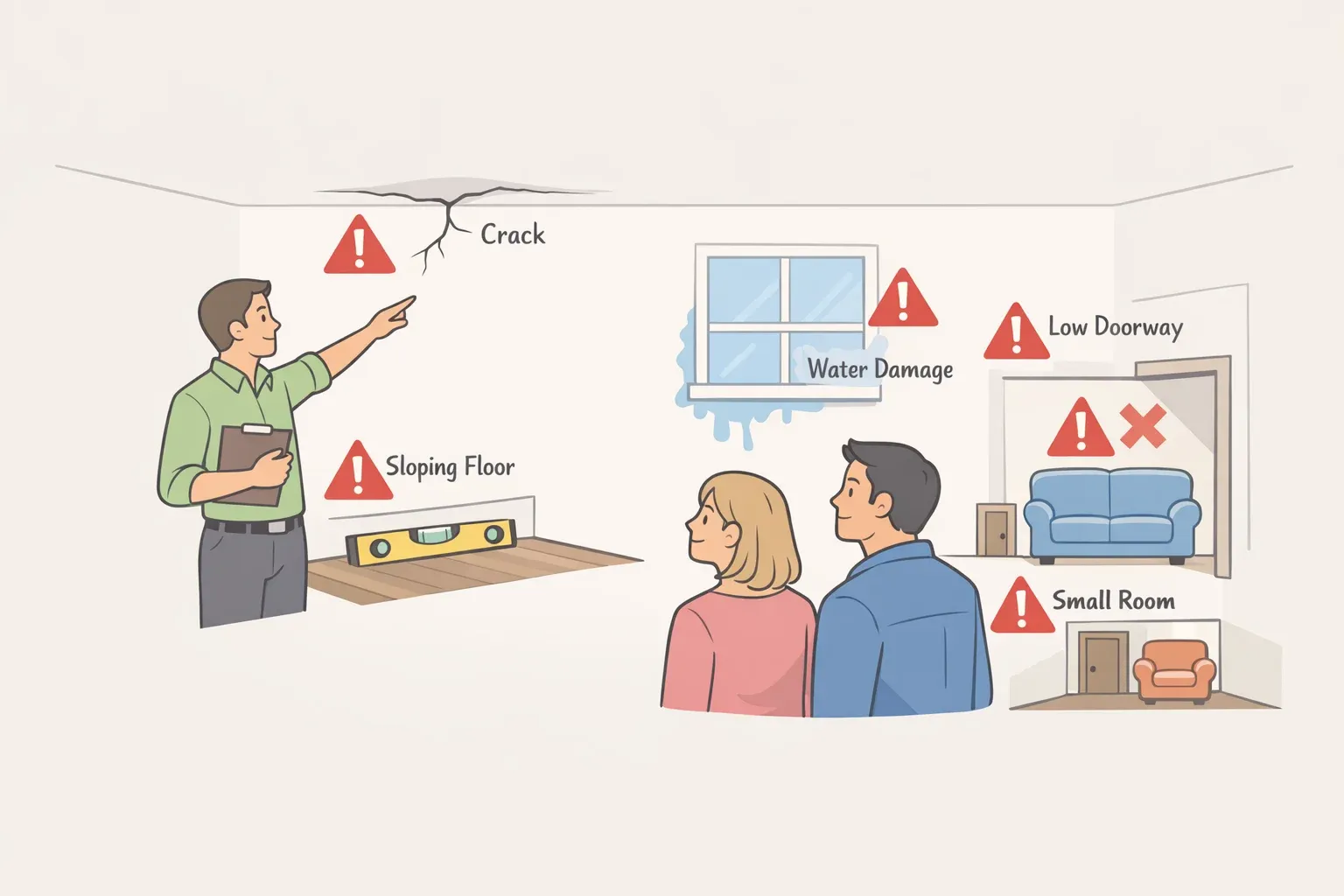
Architectural designer Brandon Ingram ties the concept to proportions: window and door openings, ceiling heights, and how a room is scaled, not the finishes layered on top. Builder Will King adds a warning of his own: sagging floors, cracked sheetrock, and doors that won't close often trace back to moisture problems or foundation settlement, and both get expensive fast.
Not every crack means trouble, though. A hairline crack under 1/16 inch is typically trivial on its own, while sudden or recurring movement deserves a professional look regardless of how the crack measures.
This guide walks through five signs, in order of how much weight they should carry in a decision: no active structural movement, a dry foundation with working drainage, workable proportions and room scale, good daylight and a thoughtful layout, and original materials paired with evidence of real maintenance. The first two are pass/fail screens for risk. The last three determine whether a structurally sound house is also one worth the work of renovating.
Sign 1: No obvious signs of active structural movement
Floor sag, cracked drywall, and doors that stick or won't latch are the first things King tells buyers to check, and for good reason. They're often the visible tip of a moisture or foundation problem that's already doing damage out of sight.
The exterior tells its own story. Cracks in brick, especially ones that show signs of a prior repair, are another indicator of foundation settlement worth flagging during a walk-through.
Size alone doesn't tell you how worried to be. Timeline matters more than measurement: new or sudden movement calls for expert attention right away, recurring movement can add up to real damage even when each instance looks small, and slow, continuous movement over years deserves the same scrutiny as a dramatic crack that appeared overnight. A crack that's sat unchanged for a decade is a different problem than one that showed up last month.
That's also why patched cracks and repair history need to be read together rather than separately. A single old crack with a solid patch and no further movement is often nothing to worry about. That same patch job paired with fresh cracking nearby, or a seller who mentions the foundation's been repaired more than once, suggests the underlying cause was never actually solved.
Note the location, width, and whether any cracks look patched. Then ask the seller or agent what caused it and whether the fix held. That history tells you more than the crack's dimensions ever will.
Sign 2: A dry foundation and functioning drainage
Water problems come before everything else, including the proportions and daylight covered later in this guide. In basements and crawlspaces, look for standing water, mold, dampness, and sagging floor joists, all signs that moisture has been running the house instead of the other way around.
Climate raises the stakes. Unmanaged humidity can damage a structure over time, a particular risk in humid regions where moisture pressure never really lets up. Above ground, gutters that clearly haven't been cleaned in years often point to rot or water intrusion happening somewhere else in the house.
An 1850 Cape covered later in this guide shows how far this can go in practice: a chronically wet rubble foundation needed a full drainage overhaul before the crew could touch anything else in the basement. Good proportions and daylight don't count for much in a house that's still fighting its own foundation.
Run a hand along basement walls, check for musty odors, and ask whether any sump pump on site has ever run continuously during a storm. That answer tells you how hard the house is already working just to stay dry.
The first two signs are pass/fail. Skip a house that fails either one, no matter how good everything else looks. The remaining three aren't about risk at all. They're about whether a structurally sound house also has good bones in the design sense, the qualities that make it adaptable, livable, and worth the effort of renovating.
Sign 3: Workable proportions and room scale
Ingram calls window and door openings, ceiling heights, and room scale the source of a house's elusive, hard-to-name feeling. Get those right, he argues, and you can take a house anywhere you want to design-wise.
This is also why proportions matter more than most buyers assume. Paint and fixtures are weekend fixes. Ceiling height and room dimensions are structural, and changing them typically means real demolition, not a trip to the hardware store.
Stand in the main living spaces and ask whether furniture, foot traffic, and daily routines fit naturally, or whether every room feels like a compromise. Awkward scale isn't cosmetic. It's a design cost baked into the walls, and you'll keep paying it for as long as you own the house.
Sign 4: Good daylight, orientation, and functional layout
Architect Kirsten Schoettelkotte prioritizes windows that face the yard or street, sunrooms that stay warm in winter and shaded in summer, and porches positioned near the kitchen or living space. Details like these tend to separate a house someone designed with intention from one built to hit a minimum spec.
If possible, visit at different times of day. Notice whether the main living areas actually get natural light or feel like they were tacked onto the floor plan as an afterthought.
Sign 5: Original materials, paired with evidence of maintenance
Old-growth hardwood, plaster walls, and fine craftsmanship carry real value, but that value holds only if the material has actually held up over time. A house can have gorgeous original floors sitting above a wet, unstable foundation. One doesn't cancel out the other.
Restoration sometimes reveals more than expected. A mantel or an overpainted stained-glass window can become a focal point once it's cleaned up, but that's a renovation bonus, not proof the house is structurally sound.
Care is a soft but useful signal. Schoettelkotte notes that a home clearly cherished by its owners was usually maintained well too, though she still insists on an inspection rather than trusting a gut feeling.
One flag outweighs everything else on this list: visible termite damage is worth addressing right away, no matter how well-preserved the rest of the house looks.
Separate what's charming from what's sound. Ask when the major systems were last serviced, and whether there's any maintenance or repair history available to review.
Signs a house has good bones: What to check at a showing
These five signs tell you what to ask, not what to diagnose on your own. Sorting what you notice into three buckets, and writing it down before you leave, makes the walk-through far more useful than a gut impression you'll struggle to describe a week later.
Before leaving a showing, jot down:
Where you saw cracks, and roughly how wide they looked
Whether any brick or drywall repairs appeared old versus recent
Any musty smell or dampness in the basement or crawlspace
Whether walls looked like they bulge, lean, or bow anywhere
What the seller or agent said about repair history, and when the work happened
That list becomes the basis for what to ask an inspector to check closely.
Usually lower concern, pending inspection: hairline cracks under 1/16 inch with no sign of recent or recurring movement, well-kept gutters, a dry basement, and good light and proportions. InspectAPedia is explicit that crack size alone shouldn't settle the question; even a small crack deserves a second look if there's any sign of ongoing movement or unusual drainage history nearby.
Investigate further: sticking doors, damp basement smells, neglected gutters, or repaired cracks in brick. Ask the seller for history and have an inspector take a closer look.
Call in a specialist: repeated repairs to the foundation or interior, or any crack pattern suggesting active, recurring, or ongoing movement. Bulging or leaning walls belong in this category too, and they deserve prompt attention rather than a wait-and-see approach. InspectAPedia notes that bulging brick or masonry can signal imminent structural collapse, particularly if additional stress from water, snow load, or vehicle traffic is applied. Have a qualified inspector assess any of these, and bring in a structural engineer if the inspector recommends it.
Good bones doesn't mean move-in ready
The 1850 Cape profiled by Fine Homebuilding sits in the historic district of Wayland, Massachusetts, added onto several times over the generations. When work began, the house was empty, in serious disrepair, and lacked even minimal modern performance standards, despite the owner's attachment to what it contributed architecturally to the neighborhood.
Like many old houses built on a rubble foundation, this one had a chronically wet basement. Before anything else could happen, the crew hung a drainage membrane over the stone walls, routed the water into a perimeter drain, and ran it out to sump pumps that pushed it into a buried tank in the yard. Only once that system was working could they insulate the basement with spray foam. Good bones bought the house a future. They didn't make the drainage problem optional.
That order reflects a broader principle. Preservation isn't the same as freezing a house in time; owners can modernize systems and interiors without erasing the elements that gave the house its bones in the first place.
Conclusion
Good bones in an old house, or a new one, start with structural stability and dry drainage. Those are the two nonnegotiables. Good proportions, daylight, and authentic materials reinforce that foundation, but they don't replace it.
Use these five signs to decide whether a house deserves a closer look. Use a qualified inspector and an engineer when warranted to decide whether it deserves your money.







Comments
Be the first, drop a comment!