



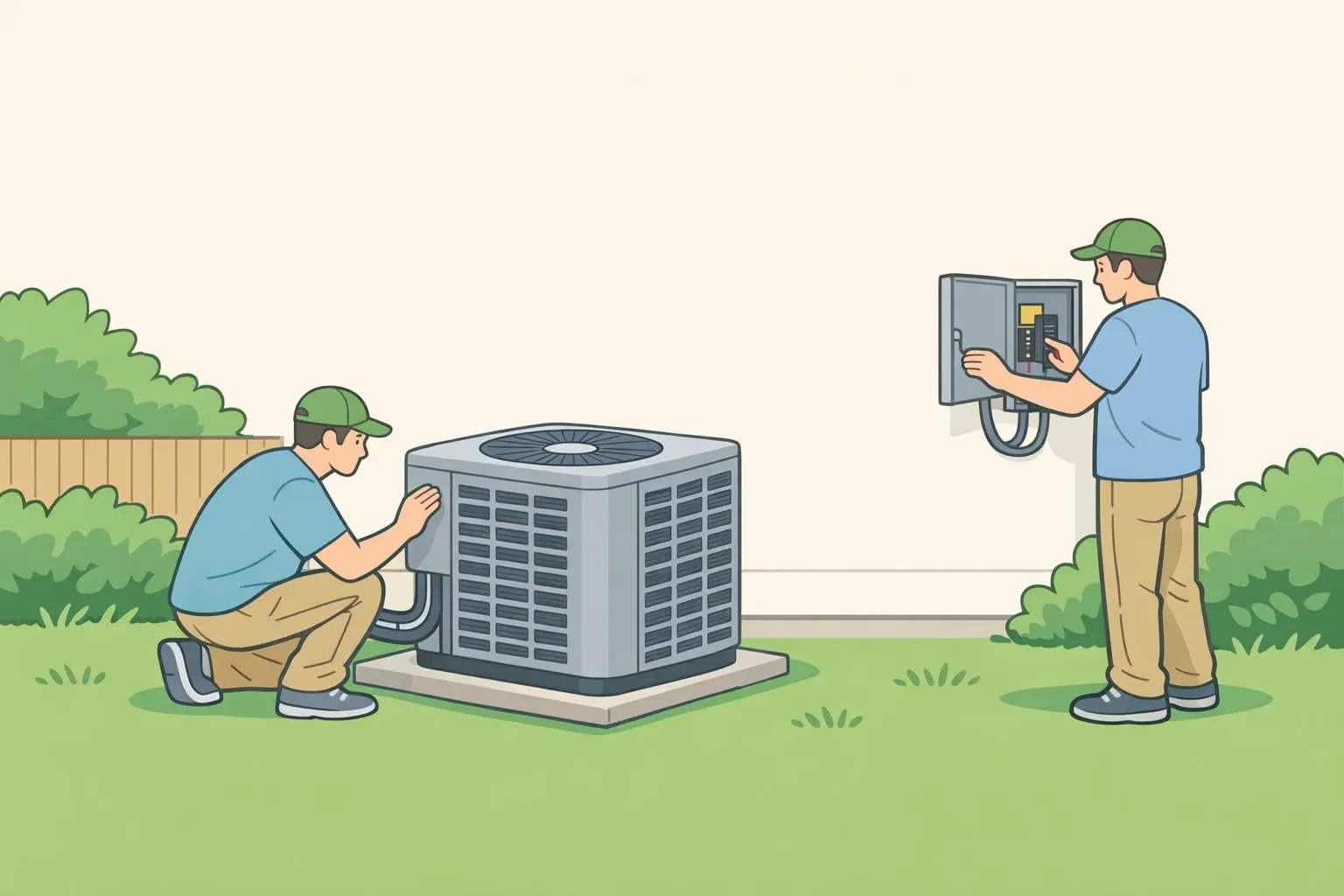
A silent outdoor unit doesn't automatically mean a dead compressor. Lennox points out that homeowners set the thermostat to "heat" instead of "cool" more often than you'd expect, and a tripped breaker or a coil buried under a season's worth of leaves can also stop cooling on equipment that isn't actually broken. This checklist walks through how to tell if your AC condenser is bad, or whether something simpler is behind the warm air coming out of your vents.
This guide won't let you confirm a failed compressor or a dead capacitor with your own hands; that call requires a technician's meter and gauges. What it will do is walk through the main checks an ordinary homeowner can safely make, help you describe the symptoms accurately, and tell you exactly when to stop testing and pick up the phone.
The outdoor cabinet contains several parts: the compressor, the condenser coil, the fan motor, a capacitor, and a contactor. A fault in the control circuit, the contactor, or the compressor can all make a healthy-looking unit go silent from outside the box, and a weak capacitor can look a lot like compressor trouble since strain on one component wears down the other. That overlap is exactly why "one symptom, one diagnosis" doesn't hold up with a condenser.
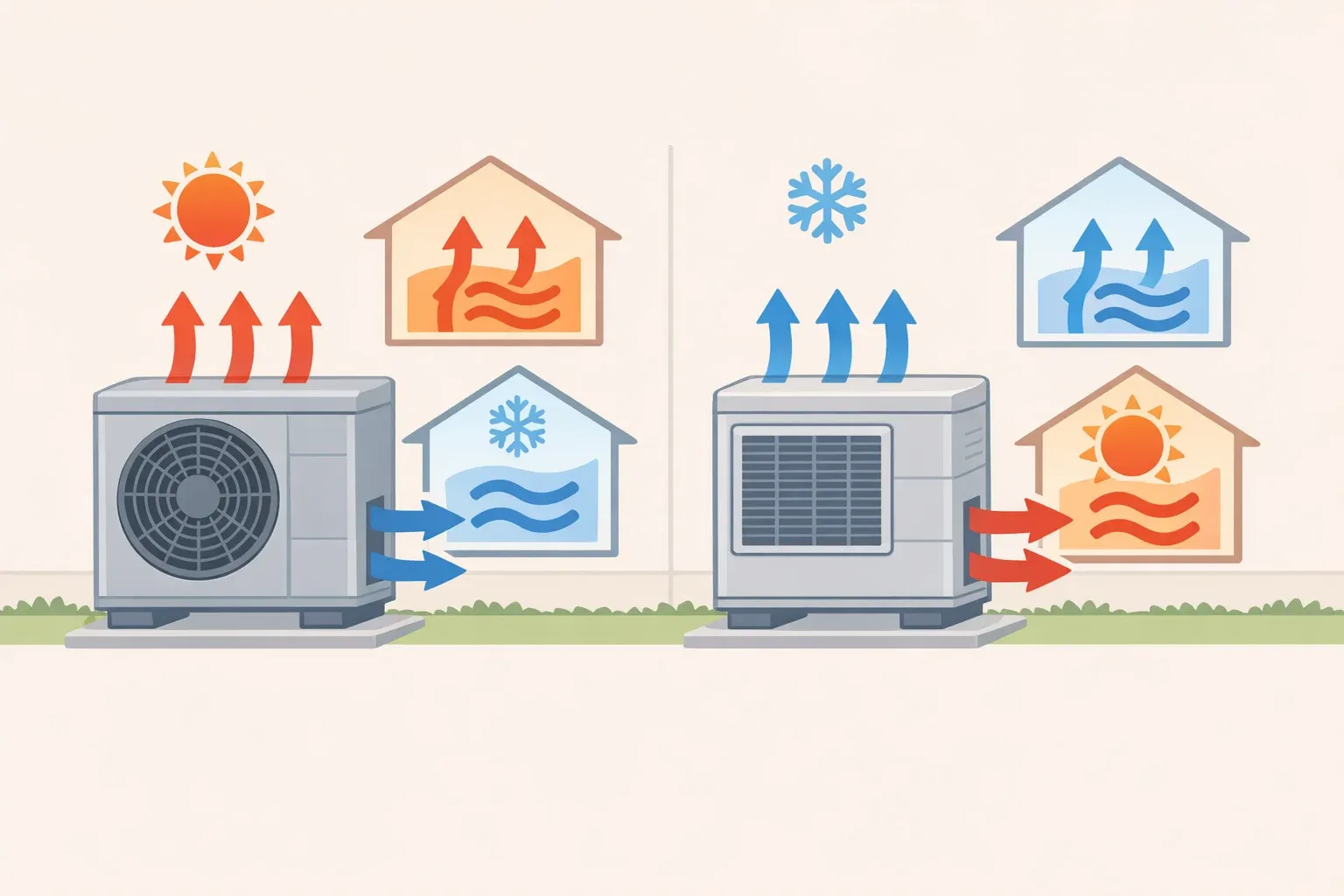
This checklist covers central air conditioners and heat pumps running in cooling mode. Heat pumps behave differently in heating mode, and a heat pump's outdoor coil can pick up frost during a normal defrost cycle, a distinction Step 3 covers in more detail. Trane's list of AC repair warning signs — no start, water leaks, no cold air, strange noises, a frozen coil — makes the same point a different way: none of those symptoms alone tells you which part failed.
What you'll need before you start
Tools: thermostat access, your electrical panel, a flashlight, and a garden hose. Skip the pressure washer; it can bend the coil's fins.
Skill level: checking settings, breakers, filters, and outdoor debris is beginner-friendly homeowner work.
Safety line: anything involving refrigerant, opening the outdoor unit's electrical compartment, or testing a capacitor is professional-only. That boundary is this guide's rule, not a suggestion.
Timing: if you find ice on a coil, budget several more hours before you can retest anything, since the coil needs to thaw fully before the system should run again.
What success looks like: by the end, you'll have either restored cooling through a simple fix, or a short, specific list of symptoms to hand a technician instead of a vague "it's not working."
Stop immediately if you see this
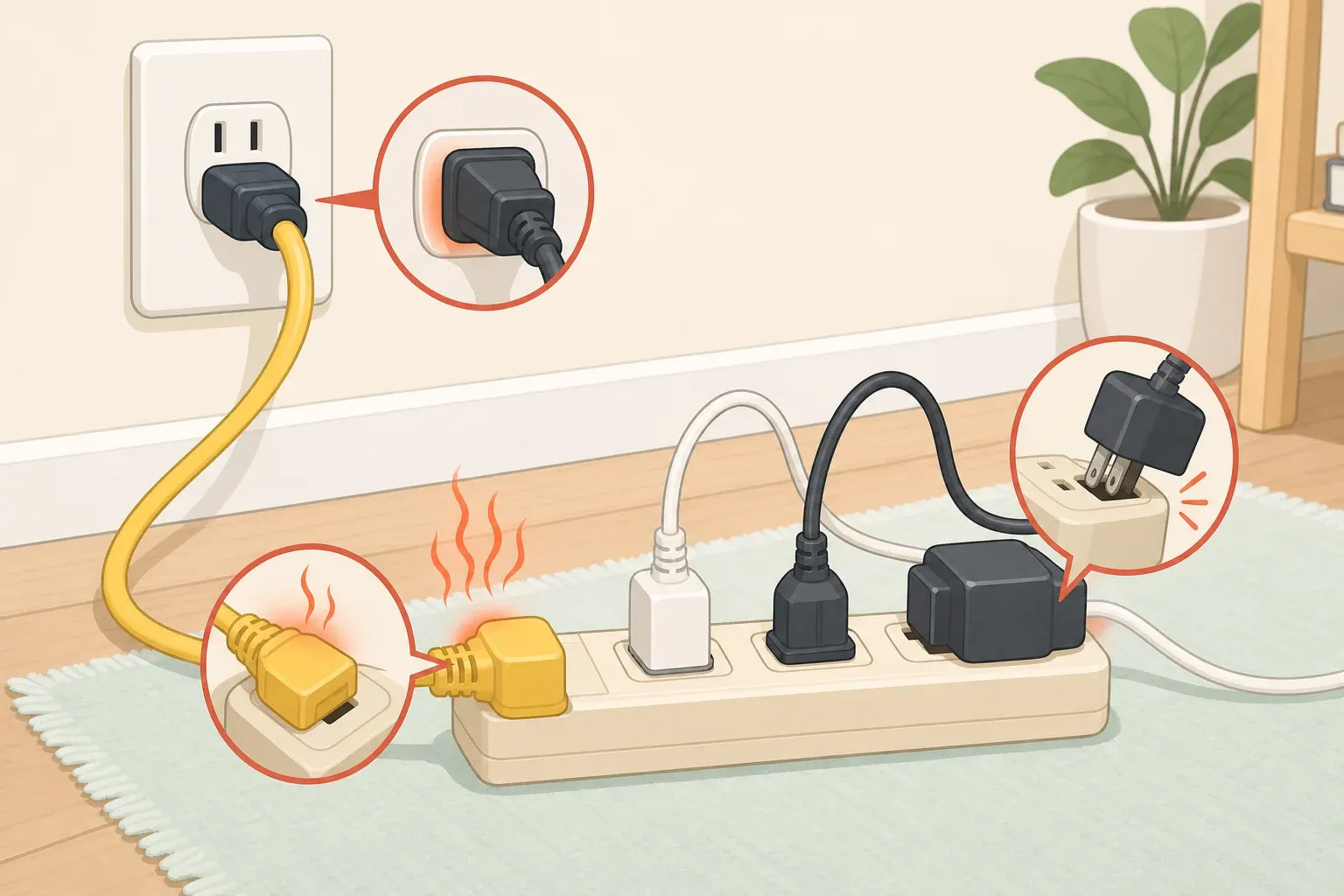
Skip the checklist and call a technician right away if the breaker trips more than once, if you smell something burning or see smoke, if wiring near the outdoor unit looks exposed or damaged, if you hear loud grinding or clanking, or if water is pooling near any electrical component. Trane and Lennox both list these as signs that go beyond ordinary homeowner troubleshooting.
Step 1: Rule out the simple causes first
Check the thermostat. Confirm it's set to "cool," not "heat," the fan is on "auto," not "on," and the target temperature is at least 3 to 5 degrees below the room's actual temperature. Wrong settings, dead batteries, or a thermostat mounted somewhere that doesn't reflect the room's real temperature can stop cooling even on healthy equipment. Adjust what needs adjusting, then wait a few minutes and check the outdoor unit. If it starts, that symptom has cleared, but go back inside and confirm the air is actually cooling before you consider it solved.
Check the breaker. If it's tripped, reset it once. Lennox describes an immediate re-trip as a sign of an overloaded circuit or another electrical hazard, so if it trips again right away, stop resetting it and call an electrician or HVAC technician instead.
Pull the filter and look it over. Check for visible dirt or clogging. Carrier recommends changing filters monthly or quarterly depending on the type, since a clogged filter restricts airflow and can cause overheating or a frozen coil that mimics real equipment failure.
If the outdoor unit starts running within a few minutes of any of these fixes and the house starts cooling, stop here. No further diagnosis needed.
Step 2: Check the outdoor unit for airflow and debris
Look closely at the coil itself. Dirt, leaves, and grass clippings block the coil's ability to release heat, and a working condenser buried in debris can act like a failing one (Lennox, 6 months ago).
Check clearance around the cabinet too. Lennox recommends at least two feet of open space on all sides; shrubs, fencing, or stored items restrict airflow and can trigger overheating or safety shutoffs.
If you see surface grime, only proceed with a rinse if you can confidently identify and switch off the unit's dedicated disconnect or the correct breaker. If you're not sure which one feeds the outdoor unit, skip the rinse and leave it to a technician.
With power confirmed off, rinse the coil from outside the cabinet using a garden hose only — nothing stronger — and don't reach through the grille or touch the fan blades. Leave deep cleaning and anything inside the cabinet to a professional.
Restore power, set the thermostat to call for cooling, and give the system several minutes to respond. If airflow returns and the air starts cooling, the debris was likely a real contributor. If not, move to Step 3 if you're seeing ice, or Step 4 if you're not.
Step 3: If you find ice, handle the coil correctly before assuming it's the condenser
Turn the system off completely and let the coil thaw on its own. Lennox notes this can take several hours, so give it the time it needs rather than restarting early (Lennox, 6 months ago).
While you wait, swap in a fresh air filter. A dirty filter restricting airflow is a common cause of a frozen coil in the first place.
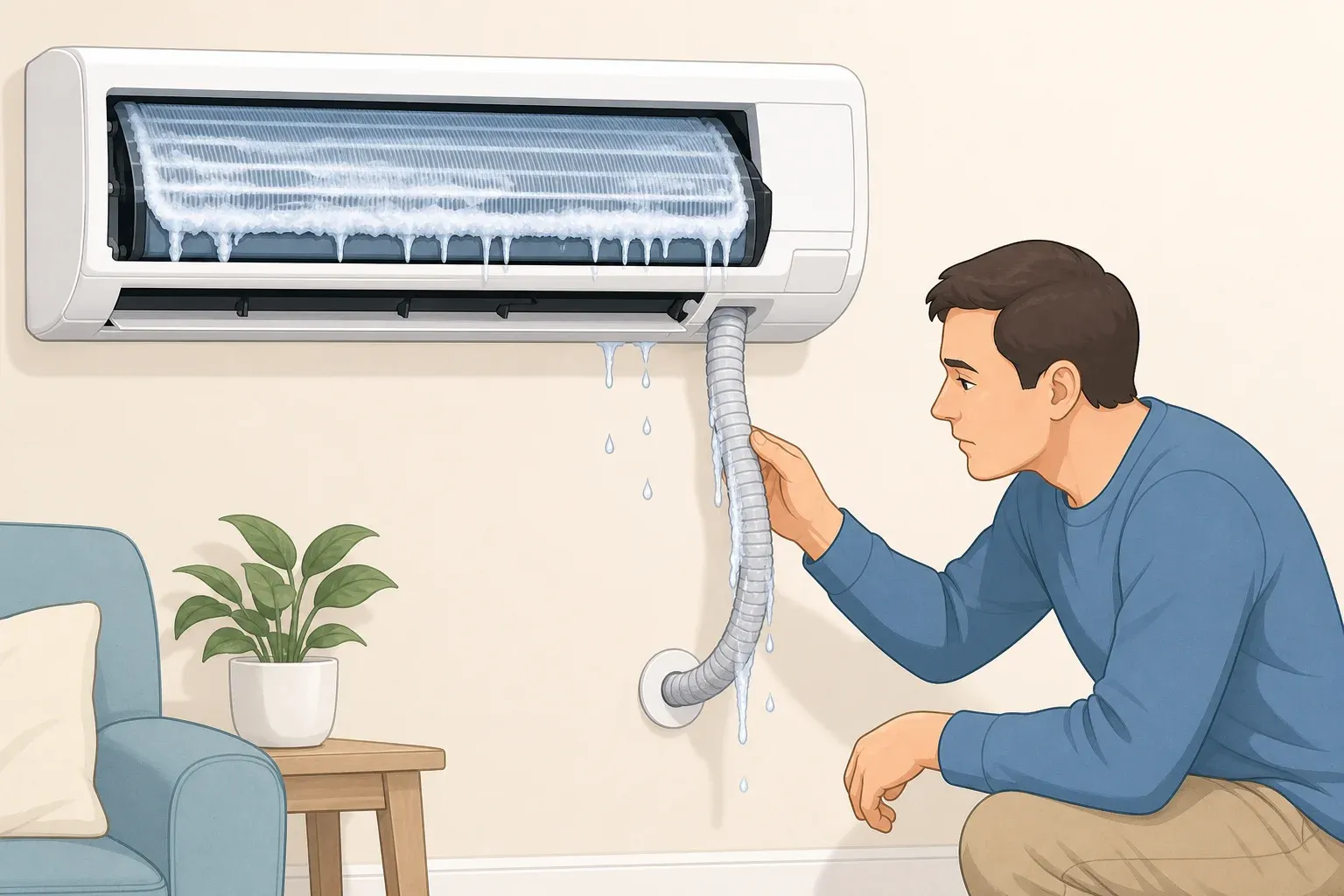
In a standard central AC system, freezing typically shows up on the indoor evaporator coil, not the outdoor condenser. Lennox notes the outdoor condensing coil only freezes when the system is a heat pump cycling through defrost mode, so a little frost during that cycle isn't automatically a failure. Ice that lingers, or keeps coming back outside of a defrost cycle, is a different problem.
Once the coil is fully thawed and the filter is replaced, restart the system and watch it. If it freezes again, stop troubleshooting on your own. That pattern likely points to something deeper, like low refrigerant or a struggling blower motor, and calls for a technician.
Check the indoor unit while you're at it. Water pooling nearby can mean the condensate drain is clogged, which can trip a safety float switch and shut the system down. Don't bypass or force the float switch. If water remains or the switch has already tripped, treat it as a service call.
Step 4: Signs of a bad AC condenser (and what they don't confirm on their own)
Two broad patterns show up here: the outdoor unit doesn't respond at all, or it runs, but the house stays warm. Before matching a symptom below, note whether the outdoor fan is turning, whether the indoor blower is pushing normal-feeling air through the vents, and whether that air is warm or just not as cold as it should be. Those details matter more to a technician than "it's not working."
Outdoor AC condenser not working at all, no hum, no click: Make sure Step 1 is fully done first. If settings, breaker, and filter all check out, a break in the low-voltage control circuit, a blown control fuse, or a contactor that isn't pulling in can each produce this same silent, no-start symptom. Only a technician's meter can tell which one it is.
Unit hums or clicks but the fan won't spin: Often consistent with a weak or failed capacitor, the small component that stores energy to start the compressor and power the fan. A jammed blade or a seized fan motor can cause a similar no-spin symptom, though. Cut power and check visually for debris caught in the fan, without touching the blades, before booking a service call.
Fan runs, unit sounds normal, but indoor air stays warm: This pattern is associated with a struggling compressor, low refrigerant, or restricted airflow, and separating those causes requires gauge and meter readings a homeowner can't safely take. This is separate from the outdoor clearance checked in Step 2; indoor airflow depends on the filter, registers, and return vents, which Trane lists among the checks homeowners can safely make before calling for service.
Ice or water at the indoor unit: Go back to Step 3. This shifts the likely cause toward airflow, filter, drain, or refrigerant issues rather than the outdoor condenser itself.
Breaker tripping repeatedly, grinding or clanking noises, or an unusual smell: These are the stop-immediately signs from earlier. If you're seeing any of them now, stop and call a technician rather than continuing to troubleshoot.
These patterns narrow the possibilities. They don't confirm which single part failed. Overlap between airflow, electrical, fan, and refrigerant problems is common, and that's exactly why the next step is a technician's meter and gauge readings, not another round of homeowner guessing.
AC condenser problems and troubleshooting: what to tell the technician
Write down what you observed before you call. A specific report gives the technician more useful information to work with before the visit than "it just stopped working." Include:
The thermostat's mode, fan setting, and target temperature when the problem started
Whether the breaker tripped, and whether it tripped again after being reset
Whether the outdoor fan runs, spins slowly, or doesn't move at all, and whether the indoor blower is pushing normal air
Any humming, clicking, grinding, or clanking sounds, and roughly when they happen in the cycle
Where you found ice or water, if any, and how long it took to fully thaw
What changed, if anything, after you replaced the filter or cleared debris
What to do now
You've checked the causes an ordinary homeowner can safely check: thermostat settings, power, filter condition, and outdoor debris. Confirming whether the capacitor, contactor, fan motor, compressor, or refrigerant charge has actually failed is a different job, one that needs a technician's meter and gauges rather than another homeowner test.
Leave the system off if it refreezes after a full thaw or repeatedly trips the breaker; those patterns need professional diagnosis, not another restart.
Before booking a repair, ask for an on-site estimate rather than a number over the phone. Trane's general figures put AC repair costs somewhere between $75 and nearly $3,000, with condenser coil work alone running $1,000 to $4,000 or more, though the actual number for your system depends on the diagnosis and your local rates. Hand the technician the notes from the section above, and let their equipment finish the job you couldn't safely finish on your own.

Comments
Be the first, drop a comment!