



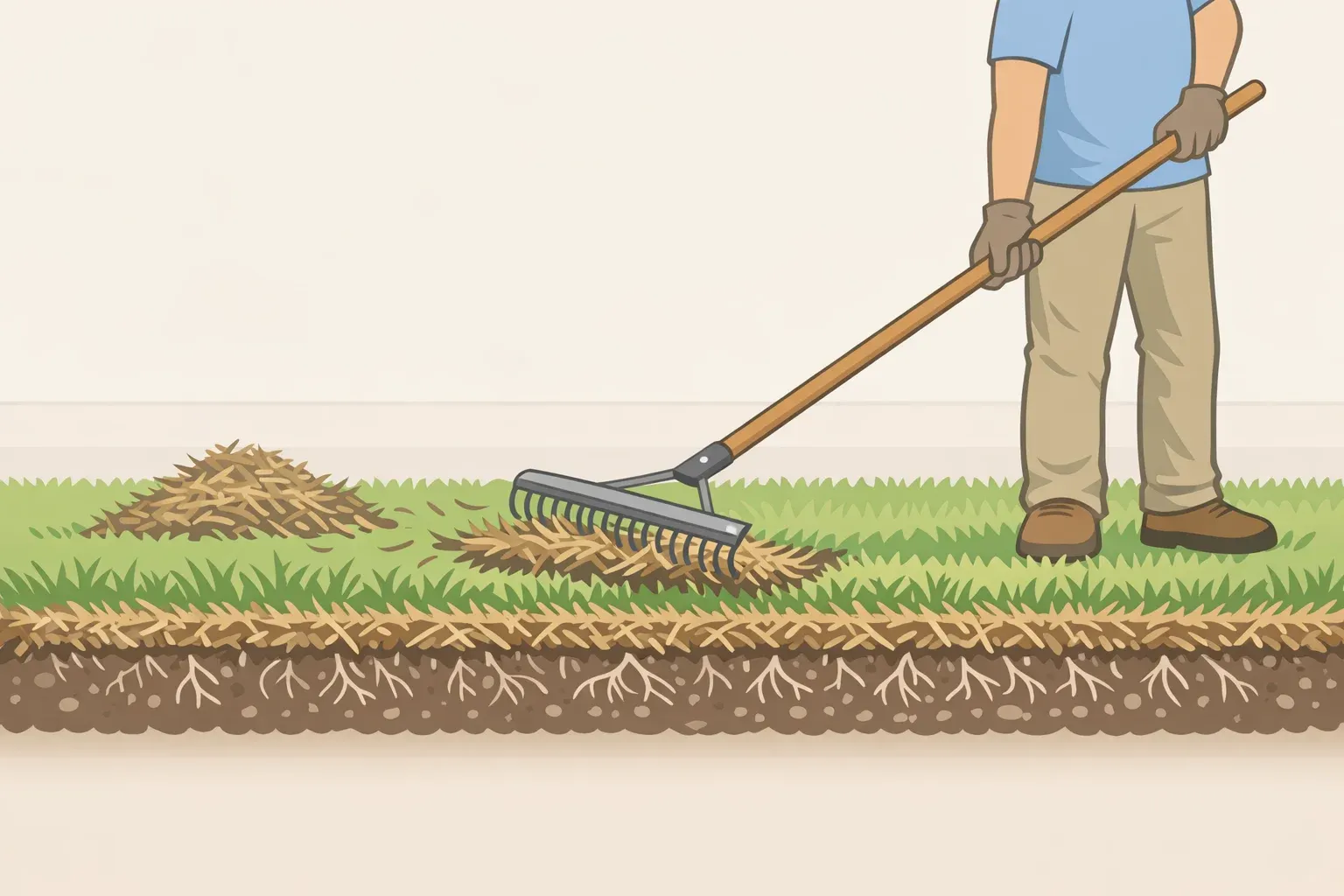
A lawn with half an inch or less of thatch may benefit from that layer rather than need it removed. That's the part homeowners skip on their way to renting a power rake every spring out of habit. Before learning how to dethatch a lawn, it helps to check whether the lawn needs it in the first place. Thatch itself isn't the enemy: it's a normal, living layer of shoots, stems, and roots that sits between the green blades and the soil, not a pile of leftover clippings.
A thin layer actually does some work for the lawn. It insulates soil against temperature swings and creates a more cushioned surface underfoot. And despite what a lot of lawn care advice implies, grass clippings have less to do with thatch buildup than most people assume.
This guide walks through how to tell whether your lawn actually needs it, when to dethatch a lawn depending on grass type, and how to remove lawn thatch step by step, along with the lawn dethatching tips that keep the turf mostly intact along the way.
What is lawn thatch, and when should you dethatch?
Thatch is made of intermingled dead and living stems and roots, and about a quarter of it is lignin, a decay-resistant compound that's the main reason buildup can outpace breakdown (Penn State Extension). That composition is why thatch doesn't quietly rot away once a lawn tips past a healthy amount.
The exact threshold for "too much" depends on who you ask. Illinois Extension and the Tennessee Master Gardener Program both flag half an inch as the point where problems can start, while Penn State puts the real danger zone above a full inch. Treat that gap as a range rather than a contradiction. Somewhere between half an inch and an inch, a lawn moves from fine to worth watching, and how it's behaving matters as much as the number.
Before doing anything else, check for yourself. Cut a small wedge of turf with a shovel or knife and look at the section between the green grass and the soil. That tan, spongy layer is your thatch, and a ruler will tell you more than a guess.
Thickness isn't the only signal. Watch for spongy footing, water pooling on the surface instead of soaking in, and mower wheels sinking low enough to scalp the grass. Once you have a number and a sense of how the lawn is acting, here's how to read it:
Half an inch or less, no symptoms: leave it alone. The layer is doing its job.
More than half an inch, with symptoms like sponginess or pooling water: look at compaction, watering habits, and fertilizer use before reaching for equipment, and consider aeration and topdressing, covered further down.
Around an inch or more: mechanical removal is likely necessary, since preventative measures alone won't keep up at that depth.
Why thatch builds up, and why dethatching alone won't fix it
Grass clippings are not the main cause of thatch buildup. When lawns are mowed regularly, without removing more than a third of the blade in a single pass, clippings are mostly water and decompose quickly rather than piling up.
The two most consistently documented contributors are aggressive nitrogen fertilization and overwatering, both of which push roots and stems to grow faster than soil microbes can break them down. More growth sounds like a good thing until the decomposition side of the equation can't keep pace, and the surplus stacks up as thatch.
Soil condition and grass species matter too. Compacted soil and low microbial activity slow decomposition regardless of what's being fed to the lawn, and certain species, Kentucky bluegrass, creeping red fescue, and creeping bentgrass among them, simply generate more thatch than bunch-type grasses like tall fescue or perennial ryegrass.
Soil pH is one area where the two extension sources diverge. Penn State ties heavy thatch to acidic soil at a pH of 5.5 or below, while Illinois Extension lists alkaline, or high pH, soil among the contributing conditions. Local soil chemistry varies enough that a soil test is more useful here than assuming either extreme applies to your yard.
Removing thatch without correcting the cause invites the problem back within a season or two. Whatever pushed the buildup in the first place — heavy fertilizer, overwatering, compacted soil — keeps working after the rake is put away.
How to dethatch a lawn step by step
Prerequisites: Confirm thatch runs roughly half an inch to an inch or more, verify the grass is actively growing rather than stressed by heat or drought, and pick a timing window using the grass-type guidance below. Have a hand thatching rake or rented power equipment on hand, along with grass seed for follow-up overseeding.
Choose your tool based on lawn size. A hand thatching rake works fine for small patches. For a full lawn, rent a powered vertical mower or power rake. Power rakes are the lighter-duty option and can struggle in dense, well-established zoysiagrass, where the tines tend to flex back instead of biting in.
Test the equipment on a low-visibility patch first. Penn State specifically recommends this before working the whole lawn, since blade depth determines how much thatch and how much live grass comes up with each pass.
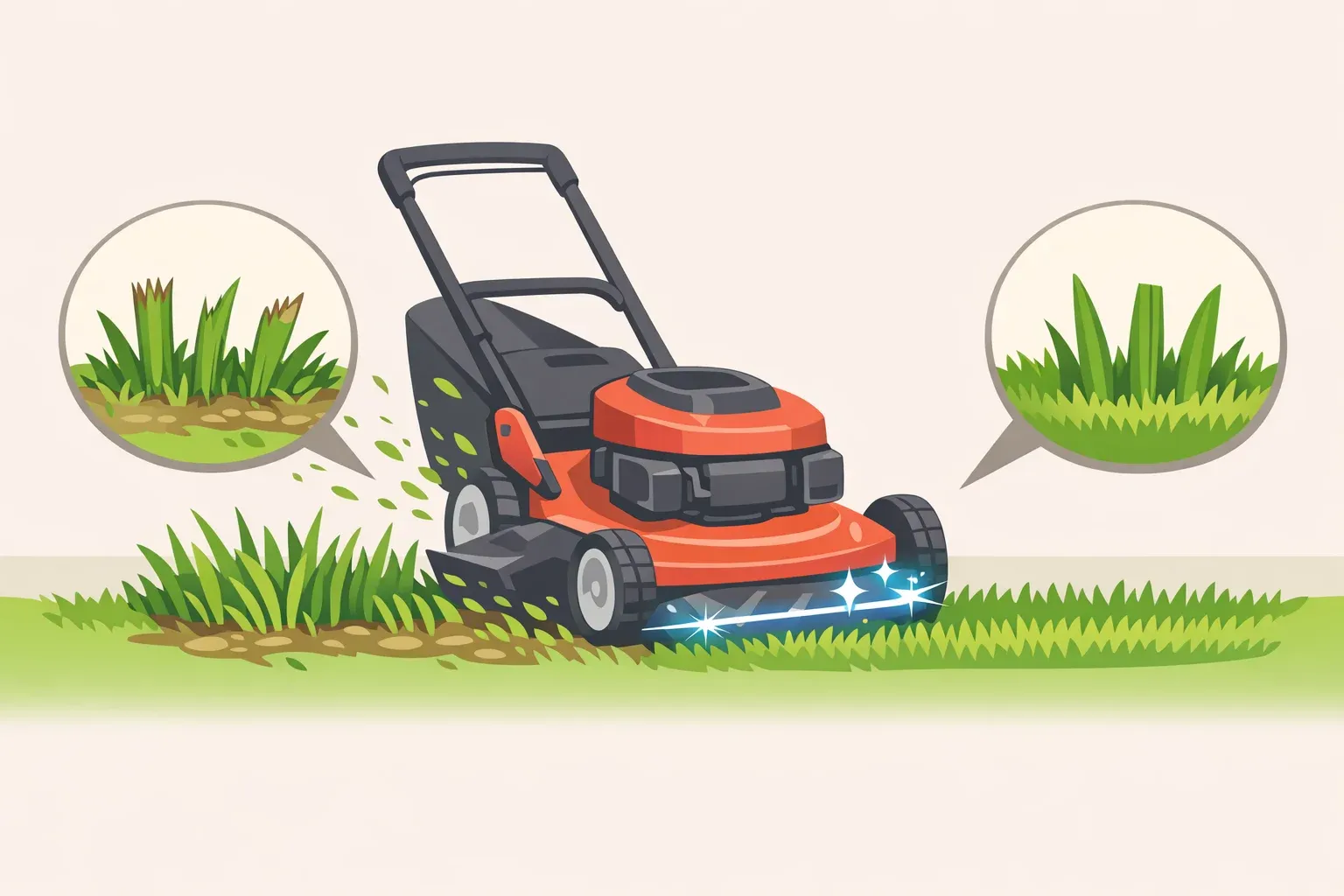
Set blades high and make a light first pass. Pulling too much material at once can severely thin the lawn. Starting conservative lets you see results before committing to anything deeper.
Check results before going further. If thatch remains and the turf still looks intact, make a second pass over the same area. Expect to see visible grooves in the lawn afterward; that's a normal side effect of the blades, not a sign something went wrong.
Clear the debris. A power vacuum works well after a vertical mower to pull up the loosened, dried organic matter left on the surface.
Plan to overseed thinned areas. Roots often grow directly into thick thatch, so removing the thatch typically pulls out live grass along with it. Both extensions note that reseeding is usually necessary afterward, so build it into the job rather than treating it as cleanup.
A caution before you start: if your thatch measures two inches or more, expect significant thinning no matter how careful you are. At that depth, most of the root system is likely growing directly in the thatch rather than the soil beneath it, so there's no gentle way to remove the layer without disturbing the grass.
When to dethatch a lawn
Timing depends entirely on what's growing in your yard. Get it wrong, and stressed grass has less to recover from an already invasive process.
Cool-season lawns, Kentucky bluegrass, fescues, ryegrass, do best with late summer to early fall dethatching, when cooler temperatures ease stress on the turf and the timing lines up naturally with aeration and seeding. Illinois Extension narrows that window further, pointing specifically to late August for the best recovery and reseeding results.
Warm-season lawns, bermudagrass, zoysiagrass, centipedegrass, and St. Augustine go the opposite direction. Early summer, while the turf is actively growing, gives the fastest recovery.
One rule holds regardless of species: never dethatch turf under heat or drought stress. Doing so raises the risk of injury and cuts the odds of a full recovery. If the lawn is already struggling through a dry spell, the thatch can wait.
Dethatching vs. aerating a lawn: what's the difference?
Aeration and dethatching get lumped together, but they solve different problems. Aeration pulls small soil cores to relieve compaction and improve airflow, which speeds up the microbial breakdown of thatch rather than just yanking it out. It's closer to prevention than cure.
Illinois Extension recommends pairing core aeration with a thin topdressing, an eighth to a quarter inch of compost or quality topsoil, aiming for 15 to 20 holes per square foot. That combination addresses the conditions behind thatch buildup, compacted soil and sluggish microbial activity, instead of just removing the symptom and waiting for it to return.
Penn State notes that once thatch passes about an inch, preventative steps like aeration typically can't keep up on their own, and physical removal becomes necessary. As a practical rule of thumb, that argues for trying aeration and topdressing first when thatch runs under an inch, and saving the vertical mower for lawns already past that mark or showing clear symptoms.
Conclusion
Prevention does more long-term work than any mower attachment. Soil testing keeps pH and nutrient levels in view, since acidic soil at or below pH 5.5 slows the microbes that would otherwise break thatch down. Moderate nitrogen use matters just as much: heavy fertilization is one of the most reliable ways to outpace decomposition in the first place.
Core aeration deserves a regular spot on the calendar too, since it improves airflow and microbial activity while chipping away at existing thatch as a side effect. And if seeding a new lawn or overseeding an old one, choosing grass species that don't pile on thatch — tall fescue or perennial ryegrass over Kentucky bluegrass or creeping bentgrass — cuts down on how often any of this comes up again.
If you dethatched this year, resist the urge to schedule it again out of habit. Cut a wedge of turf and measure the thatch layer before deciding whether the job needs repeating at all.


Comments
Be the first, drop a comment!