



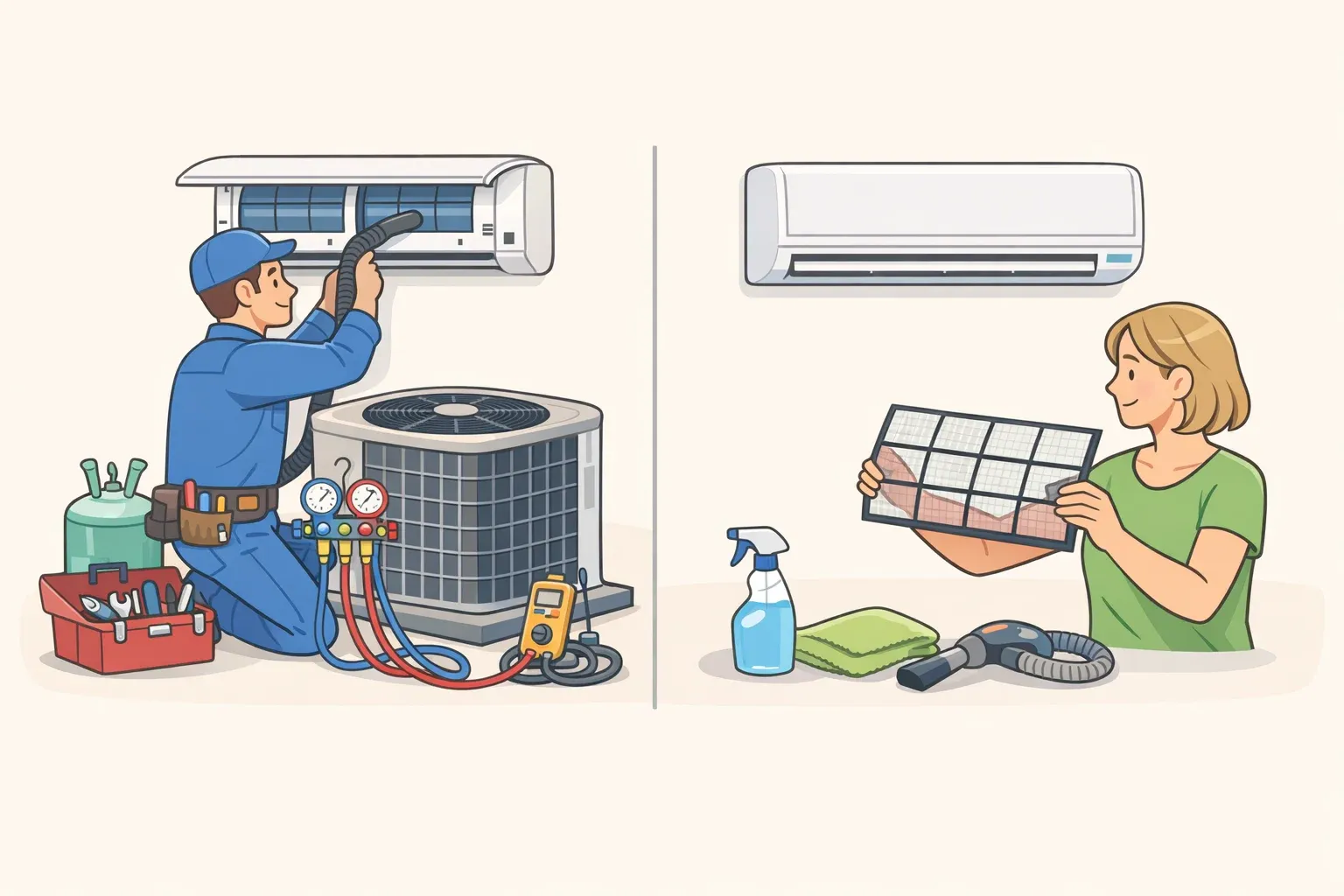
The real question isn't just how often an air conditioner should be serviced. It's what you're actually allowed to do yourself between visits from a technician.
The short answer: one professional visit a year, plus a short list of homeowner tasks in between, covers nearly every residential system. ENERGY STAR recommends booking a contractor for a pre-season checkup, cooling systems in spring and heating systems in fall, before schedules fill up.
Most central and split-system units need professional attention at least once a year, ideally ahead of peak summer demand. Between those visits, a handful of tasks — filter swaps and debris clearing chief among them — are simple enough for any homeowner to handle.
This guide lays out a clear service schedule, a step-by-step DIY routine, a firm line on what needs a licensed technician, and what a proper tune-up should actually include so you're not paying for a vague inspection.
How often should you service your AC unit?
Annual professional service, timed to spring, is the consistent recommendation. ENERGY STAR and Pick Comfort both land on once a year as the baseline for residential systems, with spring as the preferred window ahead of summer's heaviest use.
When to schedule an AC tune-up: early spring is ideal, before cooling-season demand hits. Contractors get busy the moment temperatures spike, so booking ahead avoids the scheduling crunch that follows once everyone else's AC quits in July.
Once a year isn't universal, though. Heat pumps and units sitting in dusty or coastal environments may need more frequent checks, and condensers positioned near cottonwood trees, road dust, or heavy pollen can require cleaning two or three times over a single cooling season.
A practical memory trick: tie the checkup to the clock change. Spring forward, schedule the AC tune-up. Fall back, schedule the furnace check.
Central air conditioner maintenance checklist
Monthly: Inspect the filter; clear debris from the outdoor unit during cooling season
Every 1-3 months: Replace the filter, based on usage and pets
Seasonally: Check thermostat settings
Annually: Flush the drain line with a cup of white vinegar; schedule a professional tune-up in early spring
As conditions warrant: Homes near dusty roads, heavy pollen, cottonwood trees, or coastal environments may need condenser cleaning two or three times a season
Annual is the floor, not the ceiling. Frequency ultimately depends on your equipment and your environment, which is exactly why the space between professional visits matters as much as the visits themselves.
The AC maintenance routine you can do yourself
This DIY air conditioner maintenance routine covers the tasks between professional visits, and most of it doesn't require a license. It requires a calendar reminder and a few minutes of attention.
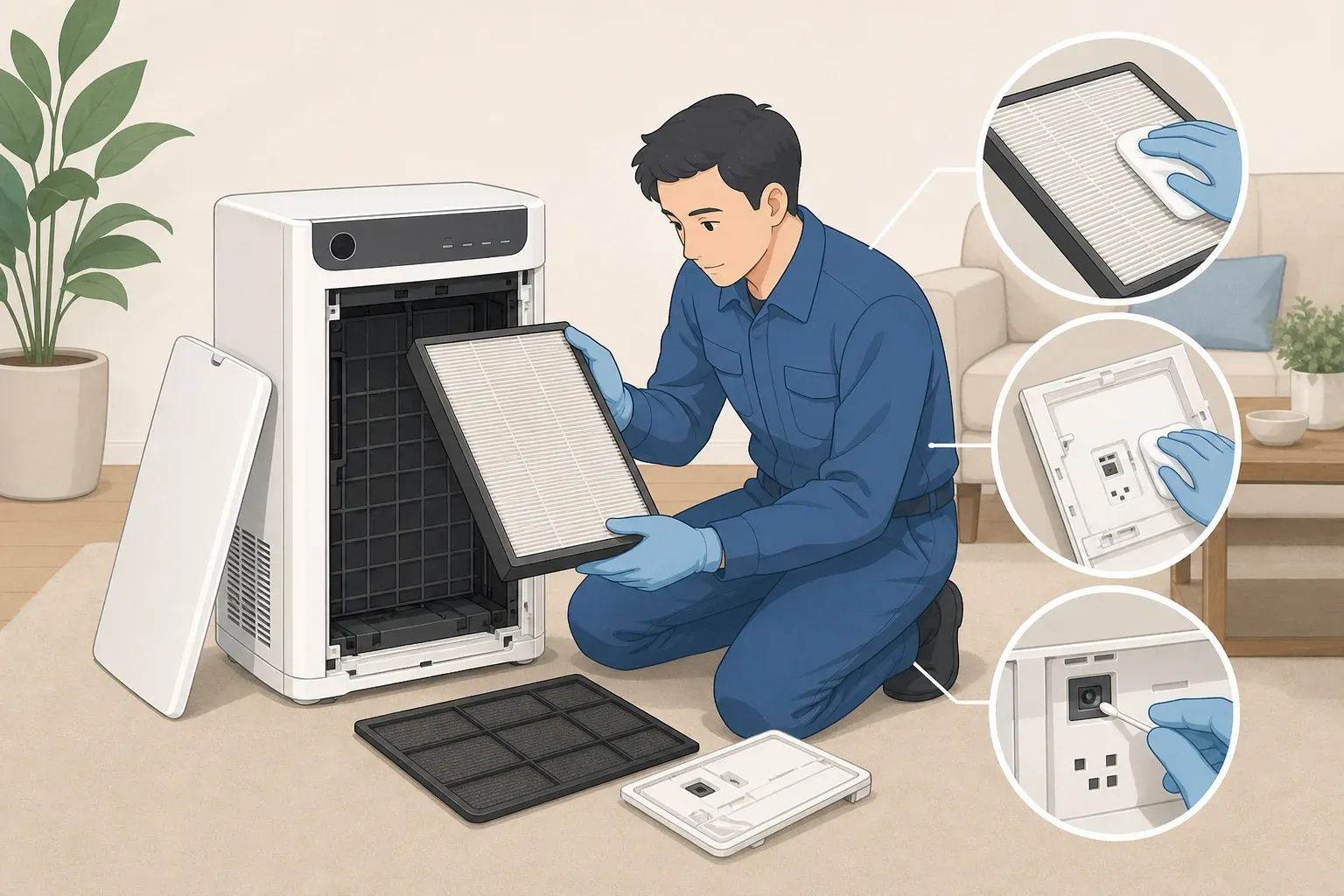
1. Check and replace the filter. Inspect monthly, and replace every one to three months depending on household usage and pets. ENERGY STAR's phrasing is slightly different, calling for filters to be inspected, cleaned, or changed monthly, but the practical rule reconciles both: check it monthly, and replace it on whatever schedule your specific filter and household actually need. A dirty filter raises energy costs and can shorten the life of the equipment, and airflow problems alone can cut system efficiency by up to 15%, a figure ENERGY STAR reports, and SkillCat cites in its own maintenance guidance. Filters carry a MERV rating from 1 to 16, and for most homes, MERV 8 to 11 is a common sweet spot, catching dust and pollen without overworking the blower motor. Treat that as a starting point rather than a fixed rule, and check your equipment manual or ask a technician if you're unsure what your system can handle.
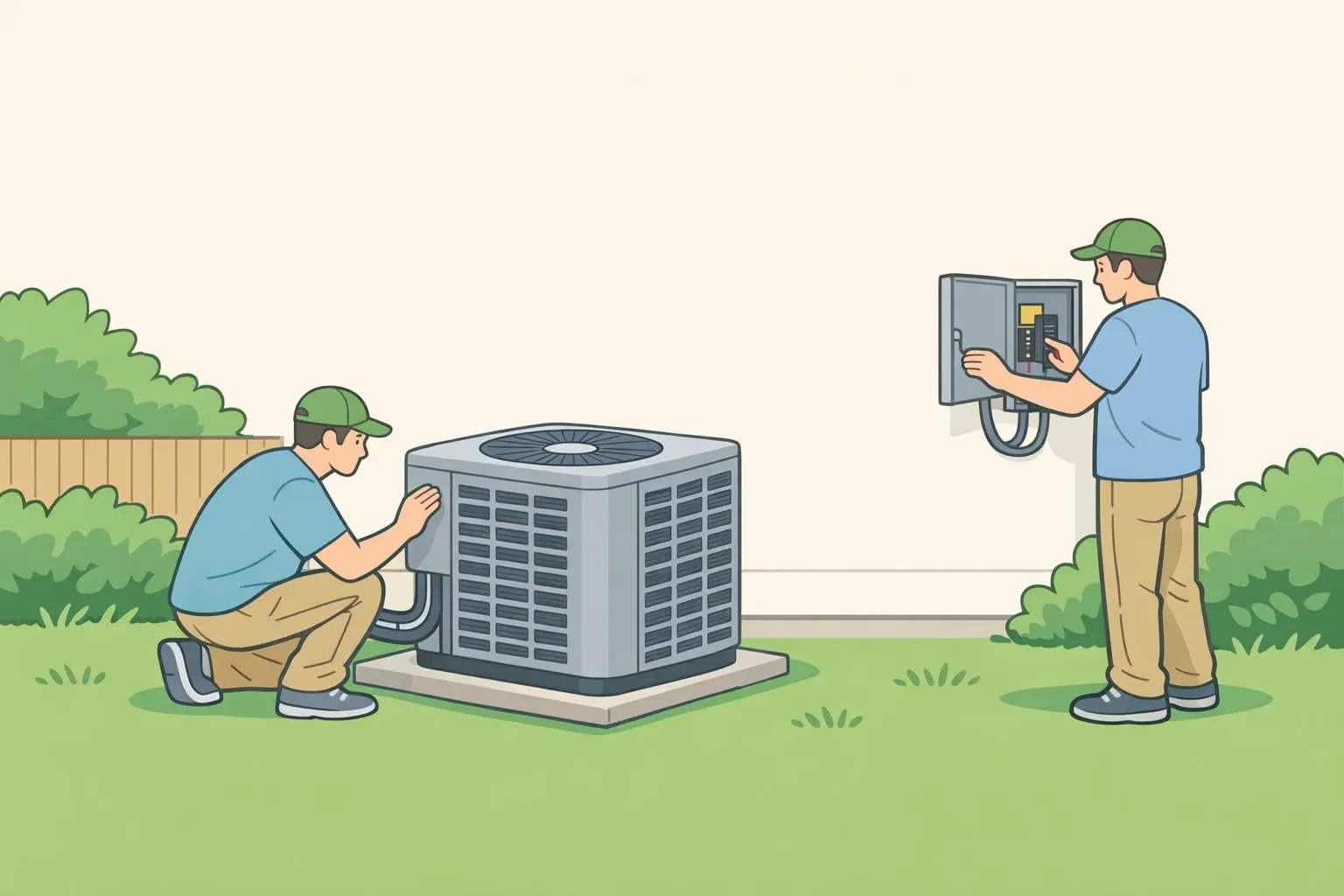
2. Clear the outdoor unit. Remove leaves, grass clippings, and other debris monthly during cooling season, and keep at least two feet of clearance around the condenser to maintain airflow. One warning worth repeating every season: never power-wash the unit. It flattens the thin aluminum fins and can block airflow entirely, turning a five-minute cleaning job into a repair bill.
3. Check thermostat settings seasonally. No tools required, just a quick review at each seasonal changeover to make sure schedules and setpoints still match how the household actually uses the space.
4. Flush the drain line annually. Find the PVC pipe exiting the indoor unit and pour a cup of white vinegar down the access port; it slows algae growth that would otherwise clog the line. Before touching anything, shut off power at the thermostat and at the outdoor disconnect box. Skipping that step leaves you working near live electrical connections, so don't skip it.
Where's the line for a homeowner? As a rule, you can handle filter replacement, clearing loose debris from the outdoor unit, reviewing thermostat settings, and drain maintenance the manufacturer explicitly allows. Stop the moment a task calls for removing an access panel, handling wiring, straightening bent fins, or touching anything refrigerant-related. Condenser-coil cleaning sits in a gray zone: doable yourself if the unit is easy to access and you're comfortable with it, better left to a professional if it isn't.
What to leave to a professional, and the signs your DIY routine isn't enough
Refrigerant handling, leak repair, and electrical work all require a licensed professional. Checking refrigerant levels means using specialized gauges, and legally, that work requires certification to handle the chemicals involved.
There's a common misconception worth correcting here: low refrigerant generally indicates a leak somewhere in the sealed system. Simply topping it off is a temporary patch that ignores the actual problem, and the level will just drop again.
Routine refrigerant testing isn't always necessary. Even technicians aren't supposed to default to connecting gauges on a routine visit; that step may be appropriate when diagnostic indicators actually suggest a problem, since connecting gauges unnecessarily introduces a risk of minor refrigerant loss. If a technician skips the gauges during a standard tune-up, that's not necessarily a shortcut.
Coil cleaning splits along a similar line: evaporator coils are a professional task, while condenser coils can go either way depending on how accessible the unit is.
Between scheduled visits, trust your own observations. If airflow weakens noticeably, something looks or sounds off, or the system starts behaving unpredictably, that's worth a call to a technician regardless of when the last tune-up happened. Waiting for the next scheduled visit is how a small issue turns into an emergency repair.
What a proper tune-up should include, and what it should cost
A standard residential visit runs roughly 60 to 90 minutes, depending on system type and how accessible the equipment is. That window generally covers cleaning, testing, and documenting the work, not just a quick visual check.
A tune-up worth paying for should cover, at minimum, filter replacement, coil cleaning, and drain-line clearing, along with documentation of what was done. Ask your contractor whether the visit also includes a thermostat and system-cycle test and a visual check of electrical connections, since not every service package covers those by default. Refrigerant testing should only happen if symptoms or actual readings point to a problem, not as an automatic line item on every invoice.
Before booking, a few questions save both money and frustration:
What's included in the price?
Will there be a written summary of findings?
Is refrigerant testing billed separately, and if so, why is it needed?
Can the invoice be itemized for your records?
On cost, Massachusetts pricing for annual maintenance runs roughly $75 to $200, though that's regional pricing and shouldn't be treated as a national benchmark. Rates elsewhere will vary with local labor costs and system complexity.
One more thing worth checking before skipping a year of annual air conditioner maintenance: some manufacturers require documented professional service to keep parts warranties valid. That's specific to each manufacturer's paperwork, so don't assume either way. Check your documentation and keep every invoice on file.
What to do next
If this year's professional visit hasn't happened yet, schedule it now rather than waiting until the next stretch of hot weather forces the issue. If it's already done, put next spring's appointment on the calendar early, before contractor schedules fill up again.
Prevention, filters, debris, and clearance are a homeowner's job. Diagnosis and anything involving refrigerant, electrical components, or sealed panels belongs to a licensed technician.
Keep every invoice on file for warranty purposes, and let the monthly filter check become the habit that catches trouble early, well before a minor issue turns into an emergency call on the hottest day of the year.




Comments
Be the first, drop a comment!