



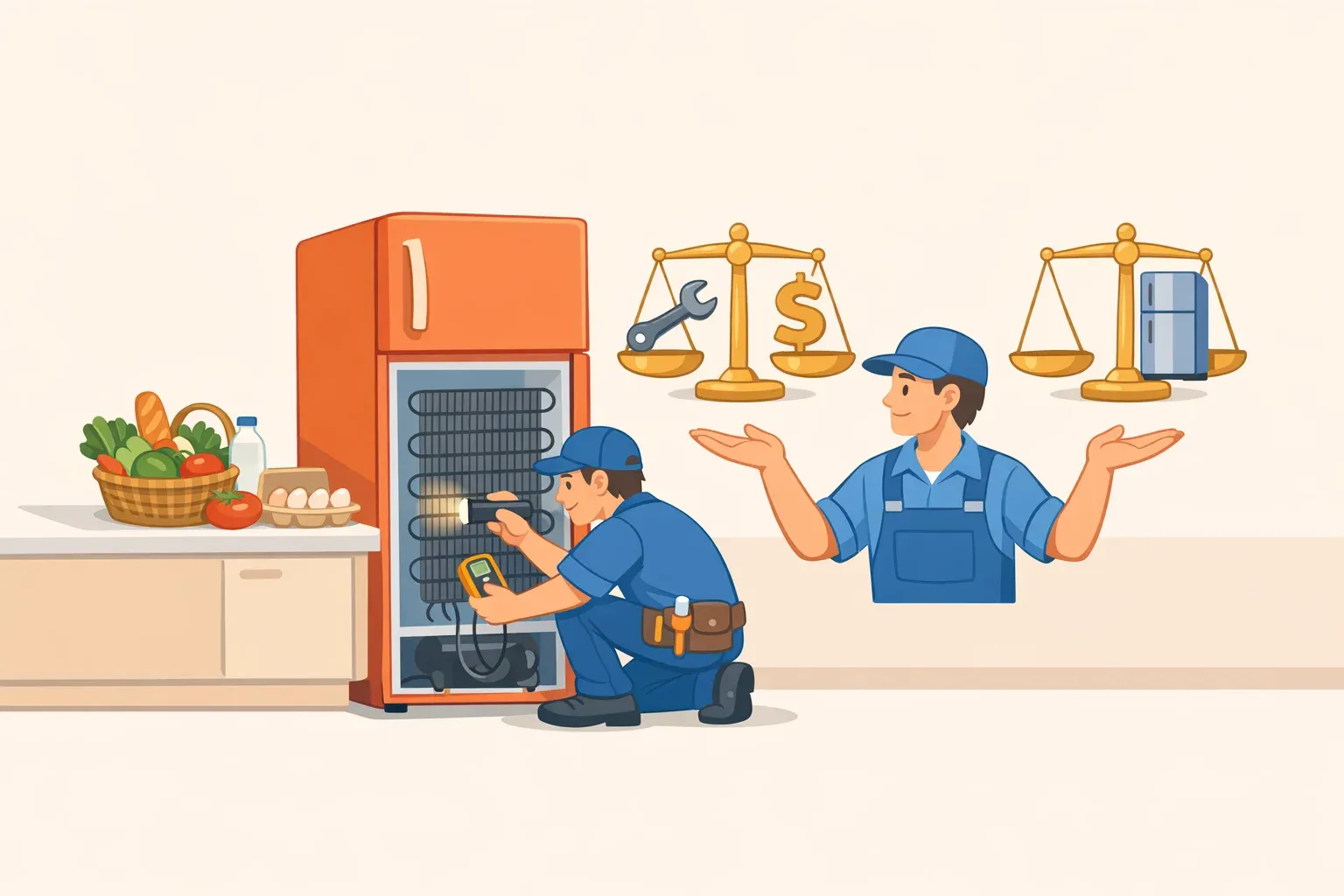
The refrigerator goes warm, food is at risk, and the instinct is to start pricing replacements. In most cases, that instinct is wrong. A master refrigeration technician with more than 20 years of field experience says the majority of not-cooling calls "resolve quickly and cheaply" and that simply cleaning the condenser coils, a free ten-minute job, resolves roughly one in four of them. The signs you need a new refrigerator are real, but they're specific. Most situations don't qualify.
This guide covers the conditions under which repair stops making sense, and replacement becomes the right call. They come down to four variables: age of the unit, type of failure, cost of the repair, and the original value of the appliance.
Some baseline numbers first. Consumer Reports reports that among all new refrigerators purchased since 2015, 49 percent have experienced a problem. The two most common failures are ice and water dispensers, at a brand-median problem rate of 15 percent, and icemakers, at 14 percent.
Compressor failure, the failure most likely to trigger a replacement conversation, occurs at a median rate of just 3 percent, according to CR's repair and replace data. The expensive problem is also the rarest.
The short version: if the failure is minor and the unit is under ten years old, the math almost always favors repair. Sealed-system failures on older or lower-value units are where things flip. What follows defines exactly where that line sits.
How to know if your refrigerator needs replacing: start with the diagnosis
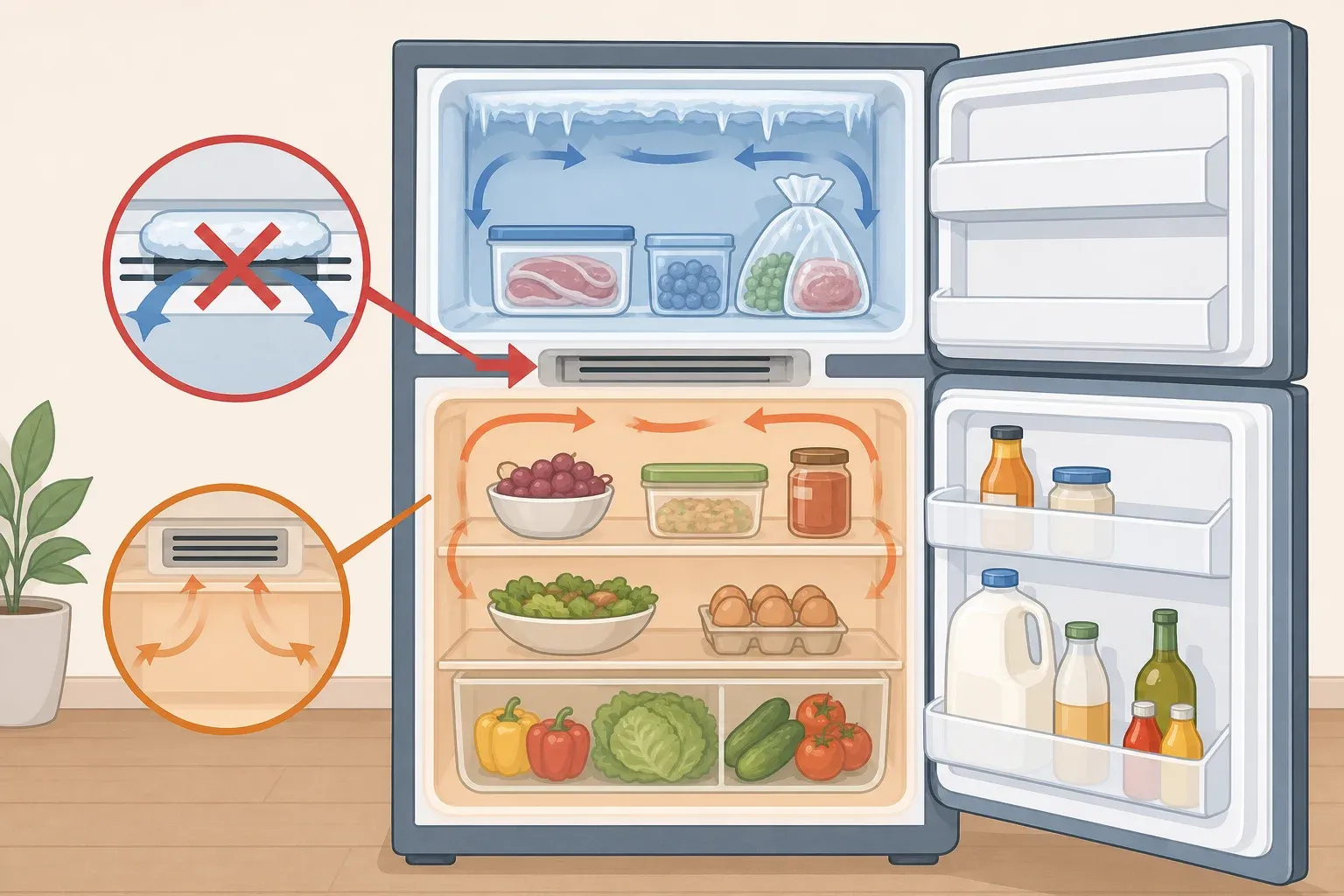
Defrost system failure is the most commonly misdiagnosed cause of refrigerator cooling loss, and the cost of missing it is significant, according to ServiceMag's field diagnostics guide. When the defrost system fails, frost builds up on the evaporator coil over several days until it blocks all airflow entirely. The unit runs, the compressor hums, but nothing gets cold. That's an almost perfect imitation of sealed-system failure. The difference is a $25 defrost heater element versus a $500–$1,100 sealed-system job.
The tell for defrost failure is a pattern, not just a symptom. The refrigerator gradually warms over five to seven days; when the rear freezer panel is removed, the evaporator coil is completely encased in ice. That pattern strongly points to defrost failure rather than a sealed-system problem, and it can be identified before any specialized tools come out. Any repair estimate that skips this check is incomplete.
A reliable technician works through a standard five-step sequence before touching the sealed system. ServiceMag's diagnostic guide lays it out:
Clean condenser coils: free, ten minutes, resolves about 25% of cases
Test the evaporator fan motor: freezer stays cool but the refrigerator section warms; $200–$300 repair
Check the start relay; a click-hum-click pattern from the compressor signals relay failure; $125–$200 repair
Inspect the defrost system: an ice block on the coil confirms defrost failure; $200–$350 repair
Sealed-system diagnosis gauges, leak detection, compressor winding test; only after the above are ruled out
If a technician skips straight to step five, ask specifically why steps one through four were eliminated.
The cost picture is what makes this so consequential. Most refrigerator repairs across common failure types run $150 to $400. The compressor is the outlier: Consumer Reports member data puts the median compressor repair cost at $562, more than double the median cost of other tracked failure categories. Confirming which category a repair actually falls into before comparing it to replacement cost is the single most important step in the entire decision.
The three conditions that actually justify replacement
Condition 1: The repair involves the sealed system
Sealed-system work compressor replacement and refrigerant leak repair occupies a different cost tier than every other common failure. Costs start at $500 and can reach $1,100 or more, per ServiceMag. At that price, the question is no longer "can this be fixed?" but "does fixing it make financial sense given what this unit is worth and how long it has left?"
Sealed-system failure triggers a replacement evaluation, not an automatic replacement. The next two conditions determine which way that evaluation goes.
Condition 2: Age and model value make further investment irrational
Consumer Reports surveyed nearly 96,000 members about more than 108,000 refrigerators purchased between 2012 and 2022 and found that units under ten years old are generally more economical to repair, with two exceptions: budget top-freezers and side-by-sides, where the math shifts earlier.
The practical contrast CR offers is precise: replacing a $400 top-freezer closing in on ten years makes sense even if the repair cost is modest; repairing a $1,200 French-door model at nine years is probably the right call.
Model value is the multiplier the age rule can't account for on its own. About 27 percent of CR members who replaced rather than repaired cited high repair costs as their primary reason, not age, not brand, not reliability history, according to that same survey. When repair costs start approaching what a comparable replacement would run, those members made the same call most financial logic would support.
Condition 3: Recurring failures signal a ceiling that repair can't raise
A single icemaker failure is a repair problem. The same component failing again within a few years, outside of any warranty, is a different signal. Consumer Reports estimates that 31 percent of refrigerators with icemakers will experience a problem within the first five years of ownership, placing them among the least reliable product categories tracked.
One important distinction: icemaker and dispenser failures are nuisance problems. Food isn't at immediate risk, and the unit is otherwise functional. Repeated cooling failures where the refrigerator or freezer section actually warms are a categorically different signal. Treating them the same inflates the urgency of minor issues and creates unnecessary replacement pressure.
Brand reliability history functions as a tiebreaker when the economics are ambiguous. A few years ago, Samsung refrigerators were cited in hundreds of Consumer Product Safety Commission complaints related to icemaker failures and temperatures warm enough to spoil food. Before approving a major repair on any unit with a known reliability record, checking brand-level ratings takes ten minutes and can change the decision entirely.
Should I replace my refrigerator? A four-step decision path
This is where the framework becomes a checklist. Each step produces an answer that either ends the decision or hands it to the next step.
Step 1: Confirm the unit's age and failure type. Find the manufacture date on the serial plate inside the door frame.
Under 10 years old, non-sealed-system failure: repair is almost always the right call. Stop here.
At or past 10 years, sealed-system failure: move to step two.
Recurring cooling failures at any age: skip to step four.
Step 2: Verify the diagnosis before accepting it. Ask the technician explicitly whether dirty coils, evaporator fan motor failure, start relay failure, and defrost system failure were all tested and ruled out before reaching the sealed-system conclusion. Defrost failure alone is the most commonly misdiagnosed cooling problem in the field, and it costs $200–$350 to fix versus $500–$1,100 for sealed-system work. If those simpler failures weren't ruled out, get a second opinion before agreeing to anything.
Step 3: Price a comparable replacement before agreeing to a major repair. Set the repair estimate alongside a real replacement quote, factoring in the unit's age and configuration. One thing worth knowing about extended warranties while you're doing this math: nearly half of buyers who purchased one never used it, and Consumer Reports data shows the typical extended warranty costs just $6 less than the median out-of-pocket repair cost of $197. They're a poor hedge for most owners.
Step 4: Decide against the trigger conditions, not the emotion of the moment. Here's the matrix:
Replace if: sealed-system failure meets an older or low-value unit; the repair cost approaches what a comparable new unit would run; or the unit has a documented history of repeated failures in the same systems.
Repair if: the failure is not sealed-system; the unit is under ten years old; and repairs in that situation typically fall in the $150–$400 range where fixing almost always beats replacing, especially under the ten-year mark.
If the decision is replacement: don't skip disposal
Replacement delivers real benefit only when the old unit exits the waste stream properly. The EPA reported that in 2018, the most recent data available, large appliances generated 5.3 million tons of waste, with 2.1 million tons sent to landfills rather than recycled, according to Consumer Reports citing that EPA data. Only 10 percent of CR members had their old refrigerator formally recycled; half simply had it hauled away.
"Hauled away" is not the same as responsibly handled. Refrigerators built before 1995 contain CFC refrigerant that depletes the ozone layer when released. Post-1995 units use an ozone-friendlier refrigerant that is still a greenhouse gas.
Both older and newer units may contain ozone-depleting foam insulation and mercury-bearing components. The EPA's Responsible Appliance Disposal program has processed more than 8.2 million refrigerators since 2006 and is the correct disposal channel; find a participating partner before scheduling any haul.
On efficiency: federal standards finalized by the Department of Energy in late 2023 are projected to cut refrigerator energy consumption by roughly 11 percent relative to current models, with manufacturer compliance required by 2029–2030 depending on configuration. That's useful context if the unit is genuinely at end of life, but it's not a reason to replace a functioning refrigerator early. The efficiency gains don't come close to justifying the cost or the waste.
The decision almost always comes down to one question: is this a sealed-system problem, or does it just look like one? Get that answer confirmed before approving any large estimate, and the rest of the math tends to follow.







Comments
Be the first, drop a comment!