



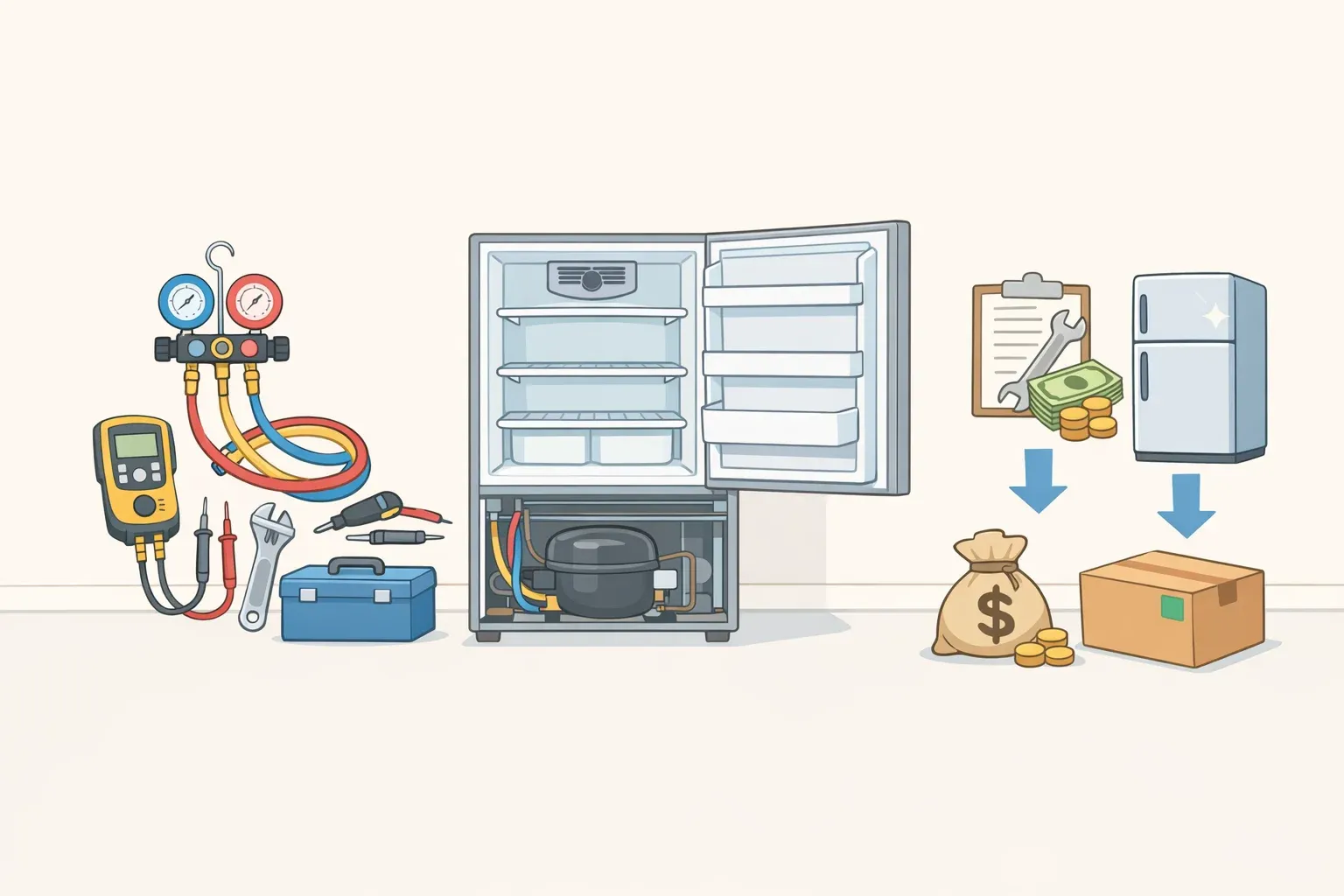
Most refrigerator repairs are expensive the way a car oil change is expensive — annoying, but manageable. Ice maker repairs run $60–$330. A thermostat swap costs $100–$440. Even dispenser problems, which Consumer Reports found affect roughly 15% of refrigerators, land in that same $150–$240 median range.
Then there's sealed-system repair. At $1,400 to $2,800, the most expensive refrigerator repair isn't just costly, it's in a different category entirely, closer to a major engine repair than anything else in the appliance world.
The conventional answer to "what's the most expensive thing to fix on a refrigerator?" is "the compressor." That's not wrong, but it's incomplete. The compressor is the centerpiece of a closed refrigerant loop, and when that system fails, what you're paying for isn't just the part. It's refrigerant recovery, leak detection, vacuum testing, and recharge — a regulated, labor-intensive process that requires specialist certification and typically two technician visits. Sealed-system repair is the most labor-intensive job on a fridge and the only one that requires EPA-certified handling.
This piece covers three things anyone facing a dead fridge actually needs to know: what sealed-system repair involves and why it costs so much, how to evaluate whether a compressor failure diagnosis is legitimate before approving the work, and how to make the repair-versus-replace call when the quote is high.
What sealed-system repair is and why the bill gets so large
The sealed system is the closed refrigerant loop that keeps your food cold: compressor, condenser coils, evaporator coils, and the refrigerant cycling through all of them continuously. Think of it like a car's engine block. You can swap a battery or replace brake pads without specialist tools, but opening the engine requires a different class of technician.
Sealed-system work is the territory for refrigerators. When anything in this loop fails, the entire system has to be addressed: refrigerant recovery, leak detection and repair, part replacement, vacuum testing, and recharge, in sequence, by someone qualified to handle refrigerants legally.
The U.S. EPA requires Section 608 certification for anyone legally handling refrigerants, a regulatory requirement that limits who can do this work and adds a specialist premium to every job, HomeAdvisor notes. Layer on technician rates of $45–$120 per hour, a service call fee of $150–$200, and a diagnostic charge of $60–$100. Add the near-certain likelihood of two visits on any repair requiring parts ordered after diagnosis, and the labor cost alone accounts for much of that $1,400–$2,800 range before a single part is priced.
This is what separates sealed-system work from every other refrigerator repair. A thermostat swap runs $100–$440. Ice maker repairs cost $60–$330. A control board replacement, which can be expensive on complex units, tops out around $800, according to HomeAdvisor. Sealed-system work starts where those numbers end.
Refrigerator control board replacement cost vs. sealed-system repair: getting the diagnosis right
The compressor is the pump at the heart of the sealed system. Consumer Reports puts the median repair cost for a faulty compressor at $562, well above the $150–$240 median for common problems, while actual compressor malfunctions affect only about 3% of refrigerators. Expensive and relatively rare, that combination makes a confident diagnosis especially important before committing to the work.
"Not cooling" is not synonymous with "bad compressor." Consumer Reports data shows refrigerators not cooling properly affect roughly 6% of units, and freezers not cooling affect another 4%, both more common than actual compressor failure at 3%. A cooling failure has many possible causes, and jumping to sealed-system work without ruling out cheaper ones is a costly mistake.
On inverter-compressor refrigerators, the inverter control board is the component that should be ruled out first. ServiceMag argues that the board is where the vast majority of inverter compressor failures actually originate, and that replacing the board before condemning the compressor is the correct diagnostic sequence. A refrigerator control board replacement costs $80–$800, depending on model, per HomeAdvisor, potentially hundreds of dollars less than sealed-system work. For inverter-equipped units, sequence matters.
One manufacturer-specific checkpoint worth knowing: following a class action settlement, LG extended its Inverter Linear Compressor warranty to cover parts and labor for 10 years from purchase on models manufactured between 2014 and 2022. LG is the clearest example of why checking warranty coverage before approving any sealed-system repair is worth a few minutes. A repair that costs $1,700 out of pocket might cost nothing under coverage the homeowner didn't know existed. The same principle applies to any brand with an active extended warranty or appliance protection plan.
Compressor replacement cost refrigerator owners should actually weigh: repair or replace?
A $1,400–$2,800 sealed-system repair quote doesn't exist in a vacuum. A new refrigerator with installation costs $650–$4,250, depending on the appliance. The widely used benchmark: if the repair quote exceeds 50% of what a comparable new unit would cost, replacement is generally the better financial decision. At $1,400–$2,800, sealed-system work clears that threshold for any refrigerator priced under $2,800–$5,600, which covers most of the market.
Age changes the math significantly. Most refrigerators last 10–15 years, with well-maintained units sometimes reaching 20 years. On a unit under seven years old with an isolated compressor problem and no other issues, a repair can make genuine sense, especially if warranty coverage applies. On a unit approaching ten years, a $1,700 repair is competing against an appliance past the midpoint of its useful life, with other components aging alongside the one that just failed.
Two concrete scenarios show how the framework plays out. A 6-year-old refrigerator receives a compressor diagnosis covered under an extended warranty repair makes clear sense. An 11-year-old refrigerator that originally cost $900 receives a $1,700 sealed-system quote with no warranty coverage that's nearly double the 50% threshold on a unit already deep into its expected lifespan, and replacement becomes the stronger recommendation.
Consumer Reports found that 27% of members who discarded a broken refrigerator rather than repairing it cited repair cost as the deciding factor, suggesting many homeowners reach this crossroads without a clear framework for evaluating it.
Before signing off on any major repair, work through this sequence:
Check warranty status first; manufacturer, extended, or settlement coverage may eliminate out-of-pocket costs entirely
Get the diagnosis in writing, including which components were tested and how
Confirm whether refrigerant handling is included in the quote; that's what tips a compressor repair into sealed-system territory and the higher price tier
On inverter models, ask specifically whether the inverter board was tested before the compressor was condemned
Compare the quote to 50% of a comparable replacement unit's cost
Factor in the appliance's age and the likelihood that other components are aging alongside the one that just failed
Making the call
Sealed-system repair is the most expensive refrigerator repair by a significant margin, and the $1,400–$2,800 price range reflects something most estimates don't make explicit: you're not just paying for a compressor. You're paying for a certified technician to recover refrigerant, test and repair leaks, vacuum the system, and recharge it to spec, a process that can't be shortcut and can't legally be done by just anyone.
The diagnostic question matters just as much as the price. Before authorizing four-figure work, ask whether the inverter board was ruled out, get the diagnosis in writing, and check warranty status. Those three steps take minutes. They can save a homeowner from paying for a compressor that wasn't broken, or from spending $1,700 on a refrigerator that was already a better candidate for replacement.












Comments
Be the first, drop a comment!