





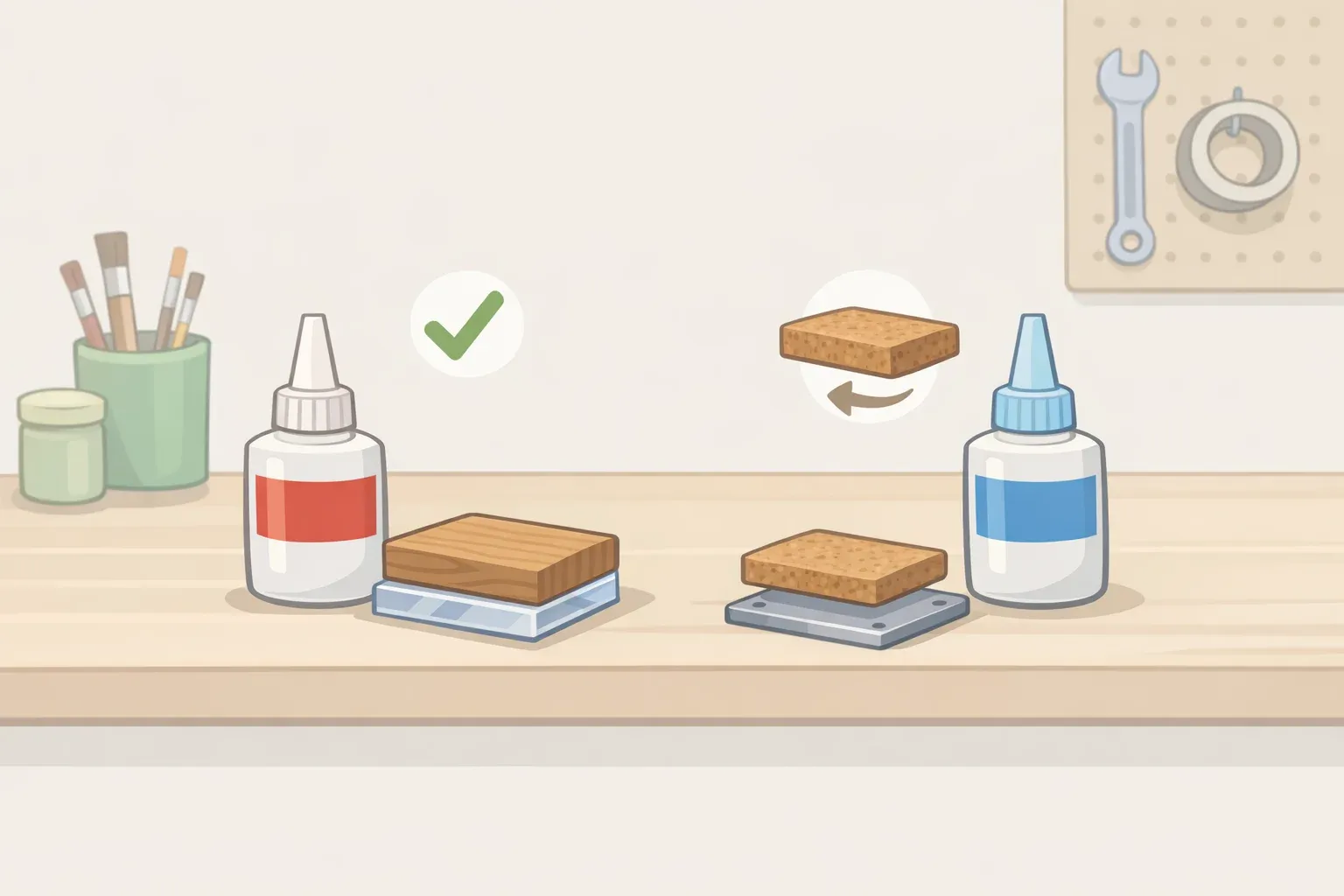
Contact cement and rubber cement are not interchangeable. The wrong choice usually isn't obvious until the bond fails or refuses to come apart, and the distinction runs deeper than most product labels suggest. It starts with a simple question: Does this joint need to be permanent?
Contact cement bonds the instant two coated surfaces meet. No repositioning, no second chance. Rubber cement is a different tool with a different purpose, but this article cannot make broad claims about its behavior without product-level documentation to back them up. Where the evidence runs out on rubber cement, this piece says so plainly. The contact cement sections draw directly from manufacturer technical data sheets and safety data sheets; the rubber cement section does not have that foundation.
There's also a second decision worth flagging upfront: contact cement is not one uniform product. The safety profile of a solvent-based formula differs sharply from a waterborne one, and for indoor work, that gap can matter more than the contact-versus-rubber question itself.
Difference between contact cement and rubber cement: the practical comparison
The decision comes down to three factors: permanence, material type, and whether you need to adjust placement after the adhesive goes on.
Bond permanence. Contact cement grabs the moment two coated, dried surfaces meet. Repositioning is not possible once firm contact is made. No manufacturer data sheet for rubber cement was available for this article, so specific claims about its removability or bond strength cannot be sourced here. Check the product label and SDS for whatever you're considering.
Application method. Contact cement goes on both surfaces, dries until tacky, then the pieces press together under firm, even pressure, no clamps required. Rubber cement application methods vary by product; consult the manufacturer's instructions.
Heat and moisture. A cured contact cement bond resists heat up to 180°F and is water-resistant, rated for interior and exterior use.
Cleanup. Wet contact cement wipes with mineral spirits. Once dried, it has to be cut or scraped away.
Use contact cement for: countertop laminate, rubber gaskets or edging, shoe soles, leather on rigid backing, and flooring trim.
Use neither for: structural or load-bearing joints, high-moisture outdoor exposure without checking product specifications, archival or photo-safe applications without confirming the specific product is rated for them.
How contact cement works and what makes it unforgiving
Contact cement is built on a polychloroprene base, a synthetic rubber and resin system that gives the cured bond its grip and flexibility. The chemistry matters because it explains the behavior: two coated surfaces bond instantly on contact with no need for clamps.
The application sequence is where most mistakes happen. Both surfaces get one coat of contact cement, which typically requires only a single application on porous and non-porous surfaces. After coating, both pieces must dry for 60 to 70 minutes until the surface feels tacky and looks glossy. Only then do the surfaces come together.
Because repositioning is impossible after contact, professional installers use a simple technique on large surfaces: lay wooden dowels across the substrate every 6 to 12 inches, position the piece precisely over the dowels, then pull them one by one from the center outward as you press down. On a full countertop laminate job, this isn't optional. Skip it, and there's no recovering a panel that lands a half-inch off.
Pressure matters: 25 pounds per square inch applied evenly, working from the center outward, equivalent to roughly 75 pounds of force through a standard 3-inch J-roller. The bond grabs immediately and reaches full strength after seven days.
The assembly window is generous. Up to three hours can pass between coating and joining; past that point, a fresh coat reactivates the surface. Worth knowing on a complex multi-piece installation where everything can't go down at once.
Where contact cement should not go: structural joints, copper or copper alloy surfaces, polystyrene foam, heavy-gauge metal. The adhesive can stain or damage painted surfaces, vinyl, and some plastics, so test a small hidden area first. These are documented failure modes, not edge cases.
What is rubber cement used for, and where the sourcing runs out
Rubber cement is a distinct product category from contact cement, designed for different applications and materials. The two are not interchangeable, and rubber cement is not simply a weaker version of contact cement.
If rubber cement is your likely choice for paper crafts, photo mounting, lightweight layout work, or any application where bond reversibility matters, pull the manufacturer's safety data sheet for that specific product before purchasing. Formulations vary. For archival photo work, food-safe surfaces, or any VOC-sensitive environment, product-level documentation is not optional; it's the only reliable guide.
Contact cement vs rubber cement for crafts and indoor projects: why formula matters as much as product type
Once contact cement is the right choice, there's a second decision most buyers skip: solvent-based or waterborne? The bond performance is documented as strong in either case, but the handling conditions are not remotely similar.
Solvent-based contact cement can be highly flammable. LePage Heavy Duty Contact Cement carries a flash point of -9°C (15.8°F) and is classified as a highly flammable liquid and vapour under GHS hazard standards, with a VOC content of 76.4% by weight, or 645 g/L. It ships as a Class 3 flammable material under UN 1133. A pilot light in a closed kitchen is a real hazard, not a theoretical one.
The ingredient list explains why. The Henkel SDS lists light aliphatic naphtha at 30 to 60% by weight, methyl ethyl ketone at 10 to 30%, and n-heptane at 10 to 30%, all volatile organic compounds with inhalation and ignition concerns. Inhalation may cause allergic respiratory reactions and airway irritation. Skin and eye contact carry their own irritation and sensitization risks.
DAP WELDWOOD Nonflammable Contact Cement changes that picture substantially. It's a waterborne, polychloroprene-based formula with a flash point above 200°F, VOC-compliant, water cleanup, and described as low odor, which translates to meaningfully different handling conditions for indoor repairs. Low odor is not zero odor, and the product SDS should still guide ventilation decisions, but the contrast with the Henkel solvent-based formula is significant.
One broader point on off-gassing: research measuring emissions from floor installation adhesives found those adhesives continued releasing airborne compounds at 1 day, 10 days, and 28 days under controlled conditions. That study used floor adhesives, not consumer contact cements, but the principle applies: an adhesive isn't done off-gassing when the surface feels dry. In occupied spaces, that's a reason to read the safety data sheet before you start, not after.
For indoor repairs, laminate countertops, rubber trim, and flooring edges, the DAP WELDWOOD nonflammable formula carries a substantially different risk profile than a solvent-based alternative. The safety data sheet is not fine print. It's where the actual differences between products live.
Choosing the right product
The contact-versus-rubber question has a clear answer once the job is defined: contact cement for permanent, pressure-activated bonds on materials that need to hold under heat and stress. For everything else, verify what rubber cement product you actually have and what its documentation says it's designed to do.
The sharper distinction is within contact cement itself. The Henkel LePage solvent-based formula carries a flash point well below freezing and VOC content above 76%, conditions that require controlled ventilation and elimination of ignition sources. DAP WELDWOOD Nonflammable is waterborne, low odor, and VOC-compliant. For a home repair project, that's often the decision that matters most.
Two timing details worth knowing before you start: contact cement reaches full holding strength after seven days, and freshly bonded assemblies need at least 72 hours before exposure to direct sunlight or temperatures above 150°F. A newly laminated countertop should not go straight into daily use.
For any specific project, pull the technical data sheet and safety data sheet for the exact product under consideration. The category label tells you the application method. The documentation tells you whether to open a window, clear the room, or pick a different formula entirely.







Comments
Be the first, drop a comment!