



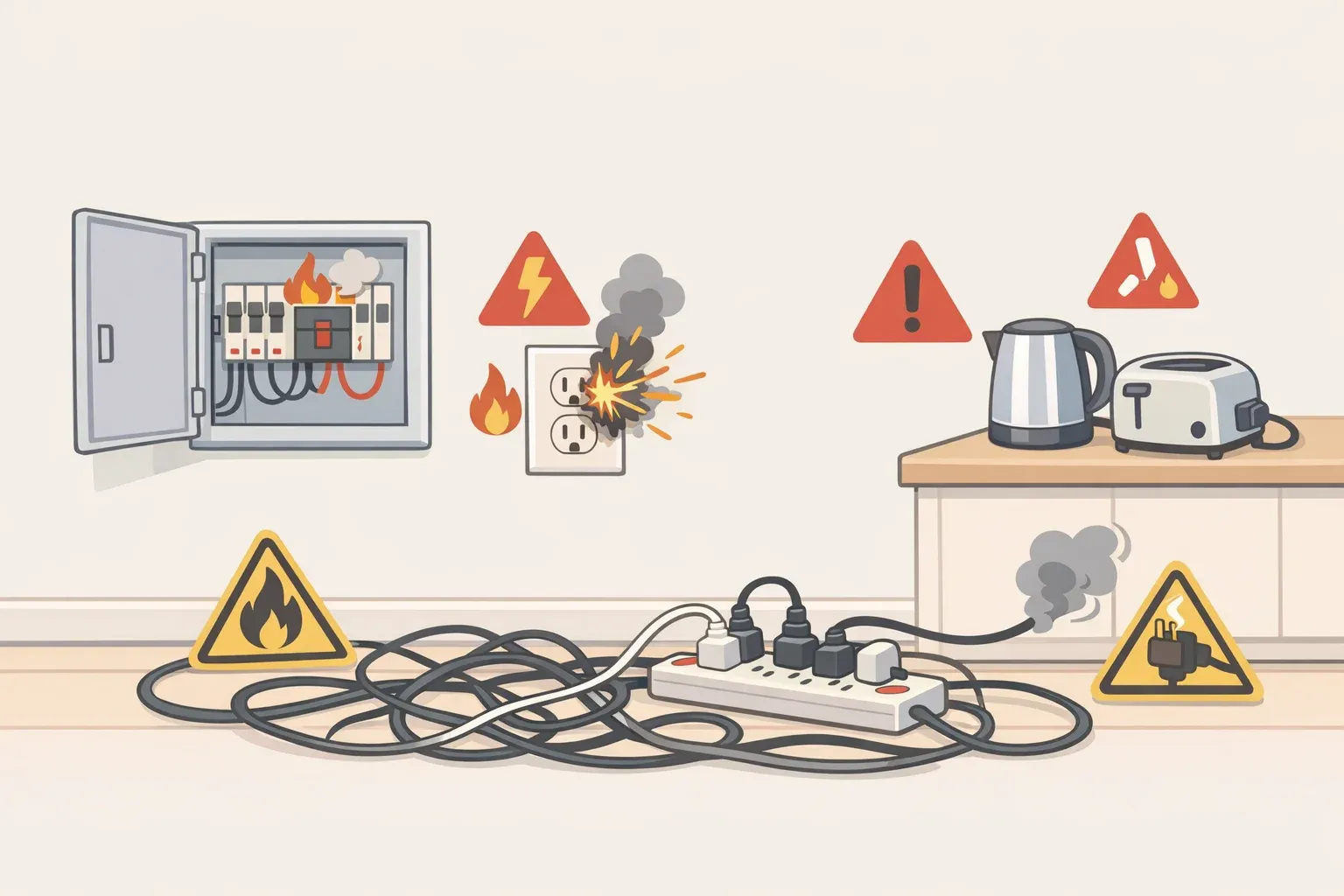
Electrical fire risks often start with ordinary household habits: a tripped breaker that keeps getting reset, an extension cord tucked under a rug, a loose outlet that gets ignored, or an older panel that has not been inspected in years.
According to the U.S. Fire Administration, electrical malfunction caused an estimated 23,700 residential building fires in 2023, and residential electrical malfunction fires rose 2% from 2014 to 2023. That does not mean every electrical mistake will start a fire, but it does mean small warning signs deserve attention before they become bigger hazards.
This guide focuses on U.S. homes and U.S. electrical safety terminology. Codes, outlet types, voltage, and homeowner repair rules vary by country, state, and municipality. Renters should not replace outlets, open panels, or alter wiring; report electrical problems to the landlord or property manager in writing.
The safest DIY boundary is simple: stop unsafe use, test accessible safety devices, label what you can identify, and call a licensed electrician for wiring, panel work, recurring trips, heat damage, burning smells, buzzing, sparking, or anything you are not legally allowed or trained to repair.
Where to start:
Start with the issue that sounds most like your home. If breakers trip often, read Items 1 and 7 first. If extension cords are in heavy use, go straight to Item 2. If you have young kids at home, start with Item 3. If your GFCI outlets have never been tested, begin with Item 4. For an older home with no recent electrical inspection, start with Items 8–12. If you have two-prong outlets or a fuse panel, focus on Items 8, 9, and 11. If you notice a burning smell, sparks, buzzing, or warm outlets, stop using the affected circuit and call an electrician.
Part 1: Seven electrical habits to stop first
These mistakes are mostly habit-based. In many cases, the fix is not a repair at all; it is stopping unsafe use and knowing when the problem is beyond DIY.
Mistake 1: Resetting a tripped breaker without asking why it tripped
A breaker trips in the kitchen, so you reset it and keep using the microwave, coffee maker, and toaster at the same time. A few days later, it trips again.
That breaker is not being difficult. It is doing its job. A breaker that keeps tripping under the same conditions may be warning you about an overloaded circuit, a faulty appliance, or a wiring problem.
Warning signs: The same breaker trips repeatedly, a breaker trips when a certain appliance turns on, or a breaker trips immediately after being reset.
What to do: Unplug devices on the circuit, reset the breaker once, and reconnect devices one at a time. If the breaker holds with a lighter load, spread high-draw devices across different circuits or avoid running them together. If it trips again with little or nothing plugged in, stop resetting it.
Do not do this: Never replace a breaker with a higher-amperage breaker just to stop nuisance trips. The breaker is sized to protect the wiring.
Call an electrician if: The breaker trips immediately, trips repeatedly on a light load, feels hot, smells burned, or may need a dedicated circuit.
Mistake 2: Using extension cords as permanent wiring
An extension cord is useful for a short-term need. It should not become the permanent way a room gets power.
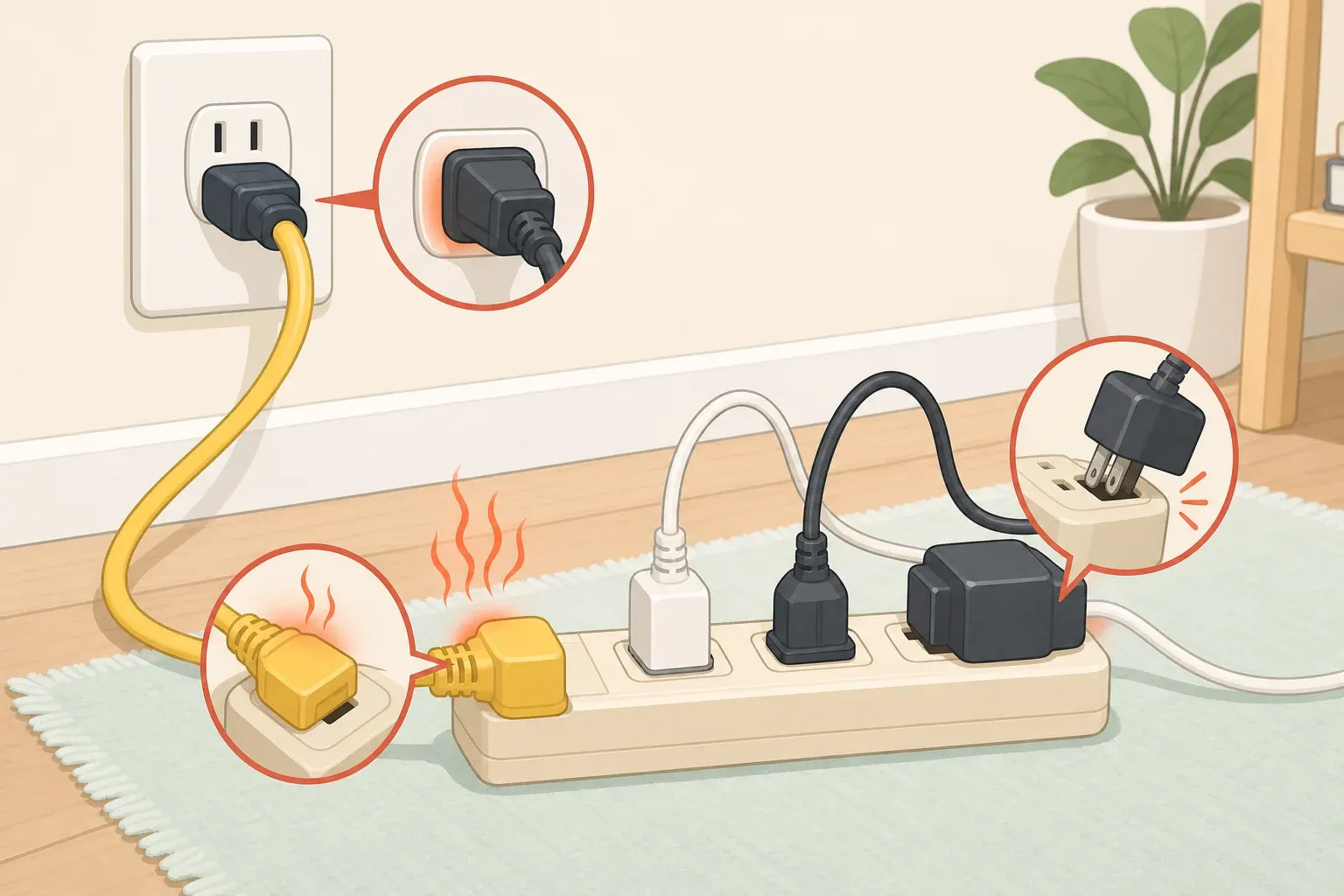
The Electrical Safety Foundation International says extension cords are temporary and should not replace permanent wiring. ESFI also warns against running cords through walls, doorways, ceilings, floors, rugs, or carpet because covered cords can trap heat.
Warning signs: An extension cord has been in the same place for months, runs under a rug, is pinched behind furniture, feels warm, powers more than one appliance, or is used because the room does not have enough outlets.
What to do: Remove cords that are being used as permanent wiring. Use only cords marked by an independent testing laboratory such as UL, ETL, or CSA. Make sure the cord is rated for the device and location, especially outdoors. Replace any cord that feels hot, looks damaged, has a loose plug, or shows exposed wiring.
Do not do this: Do not nail or staple cords to walls or baseboards. Do not run cords through doorways. Do not use indoor cords outdoors. Do not plug one extension cord or power strip into another.
Call an electrician if: A room consistently needs more outlets. The safer fix is more permanent wiring, not a longer cord.
Mistake 3: Leaving child-accessible outlets without tamper-resistant receptacles
Standard outlets are easy to overlook until a toddler starts crawling around the house.
ESFI says tamper-resistant receptacles are designed with internal shutters that stay closed unless equal pressure is applied to both slots at the same time. That helps block keys, pins, paper clips, and other small objects from being inserted into outlet slots.
Warning signs: Older standard outlets are within reach of young children, especially in bedrooms, living rooms, playrooms, kitchens, and hallways.
What to do: Check accessible outlets in rooms children use. Tamper-resistant receptacles look like standard outlets but have internal shutters behind the slots.
Do not rely only on: Plastic plug covers. They may help temporarily, but they can be removed, misplaced, or become a choking hazard.
Call an electrician if: You are renting, the wiring is old or ungrounded, you are unsure which breaker controls the outlet, or local rules do not allow you to replace receptacles yourself. ESFI says TRRs should be installed by a licensed electrician.
Mistake 4: Never testing GFCI outlets
A bathroom or kitchen outlet can look normal and still fail when it is needed most.
Ground-fault circuit interrupters, or GFCIs, are designed to shut off power quickly when they detect leakage current. ESFI says GFCIs help prevent deadly shock and are used where water may come into contact with electrical products, including kitchens, bathrooms, garages, and outdoor areas.
Warning signs: A GFCI has never been tested, the Test button does nothing, the Reset button will not restore power, or a wet-area outlet has no GFCI protection.
What to do: Press the Test button on each GFCI outlet or GFCI breaker according to the manufacturer's instructions. Power should cut off. Press Reset to restore power. If the outlet does not trip during the test, do not assume it is protecting you.
Call an electrician if: A GFCI does not test properly, a kitchen or bathroom has no GFCI protection, an outdoor outlet is not protected, or you are unsure how the circuit is wired.
Mistake 5: Dismissing repeated AFCI trips
AFCI and GFCI protection are not the same thing. GFCIs help protect people from shock. AFCIs help reduce fire risk from arcing faults.
The Consumer Product Safety Commission says AFCIs can provide added protection from fires caused by unsafe arcing and sparking in home wiring. ESFI describes an arc fault as a dangerous electrical problem that can be caused by damaged, overheated, or stressed wiring or devices.
Warning signs: An AFCI breaker or receptacle trips repeatedly, especially with no clear appliance overload.
What to do: Unplug devices on the circuit before resetting. If the AFCI holds with everything unplugged, reconnect devices one at a time to look for a faulty cord, lamp, charger, or appliance.
Do not do this: Do not keep resetting an AFCI without looking for the cause. Repeated trips deserve diagnosis.
Call an electrician if: The AFCI trips with nothing connected, trips repeatedly on light use, or the problem may be inside a wall. CPSC specifically warns homeowners not to install AFCIs themselves because installation may involve work inside live electrical panel boxes.
Mistake 6: Relying on an unlabeled electrical panel
A panel with vague or missing labels makes every future electrical task more dangerous.
If a breaker is labeled "kitchen," but it controls only half the kitchen, someone may shut off the wrong breaker before working on an outlet. If several breakers are unlabeled, emergency shutoff becomes slower and guesswork becomes more likely.
Warning signs: Breakers are unlabeled, labels are outdated, several say the same room, or past owners left confusing notes such as "lights?" or "old outlet."
What to do: Map the panel carefully. With help from another person, turn breakers off one at a time and identify which outlets, lights, and fixtures lose power. Label each breaker clearly with room and function.
Do not do this: Do not assume an outlet is dead because one nearby device turned off. Always test before touching anything.
Call an electrician if: A breaker will not reset, shows heat damage, makes noise, smells burned, or does not seem to control anything identifiable.
Mistake 7: Running high-draw appliances on shared circuits
Some appliances draw much more power than lamps, chargers, TVs, and small electronics. Running too many high-draw devices on one circuit can cause repeated breaker trips and overheating.
Warning signs: A breaker trips when a space heater, microwave, toaster oven, air fryer, laser printer, portable air conditioner, or power tool turns on. The problem gets worse when several devices run at once.
What to do: Avoid running multiple high-draw appliances on the same circuit. Plug space heaters and other high-wattage portable appliances directly into a wall outlet when the manufacturer requires it, and never use damaged cords or overloaded strips. Check appliance labels and manuals for power requirements.
Do not assume: A power strip or surge protector increases the circuit's capacity. It does not. It only gives you more places to plug things in.
Call an electrician if: A home office, workshop, garage, kitchen, or laundry area repeatedly trips breakers. Many electric ranges, electric dryers, large air conditioners, EV chargers, and electric water heaters require dedicated circuits, often 240 volts, depending on the appliance and installation.
Part 2: Built-in electrical hazards to check
These issues are not habits. They are conditions in the home. The mistake is continuing to use the electrical system as if the condition does not matter.
Mistake 8: Assuming old wiring is safe because nothing has happened yet
Old wiring can work for years and still be unsafe for modern use.
Warning signs: Two-prong outlets throughout the home, cloth-insulated wiring, visible knob-and-tube wiring in unfinished areas, frequent flickering, warm outlets, or no record of an electrical inspection in an older home.
What to check: Look for two-prong outlets, damaged visible wiring, old outlet boxes, and signs of previous amateur repairs. Do not disturb old wiring or insulation.
Why it matters: Older systems may lack grounding, modern protection devices, or enough capacity for today's appliance and electronics use. Renovations can also damage older wiring behind walls.
Call an electrician if: The home is older, has never had a recent electrical inspection, has two-prong outlets throughout, or shows any heat, buzzing, burning smell, or recurring breaker/fuse problems.
Mistake 9: Using a fuse panel for modern electrical loads
Fuse panels are common in older homes. They are not automatically dangerous, but they deserve professional evaluation, especially when the home now has central air conditioning, modern kitchen appliances, a home office, or other high-demand loads.
Warning signs: The home has a fuse box instead of a breaker panel, fuses blow regularly, fuses are replaced with higher-amperage versions, or several rooms depend on a small number of circuits.
What to check: Look at the panel type and note whether fuse ratings match the markings for each position. Do not change fuse sizes to stop nuisance blowing.
Do not do this: Never replace a 15-amp fuse with a 20- or 30-amp fuse unless a licensed electrician confirms the wiring is rated for that load. Oversizing the fuse can remove the protection the wiring depends on.
Call an electrician if: The home still has a fuse panel, fuses blow repeatedly, or you plan to add major appliances, HVAC equipment, workshop tools, or EV charging.
Mistake 10: Missing AFCI protection on older circuits
AFCI requirements expanded over several National Electrical Code cycles, and adoption varies by jurisdiction. Many older homes may lack arc-fault protection on circuits where newer or remodeled work may require it.
ESFI notes that the 2008 National Electrical Code significantly expanded AFCI requirements in new homes, but those provisions depend on state and local adoption.
Warning signs: The panel has standard breakers only, with no breakers or receptacles labeled "AFCI" or "AFCI/GFCI."
What to check: Read the labels on breakers and receptacles. If you do not see AFCI labeling, the home may lack arc-fault protection on those circuits. An electrician can confirm what protection is actually present.
Do not do this: Do not open the panel or try to install AFCI breakers yourself.
Call an electrician if: The home is older, has standard breakers only, has recurring unexplained trips, or has older wiring. CPSC says AFCI installation should be handled by a qualified electrician because panel work can remain hazardous even when main breakers are turned off.
Mistake 11: Masking ungrounded outlets with adapters
A two-prong outlet is not grounded just because a three-prong adapter fits into it.
Warning signs: Two-prong outlets, three-prong adapters, appliances plugged into ungrounded outlets, or a tingling feeling when touching a metal appliance or device case.
What to check: Identify two-prong outlets and any adapters being used to fit three-prong plugs. Do not cut off grounding pins from plugs, and do not force plugs into outlets.
ESFI warns that using a three-prong plug with a two-slot outlet defeats the purpose of the grounding pin and can create an electrical shock hazard. Its extension cord safety guidance gives the same warning for cords and plugs.
Call an electrician if: You have ungrounded outlets where grounded equipment is being used, feel tingling from an appliance, or need grounded outlets added. Retrofitting proper grounding is not a plug-adapter fix.
Mistake 12: Treating electrical symptoms as simple surface repairs
A warm outlet, flickering light, buzzing switch, scorch mark, or burning smell is a symptom. Replacing the visible device may not fix the underlying problem.
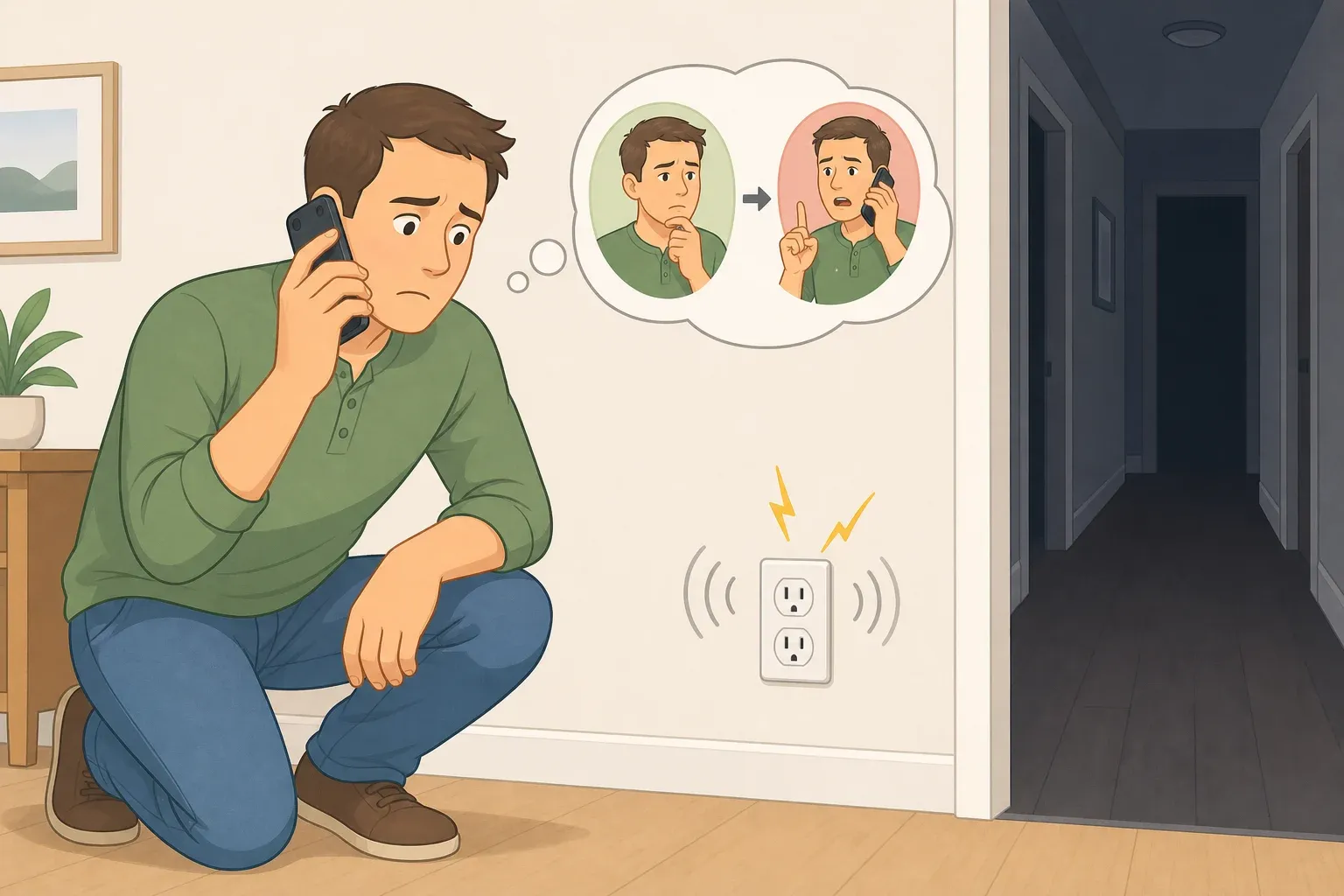
Warning signs: Outlets or switches feel warm, plugs fit loosely, lights flicker, switches buzz, an outlet is discolored, or a burning smell appears near a receptacle, switch, appliance, or panel.
What to do: Stop using the affected outlet, switch, device, or circuit. Unplug devices if it is safe to do so. If you smell burning, see sparks, or notice heat damage, treat it as urgent.
Do not do this: Do not tape over a damaged cord, keep using a loose outlet, ignore a buzzing switch, or replace a warm outlet without finding out why it was warm.
Call an electrician if: Any symptom involves heat, buzzing, sparks, scorch marks, burning smells, damaged wiring, panel work, or a problem you cannot clearly identify.
Do not forget smoke alarms
Electrical safety is only one layer of fire prevention. You also need working smoke alarms and an escape plan.
The National Fire Protection Association recommends smoke alarms as a core part of home fire safety. Test alarms regularly, replace batteries when needed, and replace alarms according to the manufacturer's instructions. Make sure everyone in the home knows what to do if an alarm sounds.
What to check first
Start with the problems you can safely spot without touching wiring:
Remove extension cords being used as permanent wiring.
Stop running cords under rugs, through doorways, or behind furniture where they can be pinched.
Do not daisy-chain power strips or extension cords.
Test GFCI outlets and breakers according to the manufacturer's instructions.
Label the electrical panel clearly.
Stop resetting breakers or AFCIs that trip repeatedly.
Check child-accessible outlets and consider tamper-resistant receptacles.
Look for two-prong outlets, fuse panels, and other signs of an older electrical system.
Then book an electrical inspection if the home is older, has no recent inspection history, has a fuse panel, has two-prong outlets throughout, lacks visible AFCI/GFCI protection, or shows any sign of heat, buzzing, sparking, burning smells, or repeated trips.
The point is not to turn every homeowner into an electrician. It is to help you recognize the difference between a habit you can stop, a device you can test, and a hazard that needs a licensed professional.



Comments
Be the first, drop a comment!