



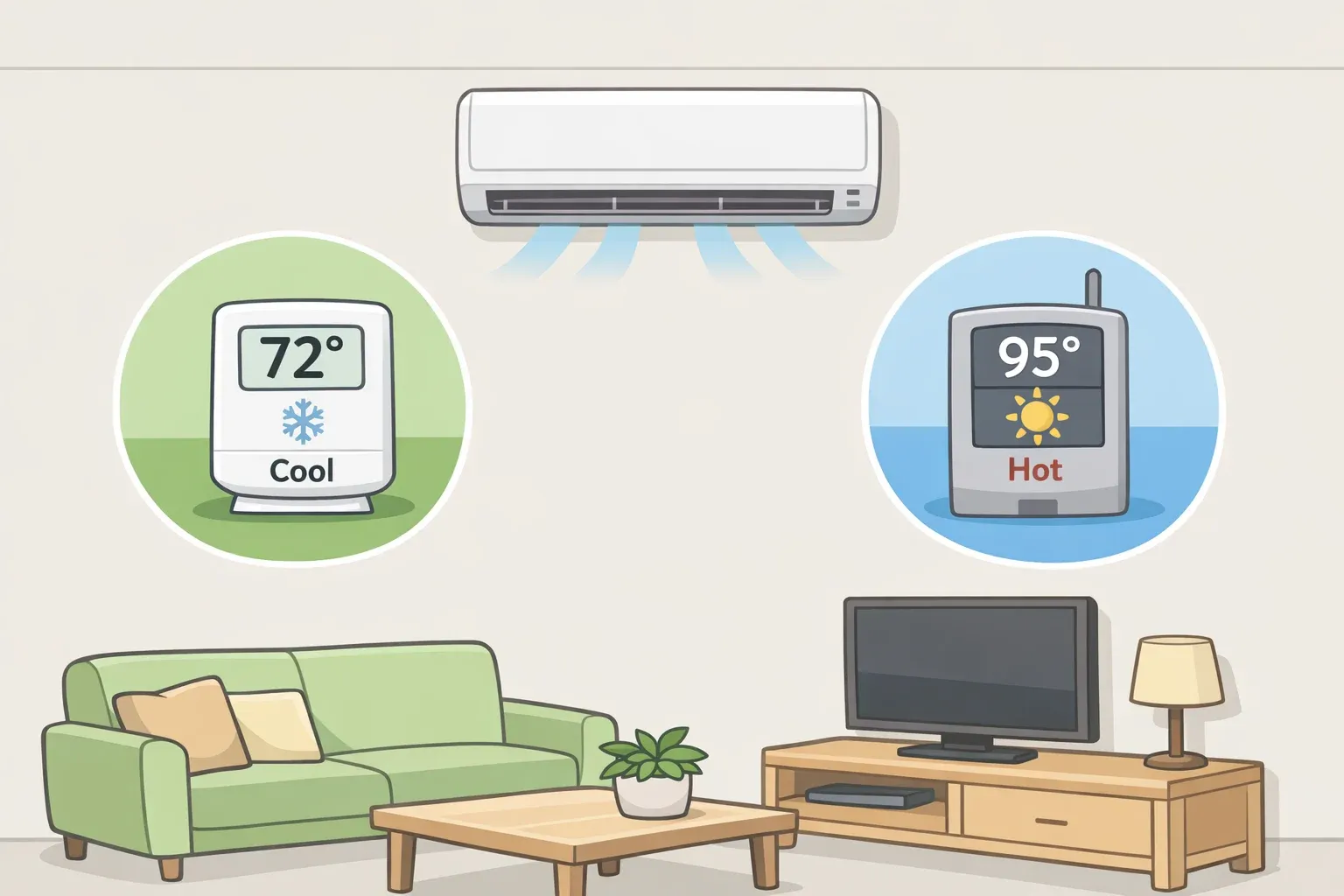
What Is the 20-Degree Rule for Air Conditioners: 2 Meanings
The 20-degree rule for air conditioners comes up constantly in HVAC conversations, and most homeowners assume it refers to a single thing. It doesn't. There are two entirely separate rules using the same number, and mixing them up is what sends people either into a panic over a perfectly healthy system or into denial about one that's quietly failing.
The first meaning is a comfort guideline: under normal conditions, a residential central AC system is designed to keep indoor temperatures roughly 20°F below the outdoor temperature, according to Climate Control Services. The second is a diagnostic check called delta-T, which measures the temperature difference between air entering the system's return vent and air leaving the supply vents. Most healthy central AC systems produce a split in the range of 15 to 20°F, consistent with general maintenance guidance summarized by Mitmunk.
One rule is about how the house feels. The other is about what the equipment is doing. Knowing which one applies turns a vague frustration into a testable question.
The two versions of the 20-degree rule, defined
Comfort rule: outside vs. inside
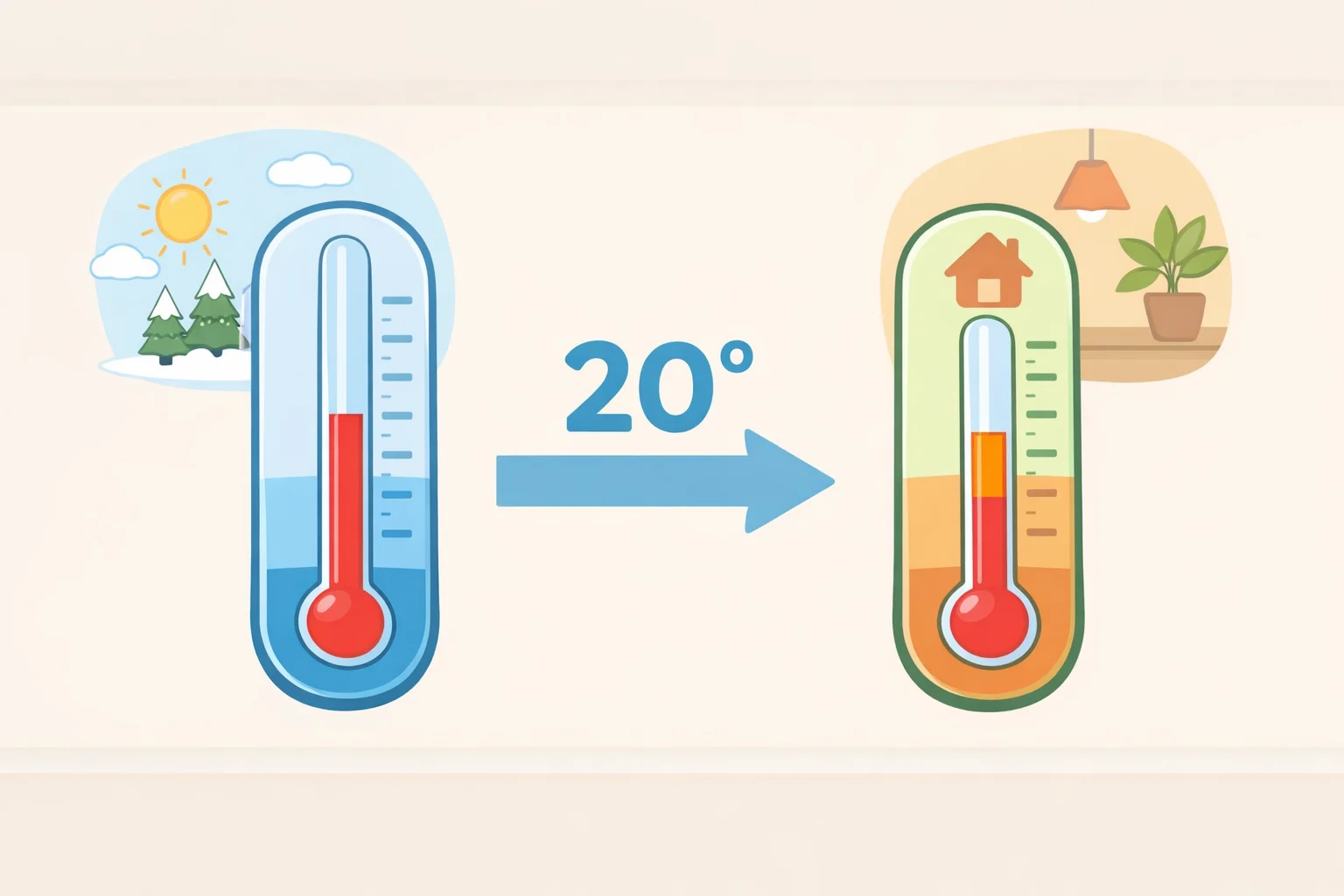
The homeowner-facing version holds that a standard residential AC is designed to keep indoor air approximately 20°F cooler than the outdoor temperature under normal operating conditions, per The Weatherman AC. Practical implication: if it's 100°F outside, a functioning system should hold the home near 80°F. Not 70°F. Not 68°F.
This is an efficiency guideline, not a guarantee, as The Weatherman AC makes clear. Climate Control Services puts it plainly: the rule describes what a correctly sized, properly functioning system can sustain, not what it will always deliver regardless of conditions. A system can push past the 20-degree limit, but The Weatherman AC notes it does so at significant cost to the equipment and the utility bill.
The misconception this corrects is a common one. Many homeowners conclude the AC is broken when it can't reach 70°F on a 110°F day, as The Weatherman AC notes. If the equipment's internal numbers are normal, the system isn't broken. The outdoor conditions have simply exceeded what residential equipment is designed to overcome.
Delta-T rule: return air vs. supply air
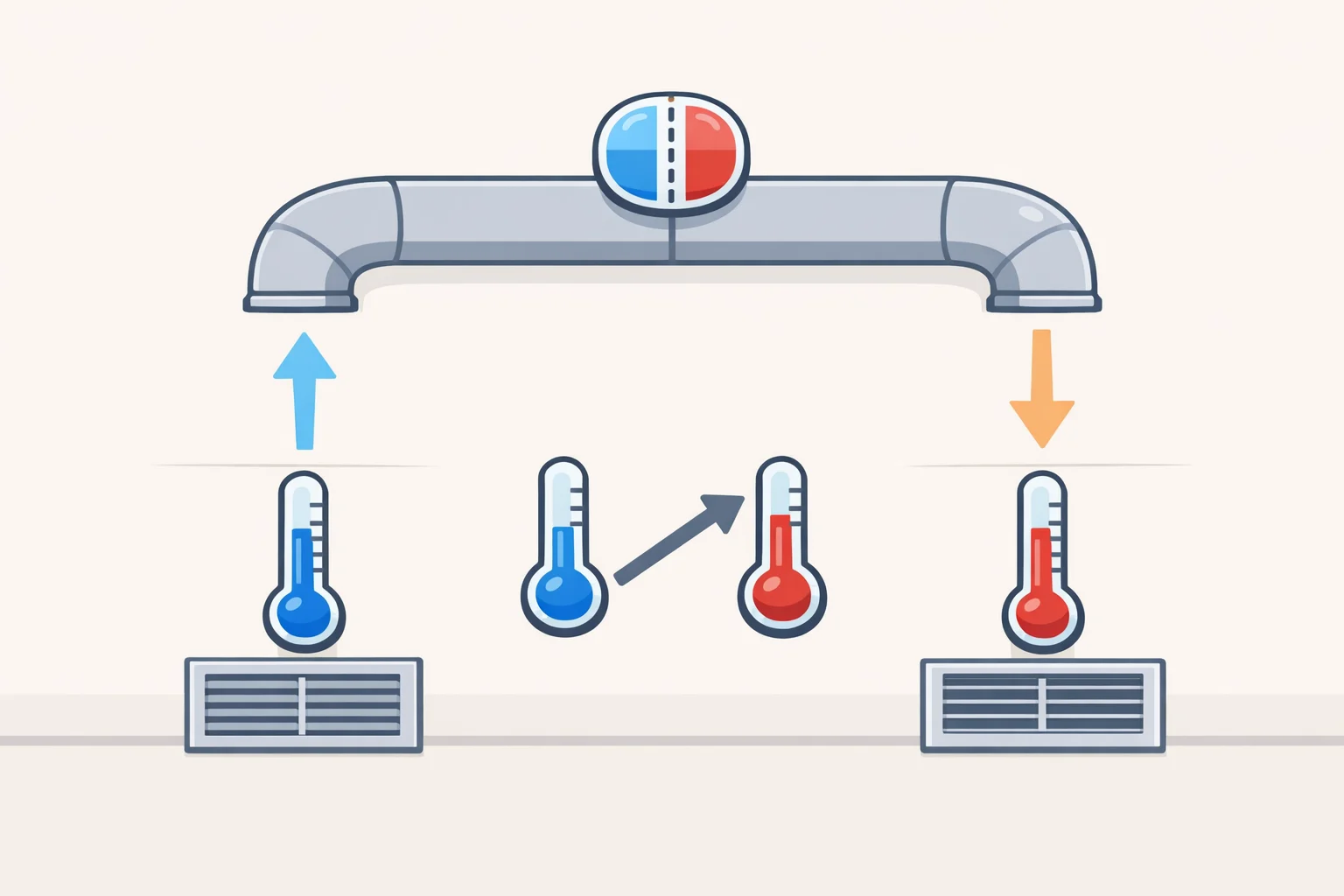
Delta-T (ΔT) is the temperature difference between air entering the system at the return vent and air exiting at the supply vents. This is what HVAC technicians mean when they talk about a "temperature split." The healthy range for most central AC systems is roughly 16 to 22°F, according to The Weatherman AC, though Mitmunk reflects general guidance citing 15 to 20°F. Different sources draw the range slightly differently; the core idea is the same.
All Time Air Conditioning describes delta-T as the industry shorthand for whether the system is running in its efficient operating zone, where the compressor runs efficiently, the coil dehumidifies, and the house stays comfortable. Unlike the comfort rule, which looks at whole-house temperature relative to outdoors, delta-T is a rough homeowner check on whether the system is cooling air as expected as it passes through the equipment.
Climate Control Services draws the line directly: the outdoor-to-indoor version is a comfort expectation; the return-to-supply version is a system health check. Treating them as the same thing is where most misunderstandings begin.
One other place the number 20 appears in HVAC is worth flagging so it doesn't cause confusion: the U.S. Department of Energy notes that air conditioners typically need about 20 BTU per square foot of living space as a sizing guideline. That has nothing to do with either version of the 20-degree rule.
How to check your AC's delta-T with a thermometer
If the comfort rule explains what to expect from the whole house, delta-T is the number that tells you whether the equipment itself is the problem. A system producing a healthy split at the vents is working correctly. If the house still feels hot, the explanation lies elsewhere. The Weatherman AC puts it directly: vents blowing air roughly 20°F cooler than the return intake means the system is doing its job.
The test requires nothing more than an inexpensive probe thermometer and two measurements.
Step 1: Find the return air grille. This is the large vent, typically located in a hallway ceiling or wall, that pulls air back into the system. Hold the probe at the vent face and note the temperature. All Time Air Conditioning uses 80°F as a worked example.
Step 2: Measure the nearest supply vent. Supply registers are the smaller vents that blow conditioned air into the room. Take a reading at the closest one. Using the same example from All Time Air Conditioning: 60°F at the supply vent, subtracted from 80°F at the return, equals a delta-T of 20°F. That's a healthy reading.
Step 3: Interpret what you have. A split of 16 to 22°F indicates a system operating in its normal range, per The Weatherman AC. Treat the result as a screen, not a diagnosis. Consumer thermometers vary in precision, and a single vent-face reading is less accurate than measurements a technician would take at the equipment itself. The point is to establish whether you're clearly inside or clearly outside the normal band.
One exception worth noting: All Time Air Conditioning notes that variable-speed systems can read 22 to 24°F when running at reduced capacity during mild conditions, then settle closer to 20°F under heavier loads. That's normal behavior for that equipment type, not a problem.
How to read the results
| What you observe | Likely explanation |
|---|---|
| Delta-T in range (16–22°F) + house still warm | Building issue: insulation, air sealing, duct leakage, solar gain |
| Delta-T low (below 15°F) + house warm | Equipment issue: filter, coils, refrigerant, airflow |
| Delta-T still low after filter change and vent check | Likely mechanical; schedule service |
| Delta-T in range but comfort uneven room to room | Zoning, duct balance, or localized insulation problem |
When the building is the problem
A system producing a correct delta-T can still lose the fight against heat if the home's envelope isn't sealed. Thin attic insulation and drafty windows let cooled air escape nearly as fast as the system produces it, per The Weatherman AC. The AC isn't failing; the house is.
The Weatherman AC also notes that direct sunlight hitting a window can raise a room's temperature by 10°F in minutes. A well-sealed building envelope, not a harder-working compressor, is what helps the AC hold its ground against solar gain.
These rules carry an implicit assumption: normal conditions. On extreme heat days well above a region's typical summer peak, the outdoor-to-indoor gap may narrow below 20°F even in a functioning, well-insulated home. That's expected behavior at the outer edge of design conditions, not equipment failure.
When the equipment is the problem
A low delta-T is a signal that something inside the system is limiting its ability to cool the air moving through it. The Weatherman AC identifies a dirty air filter as the leading single cause of efficiency loss. A professional tune-up, that source notes, can catch low refrigerant or dirty coils before they become a midsummer breakdown.
All Time Air Conditioning adds a specific and useful detail: even a thin dust film on indoor coils can cut delta-T by 2 to 3°F. Vacuum the coils every spring, that contractor recommends.
A low delta-T also affects humidity. When the coil isn't cooling air adequately, it doesn't condense moisture efficiently, per All Time Air Conditioning. A house can feel clammy and miserable before the temperature numbers look alarming.
A useful comfort-rule benchmark from The Weatherman AC: if it's 90°F outside and the system can't keep the house below 80°F, something is wrong with either the equipment or the building. A 10°F gap instead of 20°F is outside what a healthy system should produce under moderate conditions.
DIY steps before calling a technician
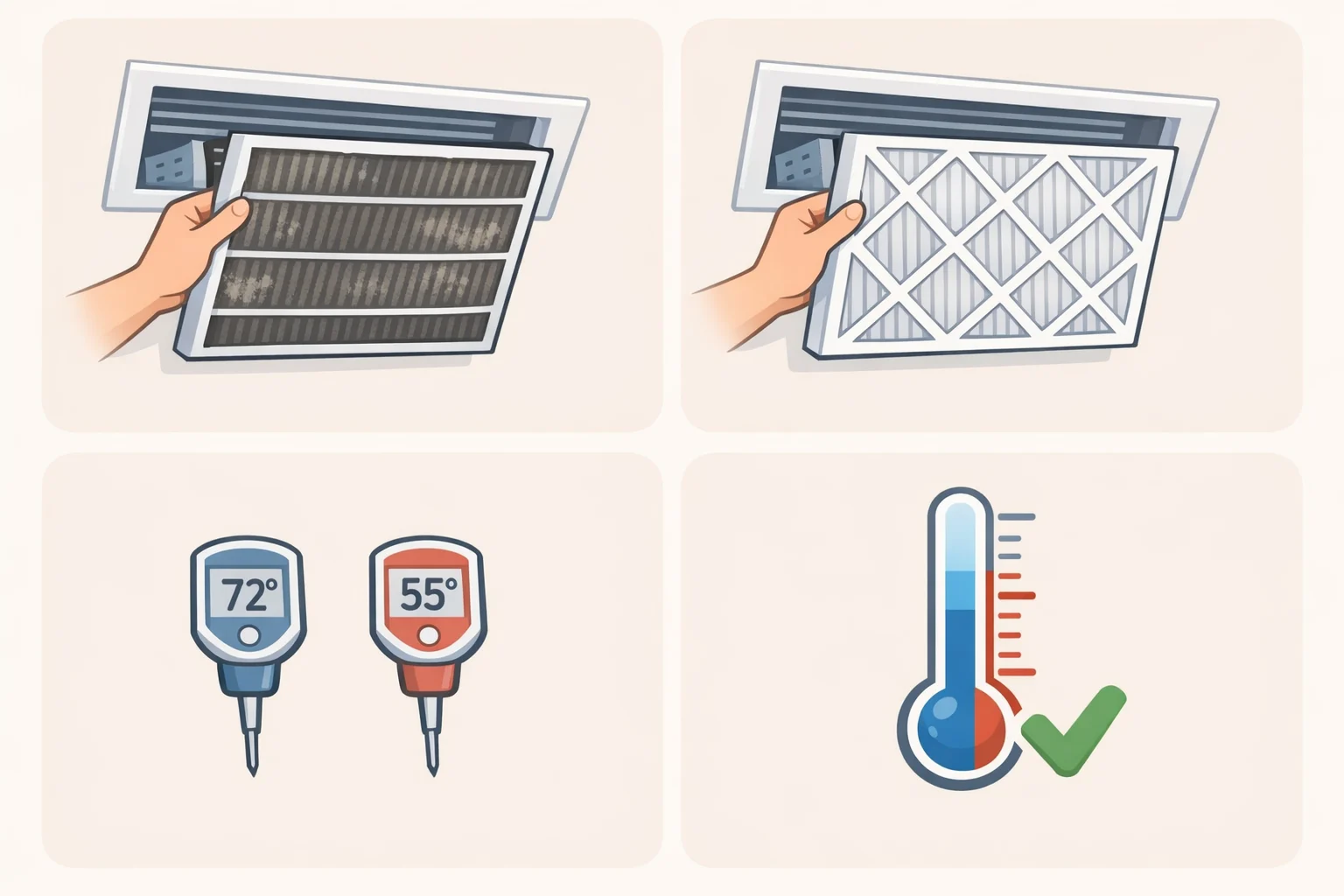
Start with the filter. The Weatherman AC calls it the single highest-impact maintenance step a homeowner can take. In dusty climates, check it every 30 days. All Time Air Conditioning recommends swapping 1-inch filters every 30 days as a baseline.
After replacing the filter, remeasure delta-T. If the split is still consistently below 15°F, the problem is likely mechanical and worth a service call.
When to call a pro
- Delta-T stays below 15 to 16°F after a filter change. All Time Air Conditioning uses 14°F as a schedule-within-24-hours threshold and 12°F as a call-now threshold; those are one contractor's benchmarks, not a universal standard, but they're a useful reference.
- The house can't maintain a 20°F gap from outside during moderate outdoor temperatures below 95°F.
- The unit is over 12 years old and repeatedly struggles during heat events. The Weatherman AC notes that modern high-SEER2 units are considerably better at handling extreme temperature spreads than older equipment, and flags frequent heatwave breakdowns as a sign the system may be worth replacing.
What the test actually tells you
The point of the 20-degree rule isn't to confirm your AC is perfect. It's to narrow the question.
Grab a thermometer. Run the system until it's been operating steadily. Measure the return, measure the nearest supply vent, subtract. If the split is in the 16 to 22°F range and the house is still warm, stop blaming the condenser. Look at insulation, air sealing, and whether the sun is winning in specific rooms. If the split is low even after a fresh filter, stop guessing and book service.
That one measurement separates an equipment problem from a house problem. Most homeowners never make it. The ones who do have a clear conversation with a technician instead of an expensive one.






Comments
Be the first, drop a comment!