



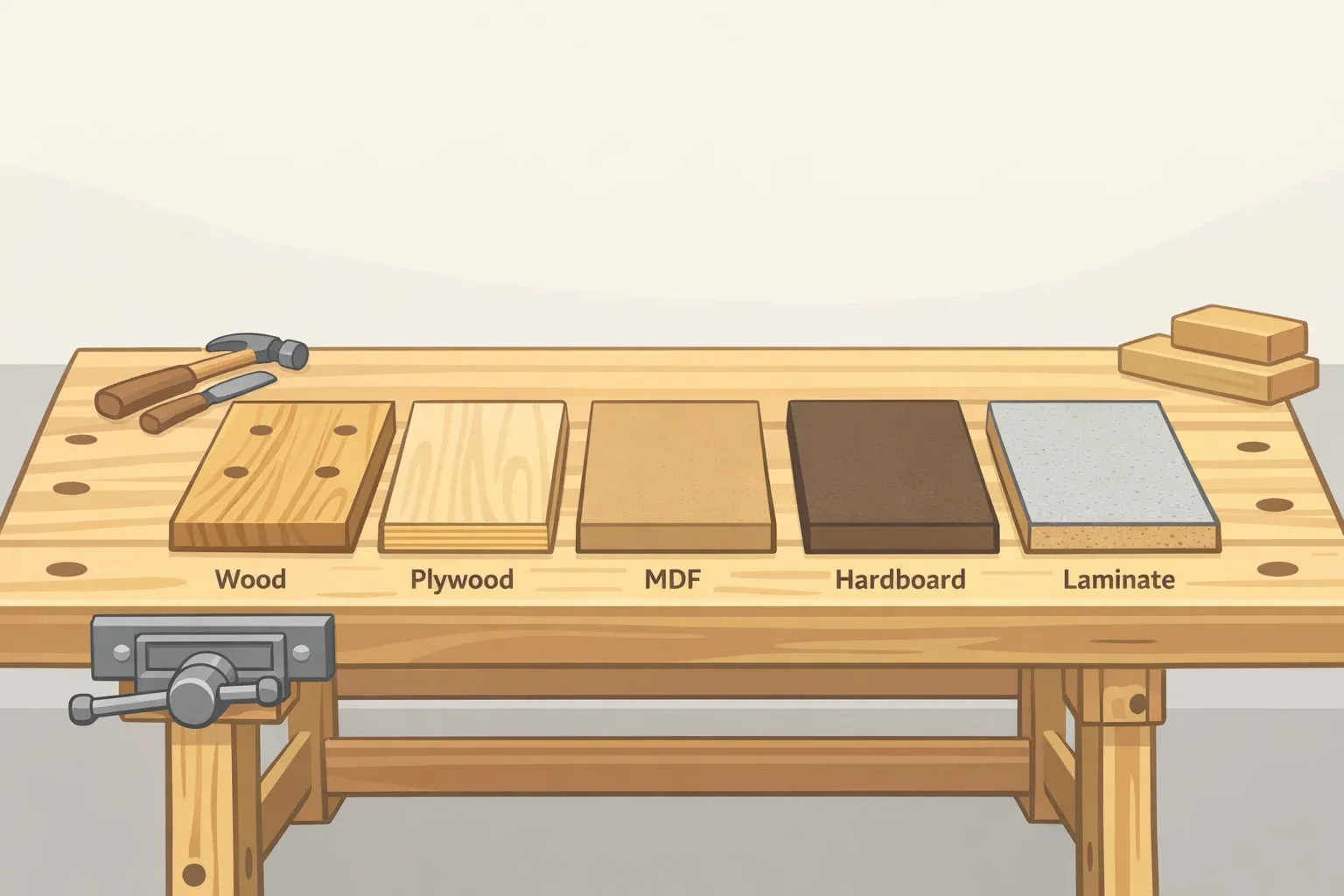
Most workbench top decisions go wrong, not because the builder bought cheap material, but because they compared unlike things. Hardwood, plywood, and steel are structural top materials: they stand alone as the working surface and carry the bench's load.
Laminate and hardboard are surface systems, thin skins that depend entirely on what's underneath them for strength. Any comparison that treats all five as equivalent workbench top materials will produce a misleading answer.
For most home DIYers doing woodworking or mixed-use shop work, a plywood core with a hardboard skin is the most practical starting build. Hardwood is the better long-term investment for a heavily used primary bench. Laminate belongs on assembly and outfeed surfaces, not primary work surfaces. Steel earns its place in metalworking, welding, and solvent-heavy environments. But the question isn't what's best, but what works for the job.
Three decisions drive everything: what does this bench do most, does the surface need to hold workpieces or just support them, and should it be repairable over time or cheaply replaceable? Every recommendation below flows from those three questions.
One up-front note on MDF: it appears throughout the research as a budget substrate option. Under controlled dry conditions, it performs adequately, but when moisture reaches its edges, it swells permanently and loses structural integrity. Its role here is as a cautionary comparison to plywood, not a standalone candidate for a primary bench top.
What to use for a workbench top: 3 questions to answer first
1. What does this bench do most?
Woodworking and mixed-use shop work favor hardwood or plywood: materials that grip workpieces and tolerate chisels, mallets, and clamps. Metalworking and fabrication favor steel, which handles sparks, heat, and solvents without degrading. Assembly, glue-ups, electronics, and light detail work favor a smooth laminate surface where cleanup matters more than grip.
Task type also drives minimum thickness. Benches built for heavy work need at least 1.5 to 2 inches of top material to handle the load and prevent flex. A layered build plywood core plus sacrificial skin achieves this at a lower cost than a solid slab.
2. Does the surface need to hold workpieces, or just support them?
This question eliminates laminate and melamine as primary bench surfaces for woodworking. Slick tops cause workpieces to shift under router pressure or hand-plane force, even with non-slip mats. The same quality that makes laminate ideal for sliding panels over an outfeed table makes it a liability when workholding matters.
Surfaces that need dog holes, vises, holdfasts, or bench dogs require a material that can be drilled and fastened at depth without cracking. That limits the realistic field to hardwood, plywood, and hardboard over a solid plywood substrate.
3. Should the surface be repairable over years, or designed for cheap replacement?
Hardwood and plywood can be sanded flat and refinished when worn. Laminate, melamine, and thin steel sheet cannot: once chipped or gouged, replacement is the only option, as Dycoventures observed in late 2025. For a bench in daily use, that difference compounds over a decade.
The practical middle path for most home shops is a structural plywood core with a thin, screwed-down hardboard skin that absorbs direct damage and swaps cheaply.
A plain-language chooser:
Woodworking, hand tools or power tools, clamps and vises, decades of use: Hardwood slab. Pay more upfront, resurface as needed, never replace it.
Most of that performance at lower cost, or building your first real bench: Plywood workbench top, two layers of 3/4-inch, with a hardboard skin screwed on top. This is the default recommendation for most home DIYers.
Dedicated assembly area, outfeed table, glue-up station, or electronics bench: Laminate over a rigid plywood core. Excellent in these roles; wrong for primary workholding.
Sparks, solvents, grinding, welding, or heavy mechanical loads: Steel plate, minimum 1/4 inch, over a plywood substrate. Wood-based surfaces struggle in this environment long-term.
The 5 workbench top materials: what each does well, and where it breaks down
1. Hardwood: best all-around for woodworking and heavy general use
Dense hardwood tops — most commonly hard maple or beech — typically 3 to 4 inches thick on a traditional bench, absorb impact in a way that protects both workpieces and cutting-tool edges. Compared to steel, hardwood quiets the shop by dampening vibration rather than ringing it back at you.
Hardwood tops accept dog holes cleanly, hold vises and holdfasts securely, and provide the natural grip that keeps workpieces from shifting under hand-tool or power-tool pressure. When the surface wears, it gets sanded flat and refinished rather than replaced. That repairability separates hardwood from every other option on this list except plywood.
The trade-off: unfinished hardwood absorbs spills and can warp or develop mold without proper sealing. Periodic refinishing is part of the deal. Skip it long enough and the surface becomes a liability.
Among all the materials here, stainless steel carries the highest upfront cost overall, with hardwood in the middle range. Hardwood is also the only material on this list that can be resurfaced indefinitely, which makes its effective cost-per-year competitive with cheaper options that require periodic full replacement.
Best for: Traditional woodworking, benches requiring regular clamping and workholding, and builders who want a single primary bench that earns its cost over decades.
2. Plywood: best budget all-arounder, and the default structural core
Structural plywood, most reliably two layers of 3/4-inch sheet laminated and fastened together, provides adequate grip, accepts vises and dog holes, and handles everyday shop abuse at a fraction of hardwood's cost. Its most important advantage over MDF is how it responds to moisture.
Under comparative testing that subjected both materials to soaking conditions and progressively increasing loads, plywood warped slightly but remained structurally usable; MDF swelled permanently at the edges and shattered under 450-pound dynamic loading. In garage and shop environments where humidity varies seasonally, that difference matters.
MDF does perform acceptably in dry conditions: with hardwood edge banding, it matched plywood under 600-pound static loads in the same testing. But its moisture vulnerability makes it a riskier standalone core for most real shops. Sealed on all faces and edges, it can function; unsealed, it's a slow failure. Plywood is the safer default.
The practical solution and the reason this entry is the default recommendation for most home DIYers is the layered build: two sheets of 3/4-inch plywood as the structural core, with a screwed-down 1/8-inch hardboard skin on top. The hardboard takes the abuse; the plywood underneath stays intact.
Compared to a laminate, a plywood workbench top costs more upfront and requires more ongoing maintenance, but the structural investment pays off over the years. Two layers of 3/4-inch construction plywood plus a hardboard skin is the most cost-effective entry point for a durable general-purpose bench.
Best for: Most home DIYers building their first real bench, anyone who wants the performance profile of hardwood at a lower cost, and the structural foundation for any layered bench-top system.
3. Laminate/Formica: best for assembly tables, outfeed tables, and light detail work
Laminate (Formica and similar products) is a thick plastic sheet bonded to a plywood or particleboard core: more durable and impact-resistant than its cheaper cousin. Melamine is a thin resin coating applied directly to particleboard or MDF, more fragile, and significantly more susceptible to chipping under impact.
Both are surface systems that depend entirely on their substrate for strength. The melamine workbench top you see recommended in budget builds is almost always doing assembly or outfeed duty, not primary workholding.
Laminate's genuine strengths are worth stating plainly. It resists stains, repels dried glue, especially when waxed, and wipes clean in seconds. Its light color makes sawdust, small fasteners, and layout marks easy to spot. That longevity is inseparable from the solid substrate and non-abusive use.
The disqualifier for primary bench use is also its selling point elsewhere: it's slippery. A workpiece shifts under router pressure or hand-tool force, even with non-slip mats in place. Drop a heavy tool or let something hot sit on it, and laminate chips or cracks in a way that can't be repaired.
Melamine is more fragile still: the coating chips under impact, there is no repair path once it fails, and water infiltrating through seams causes the particleboard substrate to swell permanently.
In active shops, laminate may need full replacement within a few years. In lower-use roles, a dedicated assembly table or outfeed surface can last far longer with proper substrate support. Always use laminate over plywood rather than bare particleboard, and add substantial cross-support underneath to prevent sagging. A melamine panel screwed over a plywood torsion box performs like a different material compared to a single unsupported sheet.
Best for: Dedicated assembly tables, outfeed tables, electronics workbenches, and anywhere a non-stick, easy-to-clean surface matters more than grip. Wrong choice for any surface that sees regular hammering, sustained router pressure, or heavy tool drops.
4. Hardboard (Masonite): best sacrificial skin for budget and general-purpose builds
Hardboard is not a competitor to hardwood, plywood, or steel. It's a surface strategy: a cheap, renewable contact layer over a structural core. It earns its place on this list because experienced builders consistently reach for it as the lowest-cost renewable working surface available.
Tempered hardboard sold as Masonite and similar brands in 1/8-inch thickness offers more friction than steel or laminate, doesn't dull edge tools the way harder abrasive surfaces can, and accepts fasteners near the edges without cracking when properly backed.
Countersunk screws hold it flat, and when it accumulates drill holes, glue drips, torch burns, and stain spills beyond usefulness, a new sheet goes down for a few dollars in under 20 minutes. Sealed with shellac or polyurethane and waxed, the surface hardens further and stays easy to clean.
Hardboard contributes nothing structural. It won't hold dog holes or vise hardware on its own; those live in the plywood layer below. In sustained moisture contact, it will swell. These aren't defects, they're simply properties of a skin, not a slab.
The plywood core is a one-time investment. The hardboard skin is a recurring small expense, making it among the lowest per-year costs of any working surface on this list, because replacement is so fast and cheap.
Best for: Budget builds, first benches, and general-purpose surfaces expected to take ongoing abuse. Also, the recommended approach for anyone building over a plywood core who wants to protect that structural investment from direct damage.
5. Steel: best for metalworking, welding, and chemical exposure
Steel handles what wood-based materials struggle with: direct spark and grinding debris exposure, heat, brake cleaner, solvents, and heavy mechanical loads without degrading. It's non-porous, making cleanup in oil-and-chemical environments fast and genuinely sanitary. For fabricators, tack-welding directly to a thick steel top is a feature, not a complication.
The trade-offs are significant. Steel is loud: every dropped wrench rings. It offers less friction than hardboard or bare wood, meaning workpieces move more readily. Thin sheet steel dents under regular hammer work.
Fabricators recommend 1/8-inch as the practical minimum for general use, 1/4-inch as the preferred thickness for regular work, and 3/8-inch or more for dedicated welding surfaces. A 4x8-foot sheet of 1/8-inch steel ran approximately $200, and stainless steel carries the highest upfront cost of any material in this comparison.
For mechanics, welders, and fabricators who would otherwise be repairing or replacing other surfaces repeatedly, the long-term cost often favors steel. Thin-gauge sheet can also be treated as disposable: screwed down, used hard, replaced when it's scarred beyond usefulness, the same replaceability logic that applies to hardboard, at a higher price point.
Thin-gauge steel performs significantly better over a plywood substrate than when it spans unsupported; the backing prevents flex and oil-canning. For general garage use, 1/4-inch plate over plywood is the practical sweet spot. For dedicated welding, 3/8-inch minimum and grounding the bench is a straightforward safety step when power tools run regularly on a metal surface.
Best for: Mechanics, welders, fabricators, and anyone whose work regularly involves heat, sparks, solvents, or grinding. Overkill and an active nuisance in terms of noise and low friction for general woodworking or light DIY.
Choose for workholding first, then durability
Most home DIYers should build a layered plywood-plus-hardboard bench as their primary surface, then keep a separate laminate or melamine assembly table if their work involves glue-ups and panel handling. These aren't competing surfaces; they cover different parts of the same workflow.
The decision order that holds across all five materials: first, determine what workholding the bench needs. If it requires dog holes, vises, or holdfasts, laminate and melamine are disqualified for that surface. Second, decide how long the surface needs to last and what you're willing to spend on maintenance versus replacement.
Hardwood and a plywood-hardboard build favor repairability; laminate and thin steel favor cheap replacement. Third, consider the environment if chemicals, heat, or sparks are part of the work; steel is the strongest fit for long-term survival, though the right gauge and substrate still determine whether it actually holds up.
Treat surface wear as normal rather than catastrophic. The builds that hold up longest are designed for it from the start, whether that means a hardwood top that gets sanded flat in a decade, a hardboard skin that swaps in 20 minutes, or a steel sheet treated as a disposable overlay. The best workbench top is the one that fits the actual work and keeps doing so when it takes a beating.









Comments
Be the first, drop a comment!