



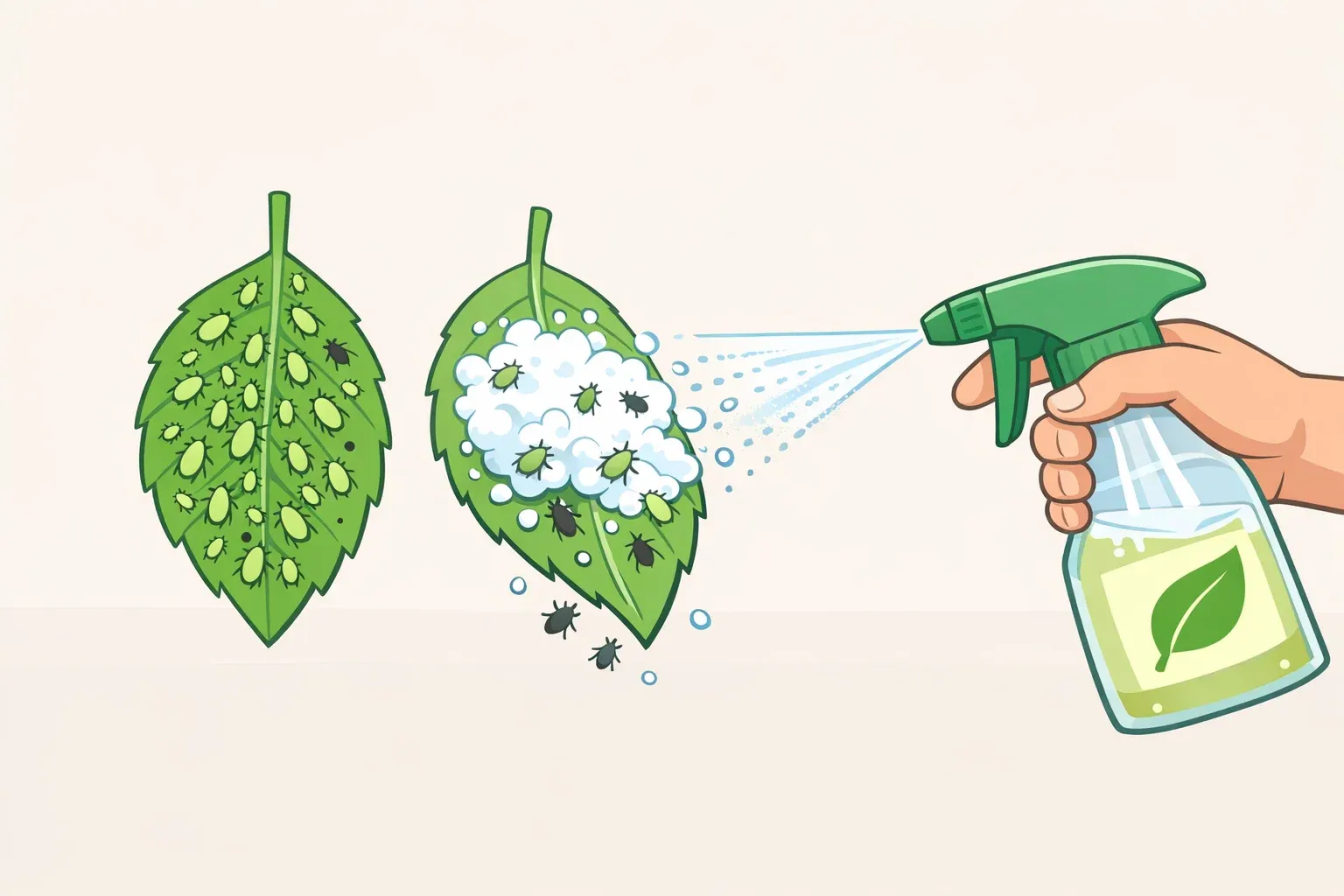
Soap belongs in the garden for one specific purpose: killing soft-bodied insects on contact. Aphids, whiteflies, mites, and similar small pests are vulnerable to it. Dish soap, laundry detergent, and other household cleaners are not the same thing, and using them on plants carries real risks. The rest of this piece explains why that distinction matters and how to use the right product effectively.
Soap has been used to kill garden insects for more than two centuries. The first EPA-registered pesticide containing soap salts appeared in 1947, which means this is anything but a trend born on social media. Extension educators have recently published warnings about gardeners using dish soap and other household products as DIY pest controls, with Illinois Extension noting an influx of gardeners adding dish soap to garden spray mixtures in hopes of controlling insects.
The problem is that soap-based pest control only works within specific limits, and reaching for the bottle under the sink instead of a commercial product risks damaging your plants while potentially not controlling the pest at all.
Soap in the garden for pests: what works and what doesn't
Insecticidal soaps kill by direct contact. The leading theory, as UGA Extension explains, is that soap breaks down the insect's protective waxy cuticle and disrupts cell membranes, causing rapid dehydration. A secondary effect may be suffocation: soap reduces water surface tension, which can allow liquid to penetrate an insect's spiracles (the respiratory openings along its body), reducing oxygen availability. The mechanism isn't fully understood, but the result is anatomy-dependent.
Small, soft-bodied insects are vulnerable because their cuticles are thin and their spiracles accessible. CSU Extension identifies the primary targets as aphids, whiteflies, psyllids, mealybugs, young scale crawlers, spider mites, and thrips. Larger insects with harder exoskeletons, such as caterpillars, Japanese beetles, squash bugs, and sawfly larvae, are largely unaffected by spray applications.
The selectivity cuts both ways. Adult bees and most hard-bodied beneficial insects are generally safe from soap sprays, provided they aren't directly coated during application. The important caveat: both pest and beneficial mites are soft-bodied, so both are susceptible. Larval stages of some beneficial insects may also be vulnerable, per CSU Extension.
Once the spray dries, it's inert. Soap sitting on a leaf does nothing to an insect that walks across it later. Any aphid sheltering inside a curled leaf, any mite under dense foliage, or insects that weren't thoroughly wetted during application simply survive. That's not a product flaw; it's how contact insecticides work. Application technique matters as much as product selection.
Identify the pest before reaching for any spray. Soap is a reasonable first-line option for soft-bodied, exposed pests clustered on leaf undersides or stem tips. For hidden, hard-shelled, or unidentified insects, it's the wrong tool. For large pests like tomato hornworms, stink bugs, and Japanese beetles, there's a different method that works: handpick them into a bucket of soapy water. Soap breaks the water's surface tension, causing insects to sink and drown, and in a bucket, any soap works fine because drowning is the whole mechanism.
Soap vs. detergent in the garden: why the product you choose is the whole point
The confusion between soap and detergent underlies most failed or damaging garden spray attempts.
True soap and synthetic detergents are chemically distinct. Soap is made by combining natural fats or oils with a strong alkali — a process called saponification, from the Latin sapo (soap) and facere (to make). Detergent is a synthetic formulation developed during World War I, when animal fats became scarce, and scientists needed a cleaning agent that didn't depend on plant-based oils. Many dish and laundry products today are petroleum-derived synthetics, not soap at all, per the UC Master Gardener Program.
The label is not reliable. Many products sold as "dish soap," "dishwashing soap," or "laundry soap" contain little or no actual soap — they are detergents, engineered to strip grease and oils. That stripping power is what makes them effective in the kitchen. Sprayed onto plant leaves, the same mechanism attacks the protective waxy cuticle that prevents leaf tissue from drying out.
The result is phytotoxicity — leaf scorch and tissue damage that can occur even at properly diluted concentrations. UGA Extension classifies dish soaps as "hard" soaps (sodium salts), noting that high concentrations burn foliage, with risk sharply elevated when plants are drought-stressed, or temperatures exceed 90°F. Hard water makes it worse: soap mixed with hard water produces calcium and magnesium salts that deposit on leaf tissue as residue, reducing both pest control effectiveness and plant health with repeated use.
That risk alone is a good reason not to improvise. But there are two further problems.
Homemade pesticide mixtures using dish soap or detergent haven't been studied in replicated research trials, so there's no reliable evidence they control pests consistently, per UC IPM. Many contain additives — degreasers, preservatives, viscosity modifiers, emulsifiers — not designed for outdoor use, and many of those components are not biodegradable, raising legitimate concerns about soil and water quality.
The regulatory side matters too. Under FIFRA (the Federal Insecticide, Fungicide, and Rodenticide Act), any substance used with the intent to kill or repel a pest is legally a pesticide. Household soaps don't fall under FIFRA's registration-exempt minimum-risk pesticide classification because they contain mixtures of components — detergents, degreasers, preservatives — rather than single approved ingredients that can be used without registration, per CSU Extension.
The practical implication for gardeners isn't criminal liability; it's the absence of a label. Commercial pesticide labels are legal documents that specify application rates, frequency limits, safety procedures, pre-harvest intervals, and whether a product is approved for use on edible crops at all. Homemade soap sprays come with none of that.
How to use insecticidal soap for plants correctly
Commercial insecticidal soaps sold under various brand names with potassium salts of fatty acids listed as the active ingredient are purpose-built for garden pest control. They are formulated to penetrate insect cuticles while minimizing leaf damage, tested for efficacy, EPA-evaluated, and sold with complete labeled instructions. When extension publications refer to "insecticidal soaps," they mean these commercial products, not household cleaning products repurposed for the garden.
These products are sold at most local garden supply stores in concentrated and ready-to-use formulations, per UGA Extension. There's no practical reason to substitute dish detergent.
If a gardener insists on mixing a soap spray and a commercial product isn't available, extension guidance points to pure vegetable-based, castile, or glycerin-based soaps as the least bad option, not detergents. The recommended dilution is a 2% solution (four teaspoons per quart of water). Plant injury is still possible with repeated applications, even at this dilution.
Practical checklist for any soap-based spray:
Active ingredient to verify: Potassium salts of fatty acids (commercial insecticidal soap)
Identify the pest first: Soft-bodied, small, exposed pests on leaf surfaces: yes. Hard-bodied, large, or concealed pests: no.
Test before treating: Apply to a small section of the leaf and wait 48 hours before treating the whole plant
Timing: Spray during cooler morning hours; avoid applications when temperatures exceed 90°F or plants are drought-stressed
Coverage: Coat insects directly and thoroughly, including leaf undersides; insects that aren't fully wetted survive the application
After application: Rinse the plant with water once the spray has dried to remove residue and reduce tissue damage risk
Frequency: Repeat applications every four to seven days may be needed for spider mites or scale crawlers, but cumulative applications increase leaf-damage risk; follow label limits
Edible crops: Check the label for pre-harvest interval and approved crop list before applying to anything you plan to eat
Sensitive plants to test carefully or avoid: Hawthorn, sweet pea, portulaca, cherries, plums, and some tomato varieties are particularly prone to damage
One practical bonus: a high-pressure spray provides both chemical and physical control simultaneously, knocking small insects off the plant even before the soap does its work.
Match the tool to the pest
The easiest rule to remember: match the tool to the pest. Soft-bodied and exposed, like aphids or whiteflies? Commercial insecticidal soap (potassium salts of fatty acids), applied directly. Large, hard-bodied pests like hornworms or Japanese beetles? Handpick them into a bucket of soapy water. Dish detergent sprayed on plant foliage? Skip it entirely.
Multiple extension programs have arrived at the same position independently, citing untested formulations, plant injury risk, non-biodegradable additives, and the absence of any safety or use guidance on unlabeled mixtures.
For those who want to go deeper on specific pests or explore other lower-toxicity options — horticultural oils, diatomaceous earth, microbial insecticides — the UC IPM Pest Notes and Colorado State University Extension guides offer pest-specific, peer-reviewed guidance on when soap is the right tool and when something else will serve better.





Comments
Be the first, drop a comment!