



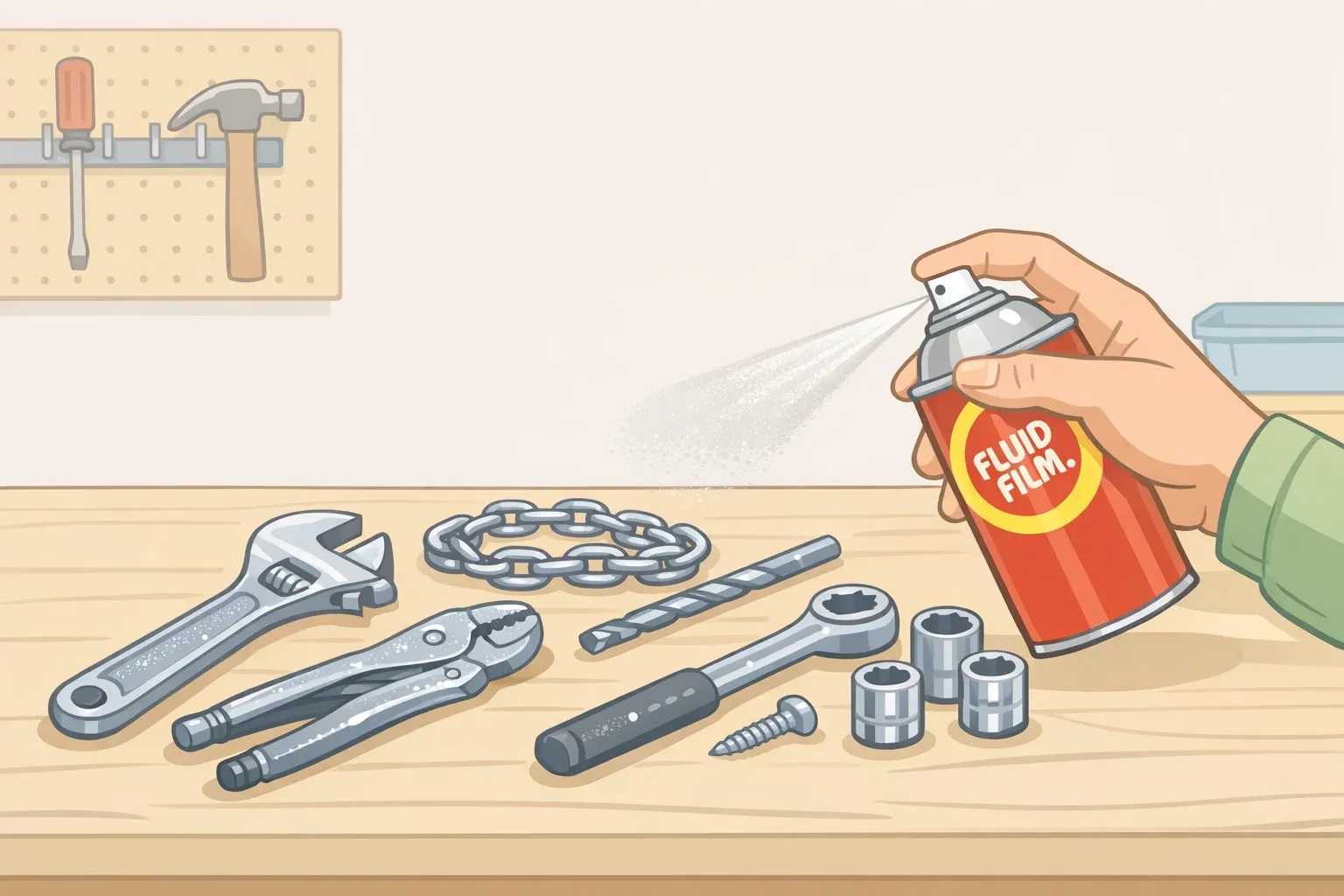
Rust doesn't ask permission. If you run a garage shop or own cast-iron machine tools, humidity will find the bare metal eventually, usually faster than you expect. Fluid Film, a lanolin-based corrosion inhibitor well established in automotive and agricultural maintenance, has found its way into at least some woodworking shops, with users applying it to lathe ways, band saws, and drill presses. The short answer to whether Fluid Film prevents rust on tools: yes, on the right surfaces, under the right conditions. On the wrong ones, it creates new problems while solving old ones.
The evidence base here is narrower than the product's general reputation might suggest. What follows combines manufacturer claims, one woodturner's direct workshop experience, one automotive long-term user report, and cautious extrapolation from adjacent applications. There is no controlled testing specific to shop tools. That's worth knowing upfront.
What Fluid Film actually is
Fluid Film is a solvent-free, lanolin-based corrosion inhibitor and lubricant. The formulation uses processed wool wax, refined petroleum oils, and selected agents to displace moisture and penetrate metal surfaces, according to the manufacturer. The distributor describes it as a product that will not dry out, distinguishing it from coatings that cure to a hard film. That single characteristic drives almost everything else about how it performs and where it belongs.
It's also worth noting what the manufacturer claims versus what independent users observe. Promotional language describes the product as capable of lasting "a lifetime." Two years of real-world automotive use tells a different story: it slows rust on protected metal, it doesn't stop it permanently, and performance varies significantly depending on how much water the coated surface sees. Treat the lifetime claim as marketing, not specification.
How the lanolin mechanism works, and why it determines everything
Fluid Film doesn't coat metal the way paint or wax does. Rather than building a shell over the surface, the formulation is designed to penetrate microscopic pores and seams, displacing moisture at the metal interface itself, a property the distributor calls "metal wetting." Think of it less like painting a fence and more like soaking wood with a penetrating oil that works its way into the grain rather than sitting on top.
Because the coating never fully cures, it can continue to migrate into adjacent seams over time and won't crack or peel under flexing metal. The tradeoff is that it can also be displaced by sustained water contact or abrasion. A coating that stays fluid stays vulnerable to being washed away. In areas shielded from water, like enclosed frame rails, one user found it held for over a year without needing a touch-up; surfaces regularly hit by water or road spray needed yearly reapplication. That's the performance variable that matters most for tool users.
The non-drying residue also transfers. It migrates into surfaces, yes, but it also moves to hands, collects sawdust, and can spread to adjacent areas. On any tool surface that contacts your workpiece, a persistent lanolin-oil film is a sensible concern: it could transfer to stock and potentially interfere with glue adhesion or finish absorption. The research doesn't include testing on this specific question, but the mechanism makes it a precaution worth taking seriously.
Where Fluid Film belongs in your shop, and where it doesn't
The strongest direct evidence for workshop use comes from a woodturner who published a tip in the American Association of Woodturners journal recommending Fluid Film specifically for lathe bed ways, band saws, and drill presses. The method: spray on, spread with synthetic steel wool or a paper towel, wipe off the excess. The woodturner noted that the heavier body of the lanolin-based formula outperformed lighter lubricants for rust prevention on shop machines. That's the most relevant direct evidence available.
From there, some extrapolation is required. Stored hand tool bodies, hinges, columns, tool post hardware, and enclosed metal parts in humid or unheated shops are reasonable candidates. Surfaces that share the key characteristics: limited water exposure and no contact with workpieces. The logic is sound, but these are inferences from the mechanism and adjacent use cases, not documented results.
The wrong places are equally clear. A table saw top used as a reference surface, the sole of a bench plane, a drill press table where stock gets clamped: these are all surfaces where residue transfer is a real risk. Fluid Film is formulated to resist washing off, which is exactly what makes it problematic on work-contact surfaces.
Cutting edges and precision-ground surfaces present additional uncertainty; the product's performance there hasn't been evaluated, and the persistent residue gives reason for caution. Tools used regularly in wet environments or subjected to constant handling will shed the coating faster than it can provide meaningful protection.
How to apply it on shop tools
Surface preparation matters more than most users assume. Wet metal and Fluid Film don't mix well, per one long-term user's experience. For tools with existing surface rust, remove the loose rust first. The coating can slow further progression on lightly corroded metal, but it won't reverse damage already done. Let the surface dry fully before applying.
For machine beds and flat surfaces, spray lightly and spread immediately with synthetic steel wool or a paper towel, working the product into the surface. The goal is a thin, even working film, not a visible pooled coat. Wipe down with a clean cloth after spreading to remove excess. A thin application is more effective and generates far less dust-trapping residue than a heavy one. This is exactly the method the woodturner used on lathe ways and band saw surfaces.
Annual inspection and touch-up is the realistic maintenance cadence for surfaces in regular shop use. Shielded indoor storage may need less; unheated garages, coastal environments, or humid climates will need more. One experienced automotive user makes fall inspection a standing routine: check for thin or worn spots, touch up as needed. The practical advantage is that fresh coats can go over existing ones after removing loose dirt, without a full strip-down. The routine stays manageable.
A horizontal machine surface with a non-drying film will collect sawdust and shop debris over time. Wipe periodically between maintenance applications. This is normal; it just means treating Fluid Film as an ongoing part of tool care rather than a one-time treatment.
One last practical note: Fluid Film carries a distinct lanolin scent, earthy rather than sharp, that tends to linger for about a week after fresh application. Ventilate the shop accordingly.
How Fluid Film for tool rust prevention compares to the alternatives
Paste wax (Johnson's, Minwax, Renaissance Wax) is the traditional choice for machine surfaces and hand tools. It dries to a hard, slippery barrier that doesn't transfer residue the way Fluid Film does, making it safer on work-contact surfaces like plane soles and table tops. The tradeoff is penetration: wax sits on the surface rather than working into seams and pores. For anything that contacts your workpiece, wax remains the safer default.
Boeshield T-9 and similar dry-film products are designed specifically for tool and equipment protection. They cure to a waxy film rather than staying fluid, which makes them less prone to residue transfer and more appropriate for cutting edges and frequently handled tools. The tradeoff runs the other direction from paste wax: less penetration into seams and cavities, and higher per-application cost compared to buying Fluid Film by the gallon.
Ceramic coatings are worth a mention. At least one woodworker has experimented with automotive ceramic coatings on hand tools, reporting no rust through five months of variable humidity conditions, though soles were deliberately excluded from treatment. The approach requires more surface preparation, the observation window is still short, and it hasn't been evaluated on cast-iron machine surfaces. Potentially more durable for specific applications, but less proven.
Where Fluid Film has a genuine edge: cost and versatility. One user reported a gallon at around $40, compared to roughly $60 for a competing lanolin-based product. It's available without special equipment, doubles as a lubricant for stuck hardware and seized fasteners, and penetrates into enclosed areas and seams better than any dry-film product. For cast-iron machine surfaces in a humid shop, it's a practical and credible option.
The bottom line
Fluid Film earns its place in a woodworking shop on specific surfaces: cast-iron machine beds, lathe ways, band saw and drill press hardware, stored tool bodies, hinges, and enclosed metal parts that see limited moisture and no workpiece contact. A woodturner's consistent results on exactly those surfaces remain the most directly applicable evidence for workshop use. Keep it away from plane soles, table saw tops, cutting edges, and anything that regularly touches your stock.
Apply it to clean, dry metal. Spread thin, wipe off the excess, and build annual inspection into your shop maintenance. The non-drying formulation means reapplication is straightforward, directly over the existing coat once loose debris is cleared.
The open question that the available evidence can't answer is workpiece contamination: whether Fluid Film residue measurably affects glue joints, finish absorption, or wood surfaces under normal shop conditions. That testing doesn't exist yet. Until it does, the sensible position is to keep Fluid Film on non-contact surfaces and reach for paste wax or a dry-film product anywhere your tools meet your wood.















Comments
Be the first, drop a comment!