



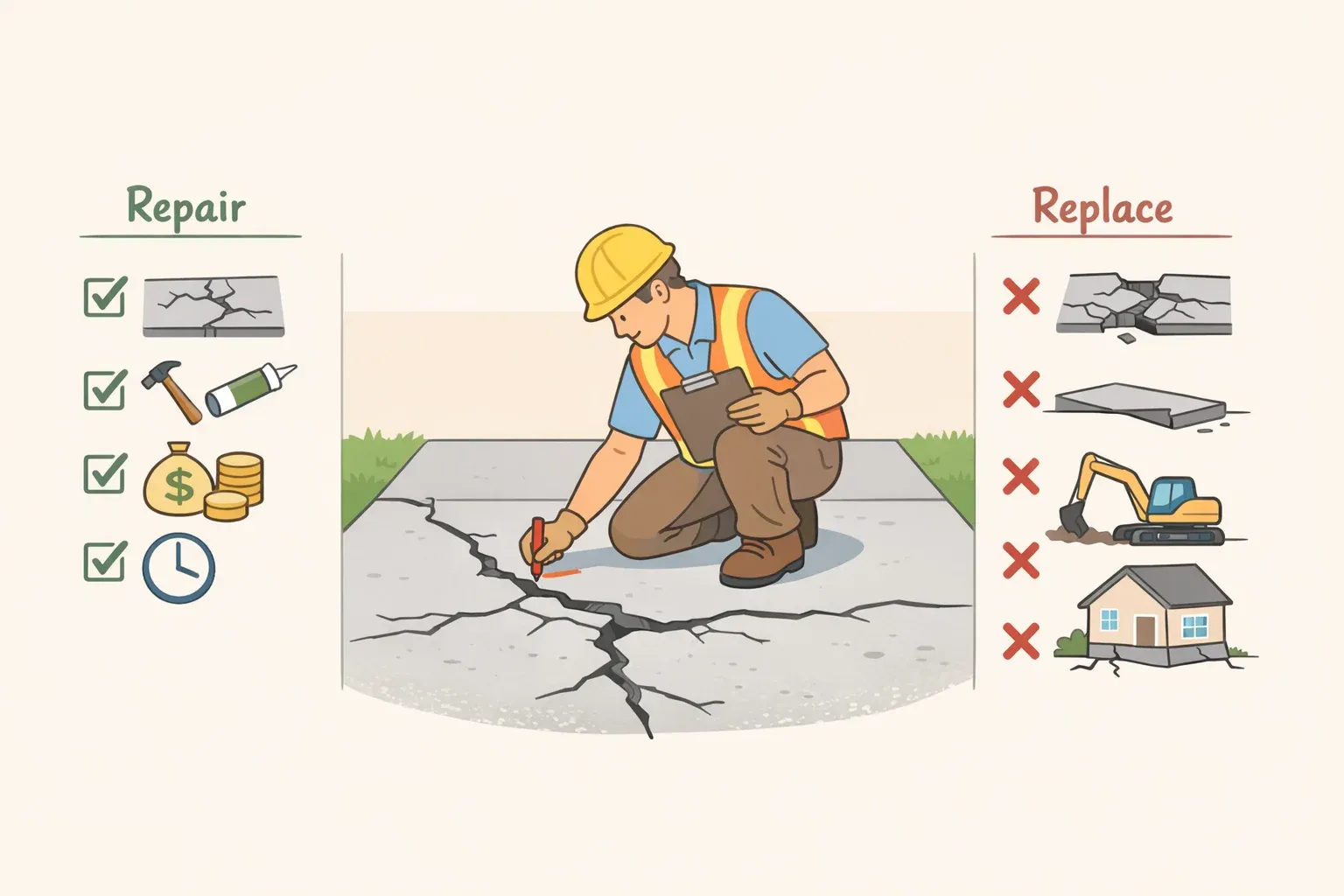
Most homeowners treat a damaged driveway as a budget question. It isn't. It's a diagnosis question. Repair money spent on a structurally compromised slab can fail quickly, which means you may end up paying for both a repair and a replacement.
The American Concrete Institute's current concrete repair guide supports the broader principle: repair methods and materials should be selected after the concrete's condition and repair needs are understood. For a homeowner, that means the first question is not "What is the cheapest fix?" It is "What is actually causing the damage?"
Many well-installed concrete driveways can last several decades, but climate, drainage, soil movement, deicing salts, installation quality, and vehicle load can shorten or extend that life. The Spruce notes that concrete driveways often remain functional for 25 to 50 years with proper construction and maintenance, but age is still only one clue. The condition of the slab matters more than the calendar.
This guide walks through a four-step diagnostic sequence: age, visible surface damage, structural warning signs, and the final repair-or-replace decision. Use it to understand what kind of problem you may have before collecting contractor quotes.
Homeowners can photograph, measure, and document visible damage, but a walkaround is not a structural diagnosis. Use this inspection to ask better contractor questions, not to confirm hidden subgrade problems on your own.
Quick driveway decision guide
As you inspect the driveway, start by matching what you see to what it might mean. Hairline cracks with level edges may point to normal aging, shrinkage, or minor movement, while one slab sitting higher or lower than the next suggests settlement, heaving, or base movement that needs a contractor's assessment. Widespread shallow flaking may be a surface problem that can be patched or resurfaced, but white mineral deposits, peeling coatings, or damp-looking spots after dry weather can point to moisture trouble.
If you see those signs, ask how the contractor will check for moisture before resurfacing. Many cracks running across several sections are more concerning because they may point to structural or base failure, which could require replacement, partial replacement, or leveling.
Step 1: Start with age
Age does not make the final decision, but it tells you how much useful life may remain in the existing slab. That changes the math for every option that follows.
A driveway under 10 to 15 years old with isolated damage is often a strong repair candidate, especially if the slab is level, drains well, and shows no signs of active movement. There may still be meaningful service life left, but age should never override the actual damage pattern.
A driveway past 20 years deserves closer scrutiny if it has several problems at once, such as widening cracks, settled panels, deep spalling, or drainage issues. Major repair work may deliver fewer useful years on an older slab than the same repair would on a younger one.
A 22-year-old driveway with one hairline crack is a different conversation than a 22-year-old driveway with three shifting panels and spalling across much of the surface. The number tells you where you are in the slab's lifecycle. The damage pattern tells you what is happening to it.
If you plan to sell soon, the best choice may be the one that safely solves the visible problem rather than the one that maximizes long-term service life. Repair or resurfacing can make sense if the slab is structurally sound. Replacement is more disruptive: it requires demolition, a curing period, and new concrete. It is the right call when the slab warrants it, not the default.
Step 2: Inspect the surface
A surface inspection helps you separate problems that may be repairable from warning signs that need a contractor's diagnosis. Walk the full driveway slowly. Look from several angles. Take photos, measure cracks, and note whether damage is isolated or spread across several panels.
Crack width and pattern
Measure the widest cracks and note whether the edges are level. Wider cracks, vertical displacement, or spiderweb/map-cracking patterns are warning signs that the slab may be moving or failing below the surface. Do not approve an overlay until a contractor explains the cause.
Hairline cracks with level edges are often manageable. Cracks with one side higher than the other are more concerning because they suggest movement between sections.
Surface spalling and staining
Shallow spalling on an otherwise sound slab may be patchable or resurfaced, but deep or widespread spalling is a stronger replacement warning sign. Staining and discoloration are usually cosmetic and may respond to cleaning, pressure washing, or sealing.
If the surface is flaking in many areas, ask whether the damage is only at the surface or whether the slab itself is deteriorating.
The tap yest
Knock gently with a hammer handle, or drag a length of chain across the surface. A hollow or dull sound can flag possible delamination or voids, but this is only a screening step. A contractor should confirm what is happening below the slab before you choose a repair.
Settlement and heaving
Check whether one slab section sits higher or lower than the next. Even a small vertical offset can become a trip hazard. If one section is noticeably raised, sunken, or tilted, treat it as a contractor-assessment issue rather than a surface-repair issue.
Settlement and heaving cannot be fixed by a surface treatment alone. An overlay or patch applied over a moving slab is likely to crack again because the underlying movement has not been corrected.
Step 3: Look for structural warning signs
Many serious driveway problems start below the slab. Poor compaction, clay soil movement, drainage problems, tree roots, or an inadequate base can all cause concrete to crack, settle, or heave. That is why a surface repair may fail even when the concrete mix itself was not the main problem.
For homeowners, the practical takeaway is simple: if the slab is moving, sinking, or repeatedly cracking in the same area, the base and drainage need to be evaluated before anyone patches the surface.
Check for downspouts dumping beside the driveway, water pooling near the garage, soil washing out along slab edges, or a slope that sends water under the concrete. These clues matter because drainage problems can make a surface repair fail again.
Moisture can also interfere with overlays and coatings. White mineral deposits, bubbling or peeling coatings, or damp-looking spots after dry weather can be warning signs, but they do not prove the cause by themselves. Ask the contractor how they will check for moisture before recommending an overlay.
Visible red flags that warrant a contractor assessment include:
Sections that have dropped, heaved, or shifted
Cracks with vertical displacement between adjacent panels
Widespread spiderweb or map-cracking patterns
White mineral deposits, peeling coatings, or persistent damp-looking areas
Water pooling near slab edges or flowing toward the garage
If a contractor confirms an active subgrade or drainage problem, patching or resurfacing alone will not solve it. The durable fix may require drainage correction, slab leveling, partial slab replacement, or full replacement, depending on how widespread the problem is.
Step 4: Choose repair, resurfacing, or replacement
The diagnostic sequence above should lead to one of three main paths. None is automatically cheaper or better. They solve different problems.
Repair
Repair may make sense when damage is isolated, the slab is level, drainage is not pushing water under the concrete, and no structural red flags appeared during inspection. Age matters, but it should not override the condition of the slab.
For example, a 12-year-old driveway with two narrow cracks near the apron, no panel shifting, and no drainage problem may only need crack filler and sealant. Even then, address water pooling at the base of the driveway. A simple repair will not last if water keeps working under the slab edge.
Resurface or overlay
Resurfacing may make sense when the slab is structurally sound but cosmetically rough, stained, or shallowly deteriorated across a wider area. A properly bonded overlay can be more than a cosmetic cover, but only if the existing slab is stable, dry enough for the product being used, and properly prepared.
An overlay is risky if the slab is moving, if moisture is coming through the concrete, or if the contractor plans to skip surface preparation. If moisture is suspected, ask what test or product-specific check the contractor uses before recommending an overlay.
A realistic resurfacing candidate might be a 16-year-old slab that is stained and rough across much of the surface but has no settlement, no vertical displacement, and no signs of moisture trouble.
Partial replacement or leveling
Partial slab replacement or leveling may be an option when only one section has settled and the rest of the driveway is sound. That is a contractor-level call, but it is worth asking about before assuming the only choices are patching or full replacement.
Leveling can sometimes help when a slab section has settled but is not badly cracked. Partial replacement can make sense when one damaged panel is the clear problem. Neither option solves widespread base failure.
Replace
Replacement becomes more likely when the slab shows active settlement or heaving, cracks have vertical displacement, map-cracking is widespread, moisture is compromising the surface system, or multiple problems suggest the base is failing.
Better Homes & Gardens warns against "capping", or pouring new concrete over old concrete or asphalt, because unresolved cracks or frost heaves can carry over into the new surface
A 24-year-old slab with widespread spalling, one panel settled below its neighbor, and white mineral deposits along the low edge is a replacement-level problem unless a contractor can isolate it to one repairable panel. An overlay would be risky because it would not correct the settlement, drainage, or base conditions driving the movement.
How to think about repair vs. replacement costs
Contractor quotes only make sense after you know what problem the quote is solving.
Repair is cheaper upfront, but only if the slab is fundamentally sound. When damage is isolated, the cause is surface-level, and the slab has useful life remaining, a targeted repair can be real value. When those conditions do not hold, the lower invoice may only delay a larger expense.
Replacement becomes more economical when repairs are extensive or structural problems are present. At that point, the better comparison is not repair invoice versus replacement invoice. It is cost per year of usable life.
Resurfacing sits between repair and replacement when the existing slab is sound. Done on the wrong slab, it can fail early and leave you paying for both overlay removal and replacement.
Before you hire a contractor
Start with structural diagnosis, then weigh lifespan and cost in that order. Age sets the context. Damage spread tells you whether patching is targeted or extensive. Slab stability tells you whether any surface treatment can hold at all.
Execution quality matters. A useful proposal should do more than name a price; it should explain the likely cause of the damage, how the surface or base will be prepared, what drainage issues need correction, and what conditions could cause the repair to fail.
Before work begins, ask:
What is causing this damage?
Is the problem surface-level, structural, or drainage-related?
How will you prepare the surface or base before repair, resurfacing, or replacement?
What problems would make this repair fail early?
Is partial slab replacement or leveling an option if only one section has settled?
For replacement quotes, does the scope include base preparation and drainage correction, or only slab removal and a new pour?
Also photograph cracks, spalling, low spots, and vertical offsets before the contractor arrives. Bring measurements to the conversation so you can compare proposals more clearly.
The most expensive outcome is not choosing repair or replacement. It is paying for the wrong one first. Walk the whole slab before comparing quotes: diagnosis first, budget second. A contractor who gives a price before looking at the damage pattern, drainage, and slab movement has not finished the assessment.










Comments
Be the first, drop a comment!