



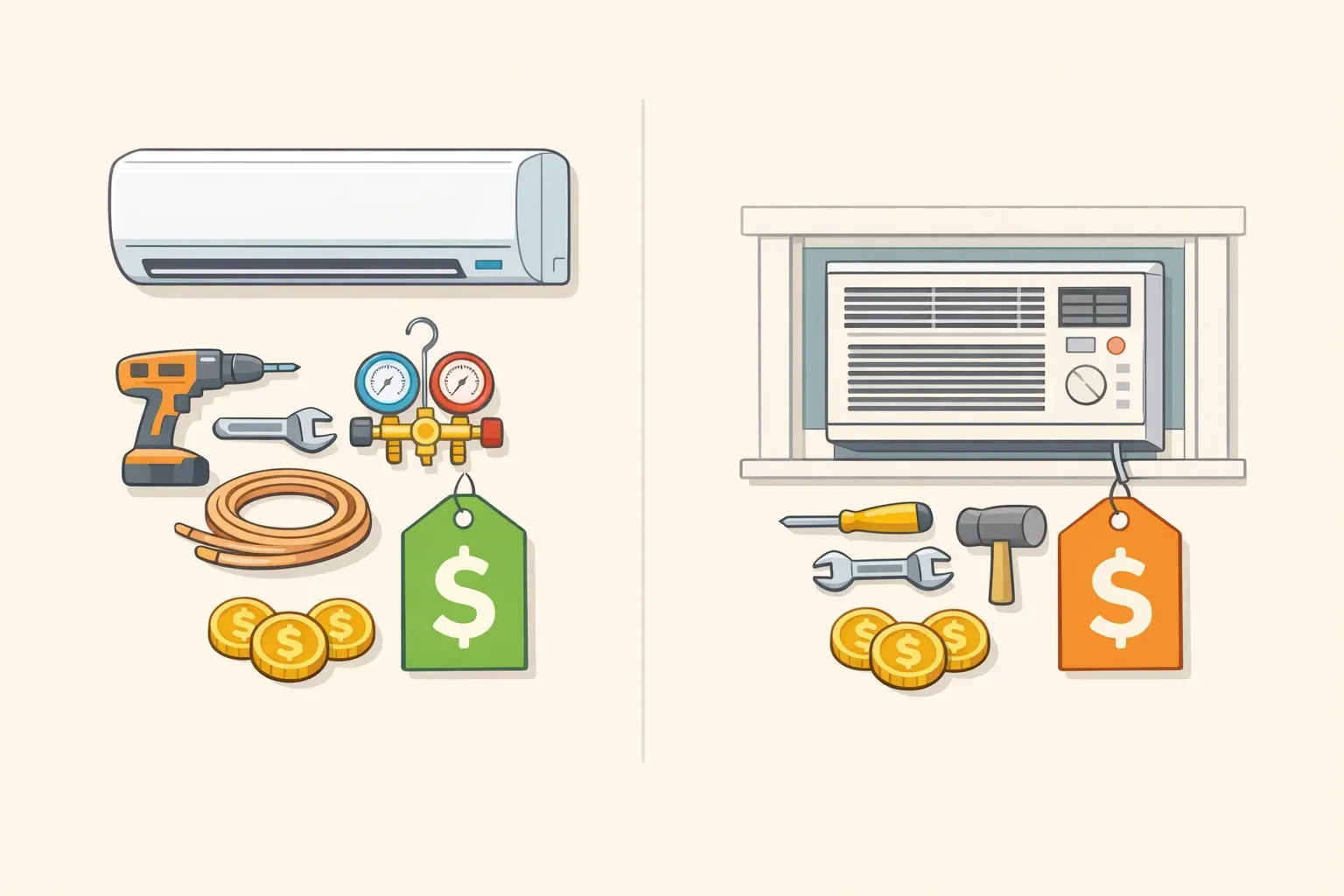
Window AC vs mini split is one of those decisions that looks straightforward until you start pricing it out. On nearly every technical measure — efficiency, noise, lifespan, operating cost — mini splits come out ahead. The question worth asking is why the window unit still makes sense for a lot of buyers. The answer has almost nothing to do with performance.
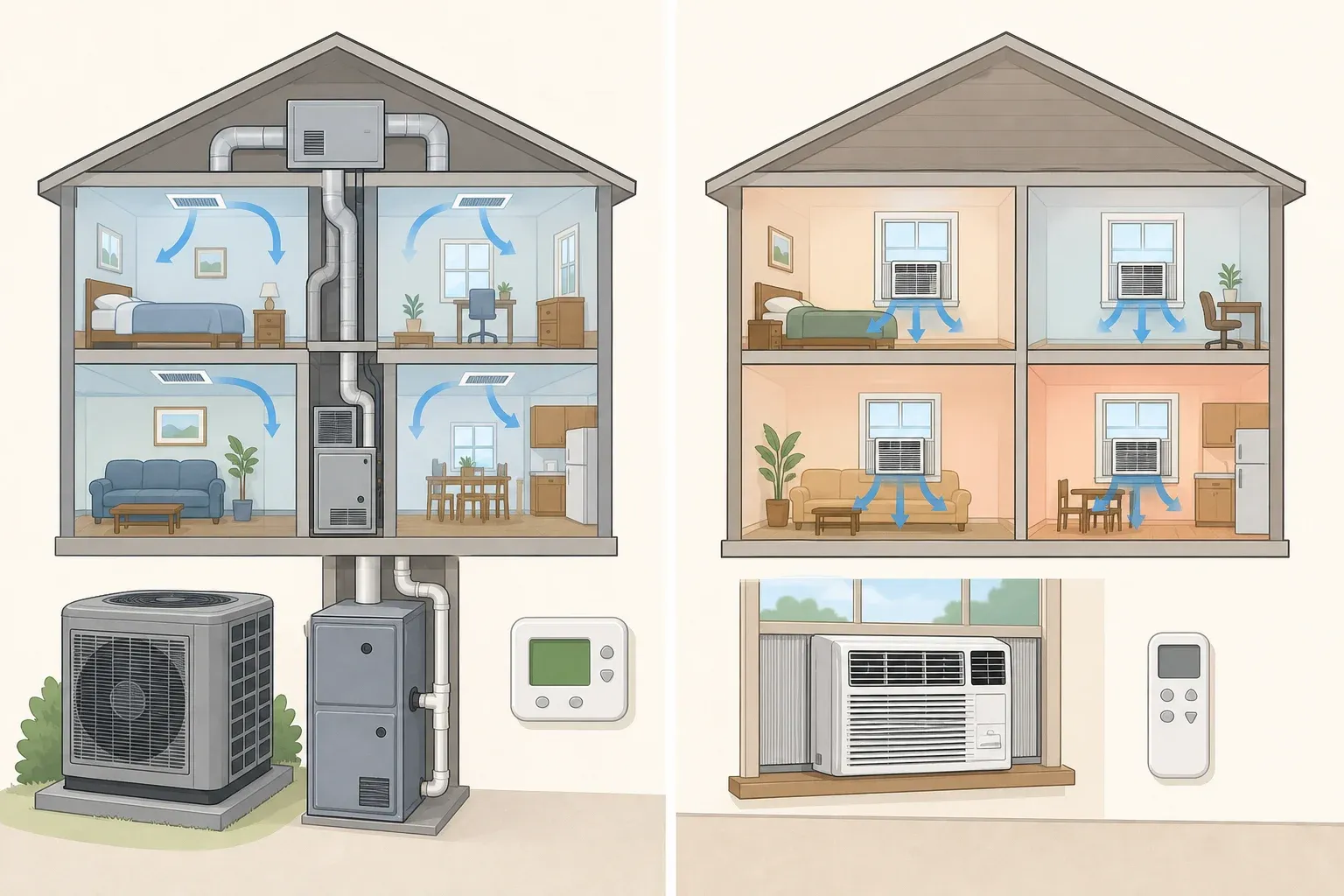
A window AC is a self-contained unit that sits in a window frame and plugs into a standard household outlet. A mini split (also called a ductless mini split) separates into two components: a wall-mounted indoor air handler and an outdoor compressor, connected by refrigerant lines through a small hole in the wall. One is plug-and-play; the other is a minor construction project.
That distinction shapes everything. The choice hinges less on which system performs better and more on whether your home, budget, and situation can actually support the better-performing option. With the national average residential electricity rate at 18.05 cents per kWh as of April 2026, up 5.4% year over year per Filterbuy, the efficiency gap between these two systems now translates to meaningfully more money over a full cooling season than it did even a few years ago.
This article focuses on summer cooling. Mini splits also function as heat pumps, and that heating-mode case is legitimate, but it deserves its own treatment. Heating capability gets a mention where it affects upfront cost math, nothing more.
Window unit vs mini split cost: upfront price, monthly bills, and who benefits from which math
Start with the money.
Window units typically run $150–$700 depending on size and brand. Most people can install one without professional help in 15–30 minutes, per Filterbuy. There may be delivery costs or mounting hardware depending on the unit, but there's no installation crew and no electrician. A mini split runs $2,000–$10,000 installed, depending on the number of zones, equipment brand, and local labor rates, a range wide enough to be nearly useless without an actual quote.
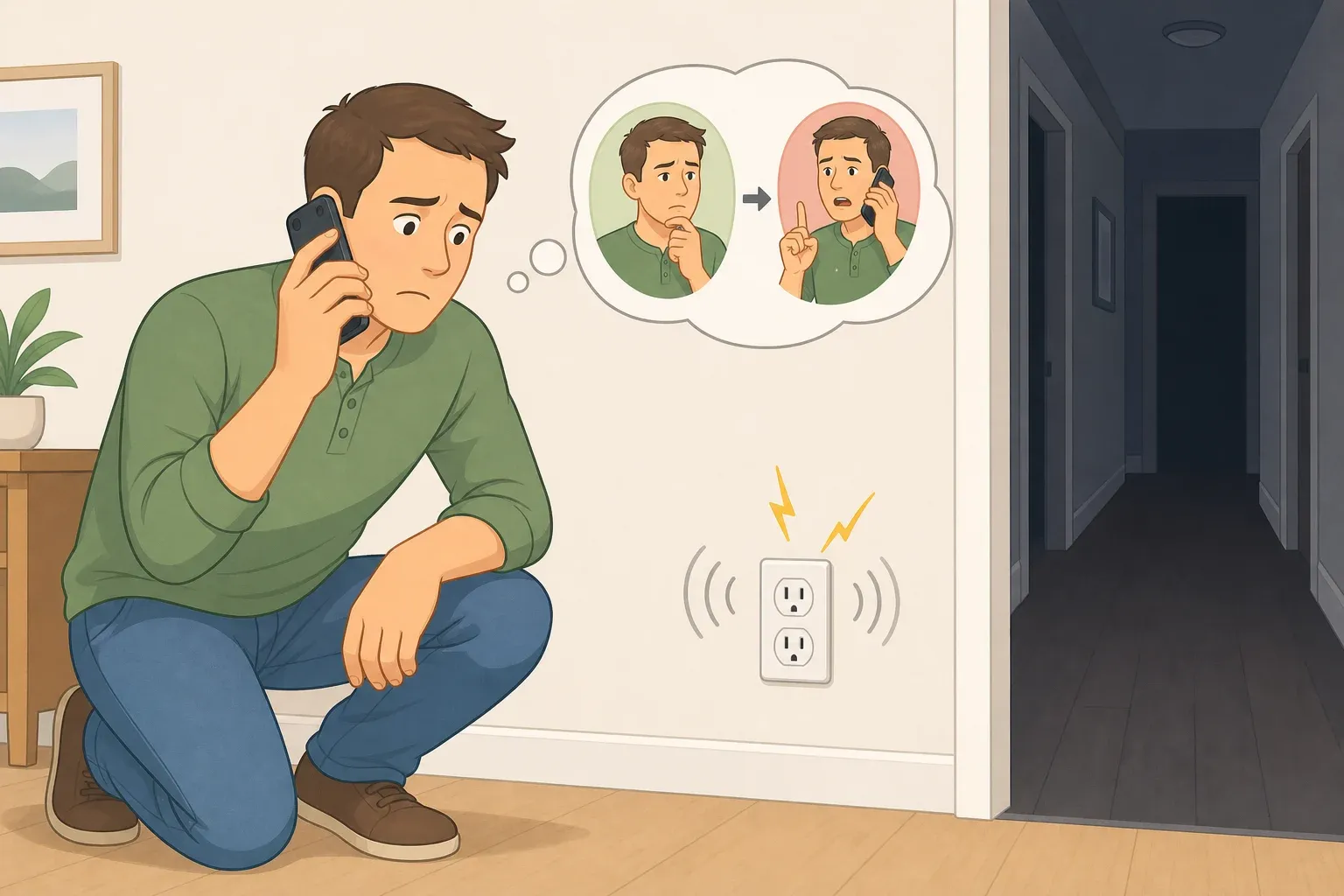
The real wildcard is electrical. Mini splits require a dedicated 208–240V circuit drawing 15–40 amps, depending on system size. If your panel doesn't have capacity, a project quoted at $5,000 can reach $7,500 before the first cool air moves through the room. A full panel replacement adds another $1,500–$3,500 on top. Get an electrician's assessment before buying the equipment, that single step prevents the most common costly surprise.
Utility, state, and local rebate programs can reduce mini split upfront costs, but verify current federal tax-credit availability separately before budgeting for it. Before treating $2,000–$10,000 as the final number, check the ENERGY STAR rebate finder and your utility's incentive programs. The net cost can look quite different.
On monthly operating costs, the gap is real. A 12,000 BTU mini split running 8 hours daily costs approximately $26/month at current national average rates. The equivalent window unit runs roughly $43–$52/month for the same output, a monthly difference of $17–$26, per Filterbuy.
For a data point on the better end of the window unit market: in independent lab testing late last year, an 8,000 BTU Energy Star-certified window unit with inverter technology consumed 0.67 kWh per hour on its highest setting, projecting to roughly $122 for a full summer of 12-hour daily use, per TechGearLab. That's a well-performing window unit, not a typical one.
Who benefits from which math depends on the situation:
Renters and short-term occupants: A $300 window unit that runs $45/month wins on every budget line against a $5,000 mini split. No contest.
Long-term homeowners with panel capacity: The monthly savings from a mini split accumulate over a 15–20 year lifespan, roughly two to three times the functional life of a window unit, per Filterbuy. The payback case is plausible, especially with incentives. No formal multi-year cost model including maintenance and repairs exists in the available data, so treat any specific payback timeline with appropriate skepticism.
Homeowners who discover a panel upgrade is needed: A $1,500–$3,500 panel replacement changes the math considerably and may tip the decision back toward a high-efficiency window unit.
How to read the efficiency numbers and where the real gap comes from
Mini splits are rated using SEER (Seasonal Energy Efficiency Ratio), which measures average performance across a full range of outdoor temperatures over a cooling season. Window ACs use CEER (Combined Energy Efficiency Ratio), which captures both active cooling efficiency and standby power draw. These metrics are calculated differently and are not directly interchangeable.
Comparing a mini split's SEER to a window unit's CEER is roughly like comparing a car's highway fuel economy to a truck's city rating — directionally informative, but not a clean apples-to-apples comparison. The monthly operating costs shown above are more reliable and evidence-based.
Mini splits typically carry SEER ratings of 17–25+, versus 8–15 for window units, per Filterbuy. The underlying mechanism is inverter technology: rather than cycling fully on and off, a mini split's compressor modulates speed continuously to hold the set temperature, consuming only as much power as conditions require.
Mini splits can use 30–50% less electricity than comparable window units because of this. Every SEER2 point above 16 cuts operating cost by roughly 5–8%, and a 22 SEER2 unit typically runs 20–25% cheaper than a 16 SEER2 unit across a full cooling season.
That said, comparing mini-splits to the window ACs of a decade ago is an unfair fight. The top-rated Midea Smart MAW08HV1CWT tested independently in late 2025 earned Energy Star certification, carries a CEER of 14.5, includes its own inverter, and dropped a test room's temperature by 10.9°F in one hour, outperforming most 8,000 BTU window units in the same test category, per TechGearLab.
The efficiency lead still belongs to mini splits, but the gap with premium window units has narrowed. If you're buying a window unit, buy a current Energy Star-certified model, not whatever is cheapest on the shelf. The difference between a basic window AC and a top-tier one is real.
Installation: the barrier that decides most cases
For window ACs, installation is genuinely simple. Slide the unit into the frame, secure the side panels, and plug it into a standard outlet. Most installations take 15–30 minutes and require no prior experience. For renters or anyone who may move within a few years, portability is a real advantage. Window units come with you when you leave. Mini splits stay with the building. Building rules can still apply to window units in some settings, particularly in condos or buildings with specific window policies, so it's worth checking before assuming a clean path.
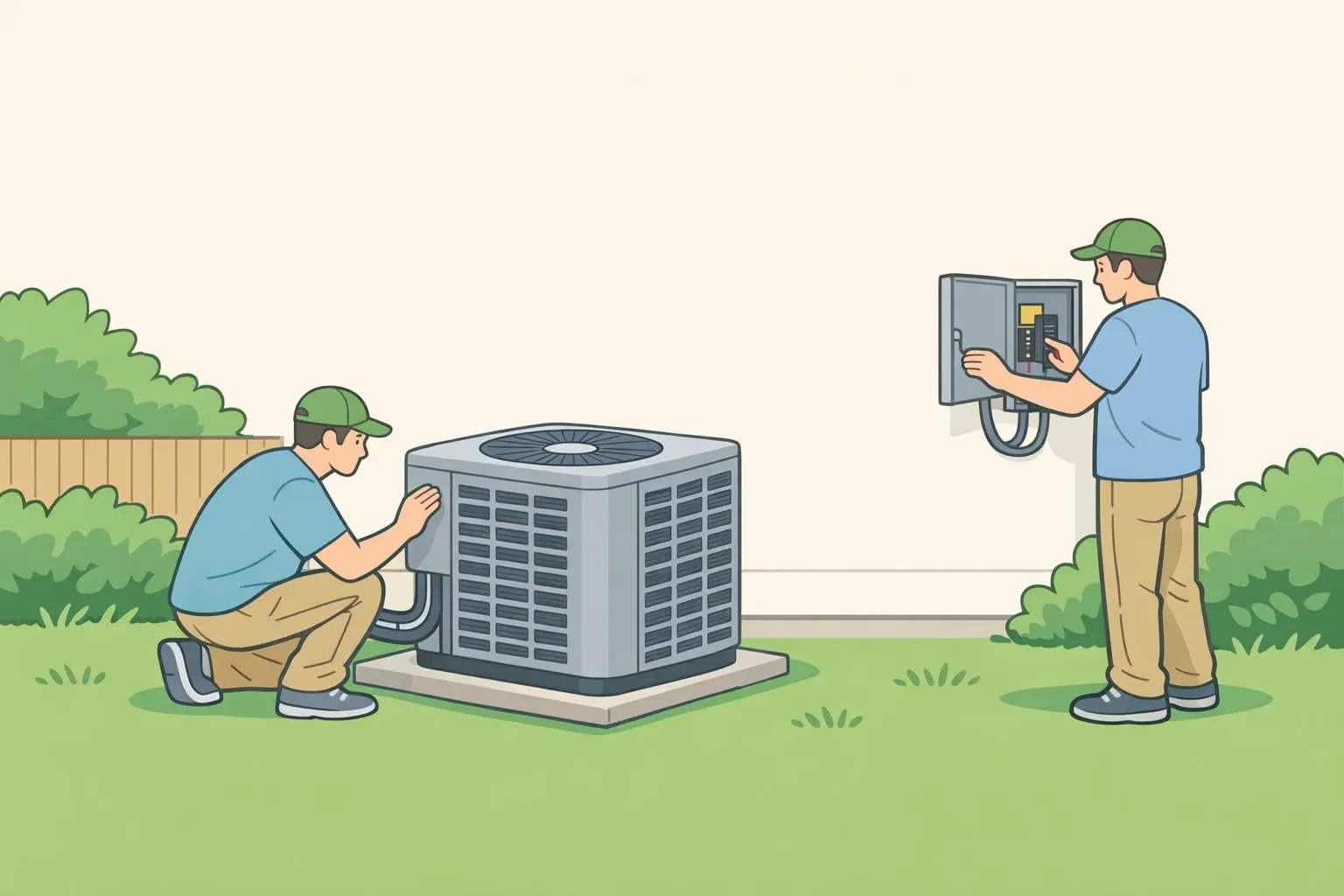
Mini split installation is a different category of project. It requires mounting the indoor air handler, positioning and securing the outdoor compressor, drilling a wall penetration for refrigerant lines and electrical wiring, and having a licensed HVAC technician connect and charge the refrigerant system. Refrigerant handling requires EPA certification. DIY is not a safe or legal option.
The electrical requirements are specific: a dedicated 208–240V circuit that cannot be shared with other devices. Smaller units (9,000–12,000 BTU) typically require 15–20 amps; larger systems need 30–40 amps, per Cascadia Comfort. The National Electrical Code allows panels to be loaded to 80% of their main breaker capacity for continuous loads. A 100-amp panel has 80 usable amps, and an already-loaded panel may not have room. Wiring runs of 25–50 feet add $200–$400 in materials; runs from 50–100 feet add $400–$800.
Renters, condo owners, and HOA members face another layer on top of all that. Exterior equipment, wall penetrations, and new electrical circuits may all require approval from a landlord, building manager, or HOA board. People often like mini splits in theory, then discover the actual blocker is permission, placement, or the fact that a "simple" install is only simple if the building agrees with you. Many buyers discover this friction after they've already ordered the equipment.
One practical difference that doesn't show up in spec sheets: window units fail forgivingly. A window AC that dies mid-summer can often be replaced quickly and at modest cost from a hardware store. A mini split with a refrigerant leak or a failed compressor requires a licensed technician and parts that may not be immediately available. A less-dramatic failure mode is part of why window units remain popular. For buyers without a reliable HVAC service relationship, that risk asymmetry is worth factoring in.
Noise, lifespan, and the smart-feature gap
These are tiebreakers, not the primary decision drivers, but they matter in the right situations.
On noise, the gap is structural. Mini splits operate at approximately 19–30 decibels indoors. Window units typically run at 50–65 decibels, similar to a normal conversation, per Filterbuy. The reason is that a window unit's compressor, fan motor, and vibration all occupy the same box, a few feet from where you're sleeping or working. Even the top-performing Midea Smart MAW08HV1CWT measured 50.5 dBA on high in independent testing, still well above what a mini split achieves. For a bedroom, nursery, or home office, that 20-decibel difference is audible every night.
On lifespan, mini splits typically last 15–20 years with proper maintenance; window units average 8–10 years, per Filterbuy. A long-term homeowner could replace two or three window units over the same period; one mini split runs a factor that belongs in any honest ownership cost comparison. Maintenance matters more than most buyers expect: a neglected filter alone can cut a mini split's operating efficiency by up to 30%. Cleaning filters every 2–4 weeks during heavy-use months is the highest-return maintenance task for either system.
On smart features, the gap has largely closed at the premium end of both markets. Modern mini splits offer Wi-Fi control, smart thermostat integration, zone scheduling, and inverter-based temperature stability. Current top-tier window units, including the Energy Star-certified Midea tested in late 2025, also include Wi-Fi, app control, sleep modes, and inverter technology, per TechGearLab and Daily Genius. Smart features alone are no longer a decisive differentiator.
Which system is right for your situation
Choose a window AC if you rent or may move soon, need cooling quickly, want the smallest financial and installation commitment, or face building constraints that make exterior equipment or wall penetrations difficult to approve.
Choose a mini split if you own the space, can confirm your electrical panel has capacity before buying equipment, plan to stay long enough for the efficiency savings to accumulate, and value quieter long-term comfort over installation simplicity.
If you're genuinely split, there's a practical tie-breaker: lean toward the window unit when the main uncertainty is about the building, and toward the mini split when the main uncertainty is about budget.
Before buying either system, work through this checklist:
Measure the room in square feet and confirm the BTU rating you need. An oversized unit cools fast but dehumidifies poorly, leaving a room cold and clammy, per DOE guidance cited by Daily Genius
For mini splits: get an electrician's panel assessment before ordering equipment
For mini splits: confirm HOA, landlord, or building approval for exterior equipment and wall penetrations
For mini splits: get at least two installation quotes and verify exactly what "electrical work included" covers; basic circuit installation is not the same as a panel upgrade, per Cascadia Comfort
For window units: verify your window dimensions accommodate the unit
Estimate how many years you expect to stay — this determines whether the efficiency payback math works in your favor
Check ENERGY STAR's rebate finder and your utility's incentive programs before finalizing your mini split budget
The efficiency case for mini splits will only strengthen as electricity rates keep climbing. For anyone doing renovation work, adding a dedicated circuit while walls are already open costs far less than coming back to do it later. The question isn't whether mini-splits are worth it in the abstract; on the numbers, they usually are. The question is whether they're worth it given your specific building, budget, and timeline.











Comments
Be the first, drop a comment!