



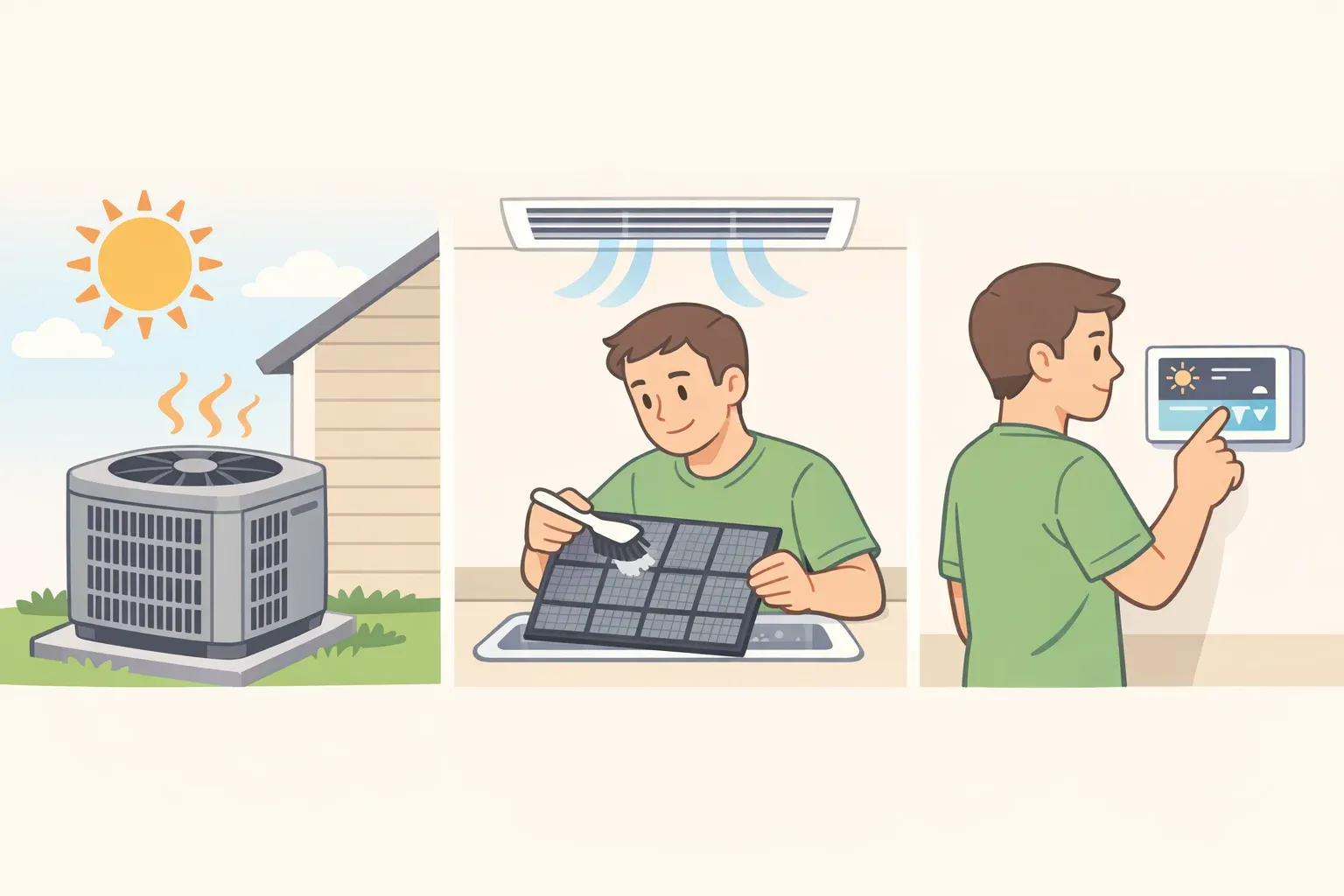
How to Keep Your AC Running During a Heat Wave: 5 Tips
Heat-wave AC failures almost always trace back to three things: restricted airflow, too much heat entering the home, and operating habits that push the system past its limits. This guide walks through five specific actions that address each one. If the system is struggling right now, start with the filter.
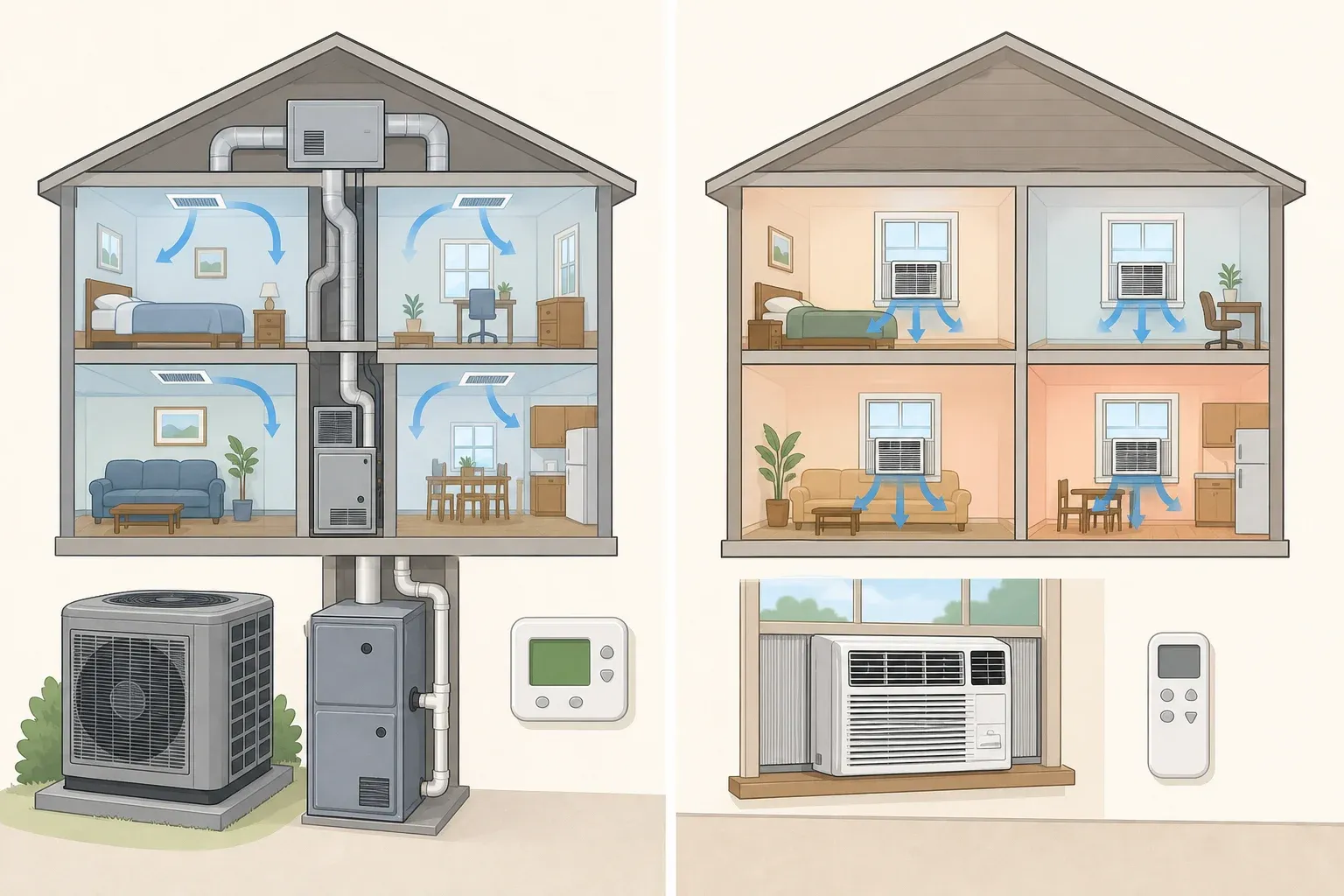
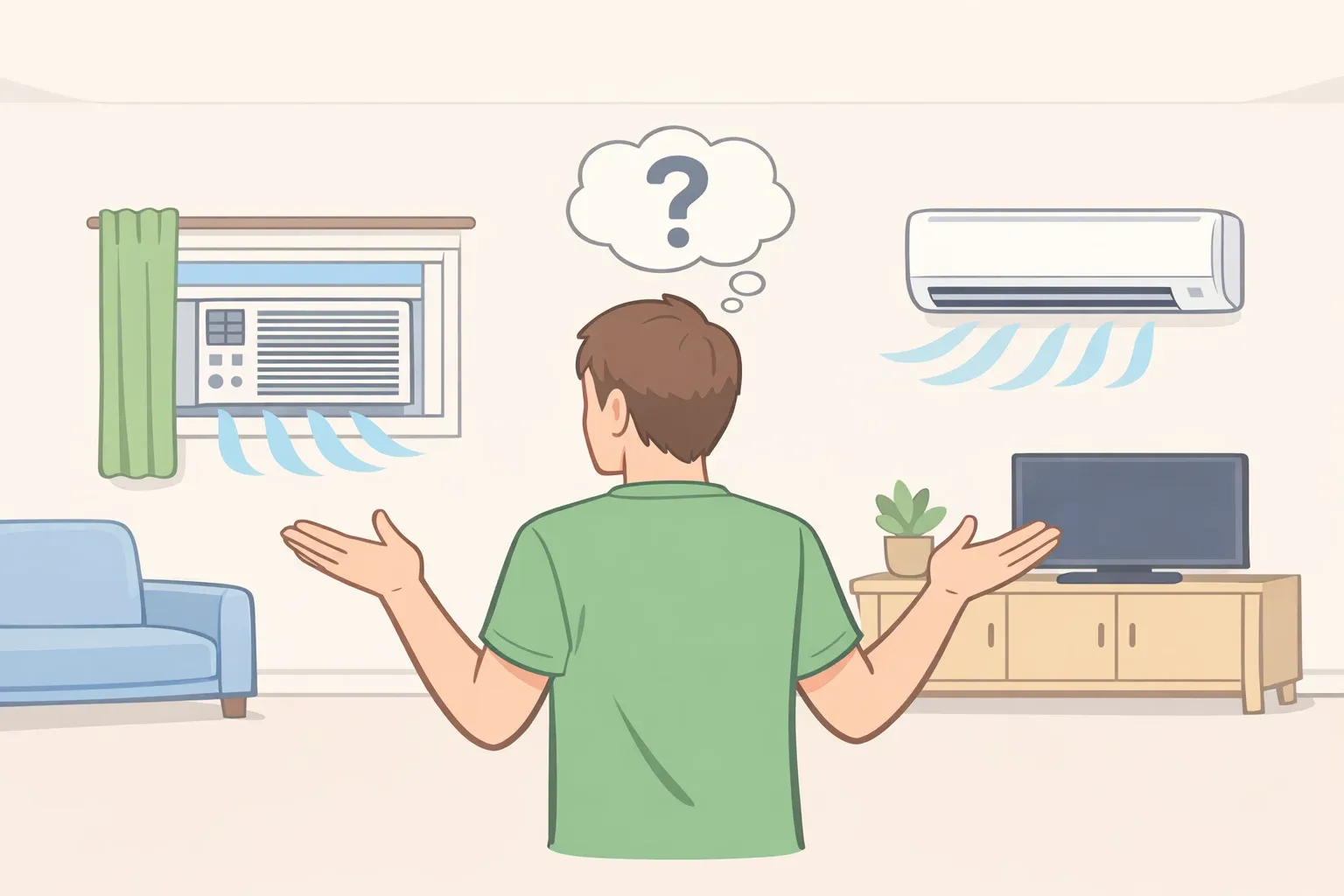
Scope: These tips apply primarily to central air systems, with window-unit adaptations noted where the guidance differs. Tip 5 (outdoor unit and professional maintenance) applies to central air only.
If you're in an active heat wave: Tips 1, 2, and 3 can be done today. Tips 4 and 5 include both immediate actions and longer-range prep, labeled clearly.
Why this matters beyond comfort
Extreme humid heat events have stopped being rare. On June 24, 2025, the PJM Interconnection, serving 65 million people across 13 states, hit nearly 161 GW of peak demand, its highest since 2011. That spike, fueled by air conditioner use during the heat surge, came dangerously close to exceeding system capacity, RMI reported last July. Utilities from Texas to North Carolina have been issuing conservation warnings as localized outages grow more frequent.
More than 700 Americans die from extreme heat every year, according to CDC figures cited by Consumer Reports (updated July 2025). An AC that fails under those conditions is not an inconvenience. It's a health risk.
One thing worth understanding before the steps: an AC doesn't create cold, it moves heat out of your home. The more heat inside, the harder the system works. Give it less to fight, and it's far less likely to fail.
Why AC units fail during heat waves
Your AC draws warm indoor air across a cold evaporator coil, extracts heat and humidity, then exhausts that heat outside through the condenser unit. When the indoor heat and humidity load is high, the system runs almost continuously, and continuous operation under strain accelerates failure. According to ENERGY STAR (2024), dirt and neglect are the leading causes of HVAC inefficiency and early failure, not age or bad luck.
One failure mode worth knowing: a frozen coil. When airflow through the system is restricted, most often by a clogged filter, the evaporator coil gets too cold, moisture freezes on it, and the resulting ice blocks heat transfer entirely. The AC runs but produces no cool air, as HVAC.com explains (2023). Fixable, but it costs hours of cooling time in the middle of a heat wave.
Humidity compounds every problem. Most standard AC systems are better at lowering air temperature than removing moisture, which leads people to crank the thermostat lower just to feel comfortable, adding load to an already-stressed system, per RMI (last July). Reducing indoor humidity sources at the source directly lightens that burden.
Air conditioner maintenance tips for hot weather: start with airflow
Tip 1: Check your air filter and replace it if there's any doubt
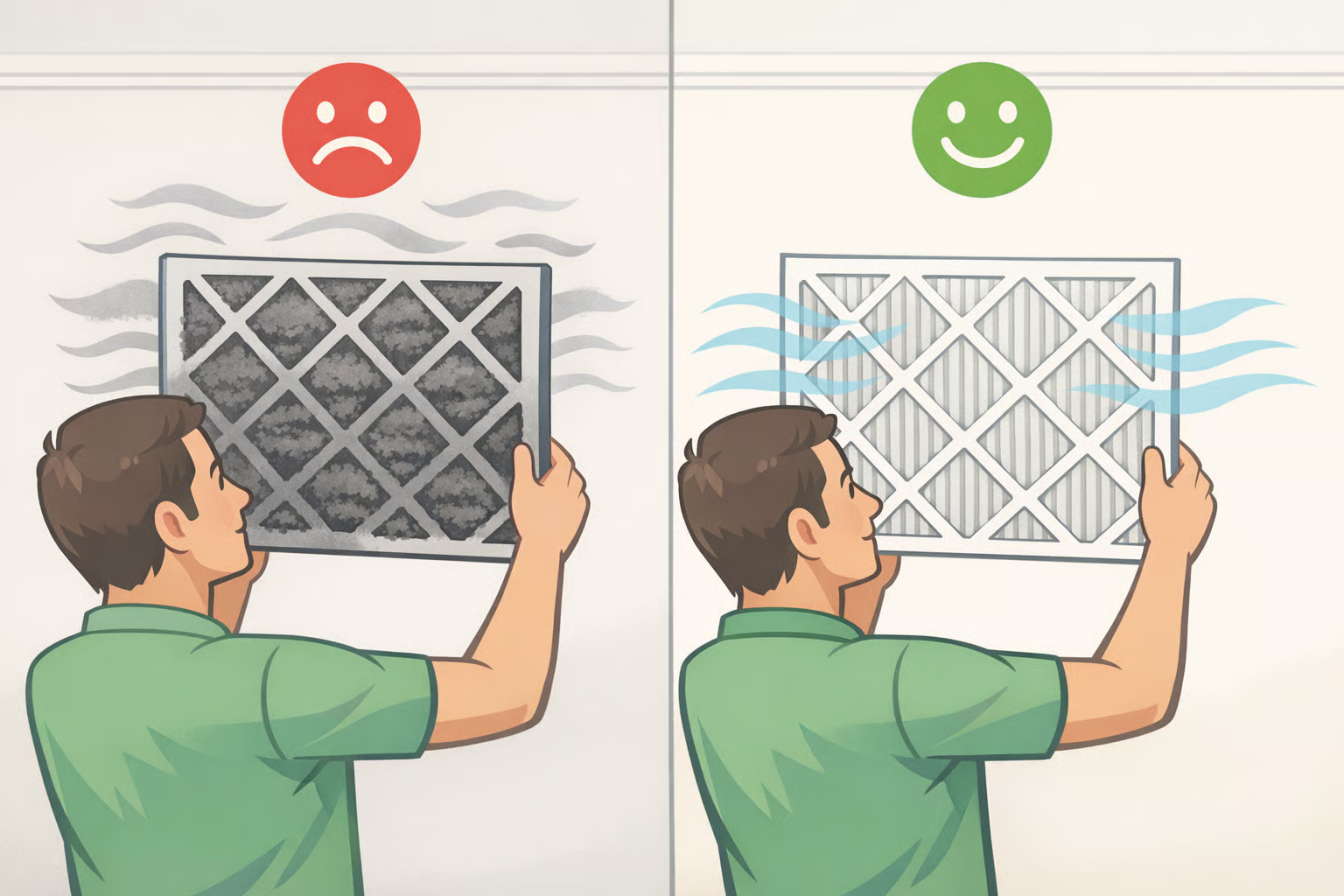
Do this today. This is the single highest-impact maintenance action a homeowner can take, and the most commonly neglected.
A clogged filter restricts airflow through the system. Less airflow means the evaporator coil gets too cold, which leads directly to freeze-up and no cool air during the worst possible conditions. ENERGY STAR (2024) links dirty filters to both higher energy use and early equipment failure. HVAC.com (2023) identifies a clogged filter as one of the most common causes of frozen coils specifically.
Most disposable filters last one to three months, but during heavy summer use, check monthly. Thicker filters (4–5 inches) can last up to 12 months; follow manufacturer specifications, per Consumer Reports (October 2023).
Step 1: Locate your filter, typically in the return air vent, air handler, or furnace. Pull it out and hold it up to a light source.
Step 2: If it's visibly gray or matted, or you can't see light through it easily, replace it now. If it looks clean, reinsert it and check again in 30 days.
Step 3: Confirm that all supply and return vents in the home are open and unobstructed by furniture or drapes. Blocked vents restrict airflow in exactly the same way a clogged filter does.
What to expect: Improved airflow, more even cooling, and shorter run cycles within a few hours of replacement.
For window units: Most window AC filters slide out from the front panel. Rinse reusable foam filters monthly under running water and let them dry completely before reinserting. A wet filter causes the same airflow problems as a clogged one.
If the system is running but producing no cool air: Check for ice or frost on the refrigerant lines or indoor unit. Switch to fan-only mode immediately. A frozen coil can take 2–24 hours to thaw. After it clears, replace the filter and restart. If it freezes again, call a technician, because the cause is likely a refrigerant issue or blower problem, not the filter (HVAC.com, 2023).
Tip 2: Set a consistent thermostat and stop cranking it down when you come home
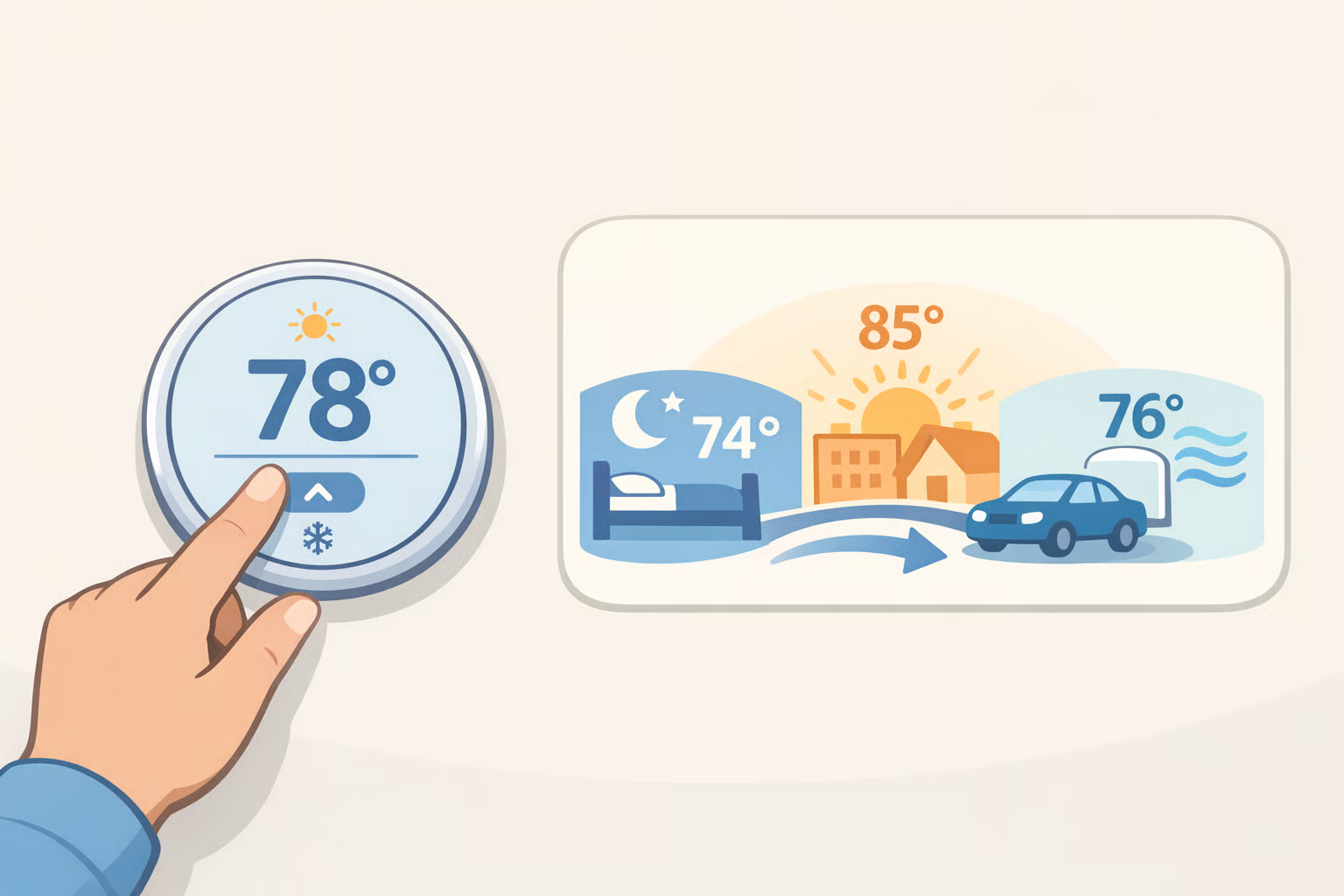
Do this today. The most persistent myth about air conditioning is that a lower setpoint cools the home faster. It doesn't.
Your AC cools at the same rate regardless of what temperature you set. A lower target just means the system runs longer to reach it. Setting it to 65°F when you get home doesn't accelerate cooling; it runs the system harder, for longer, at the moment when the grid is already most stressed. AC manufacturer Carrier addresses this directly in guidance reported by the Akron Beacon Journal (June 2025).
Each degree you raise the thermostat setting reduces cooling energy use by roughly 3%, according to DOE estimates cited by both Consumer Reports (updated June 2024) and FirstEnergy via the Akron Beacon Journal (June 2025). Less continuous operation means less cumulative strain on the system.
Step 1: Set the thermostat to 75–78°F when you're home. The Department of Energy recommends this band as the energy-efficient starting point for summer, per NPR (July 2025). That said, 78°F is a guideline, not a rule. Older adults, young children, and people with certain health conditions may need lower settings. Find the lowest setting that's genuinely comfortable, then hold it steady rather than adjusting it repeatedly.
Step 2: Raise the setpoint by 7°F when no one is home. Don't turn the system off entirely. Switching it fully off during a heat wave leaves the house heat-soaked and humid; when the system restarts into that environment, it needs much more energy and time to recover, as NPR (July 2025) and Carrier guidance via the Akron Beacon Journal (June 2025) both confirm.
Step 3: If you have a programmable or smart thermostat, schedule it to begin cooling 30–60 minutes before you return home. That gets the house to a comfortable temperature gradually rather than forcing a hard push, Scientific American reported (July 2025).
For window units: Same logic. Resist setting the unit to its coldest setting. Pick a comfortable level and hold it. Turn it up, not off, when leaving the room for extended periods.
Tip 3: How to keep AC running efficiently in extreme heat: block heat before it gets inside
Do this today. Your AC is in a constant fight against heat entering the home through three main paths: windows (solar radiation), gaps in the building envelope (air infiltration), and appliances generating heat and humidity inside.
Block solar gain through windows
Closing curtains, blinds, or blackout shades on sun-facing windows is one of the most consistently recommended low-cost steps in the research, endorsed by ENERGY STAR (2024), NPR (July 2025), and Consumer Reports (updated July 2025). Reflective or blackout coverings outperform sheer curtains substantially. Even foil-covered cardboard in a window blocks radiant heat.
Step 1: Close window coverings on east-facing windows before 10 a.m. and west-facing windows by early afternoon. South-facing windows can trap heat most of the day in summer.
Seal drafts in the building envelope
Hot outside air infiltrating through gaps around doors, windows, and utility penetrations forces the AC to condition more air than it should. Caulk and weatherstripping are a cheap fix with same-day payoff. NPR (July 2025) and ENERGY STAR (2024) both list draft sealing as a core cooling-load reduction measure.
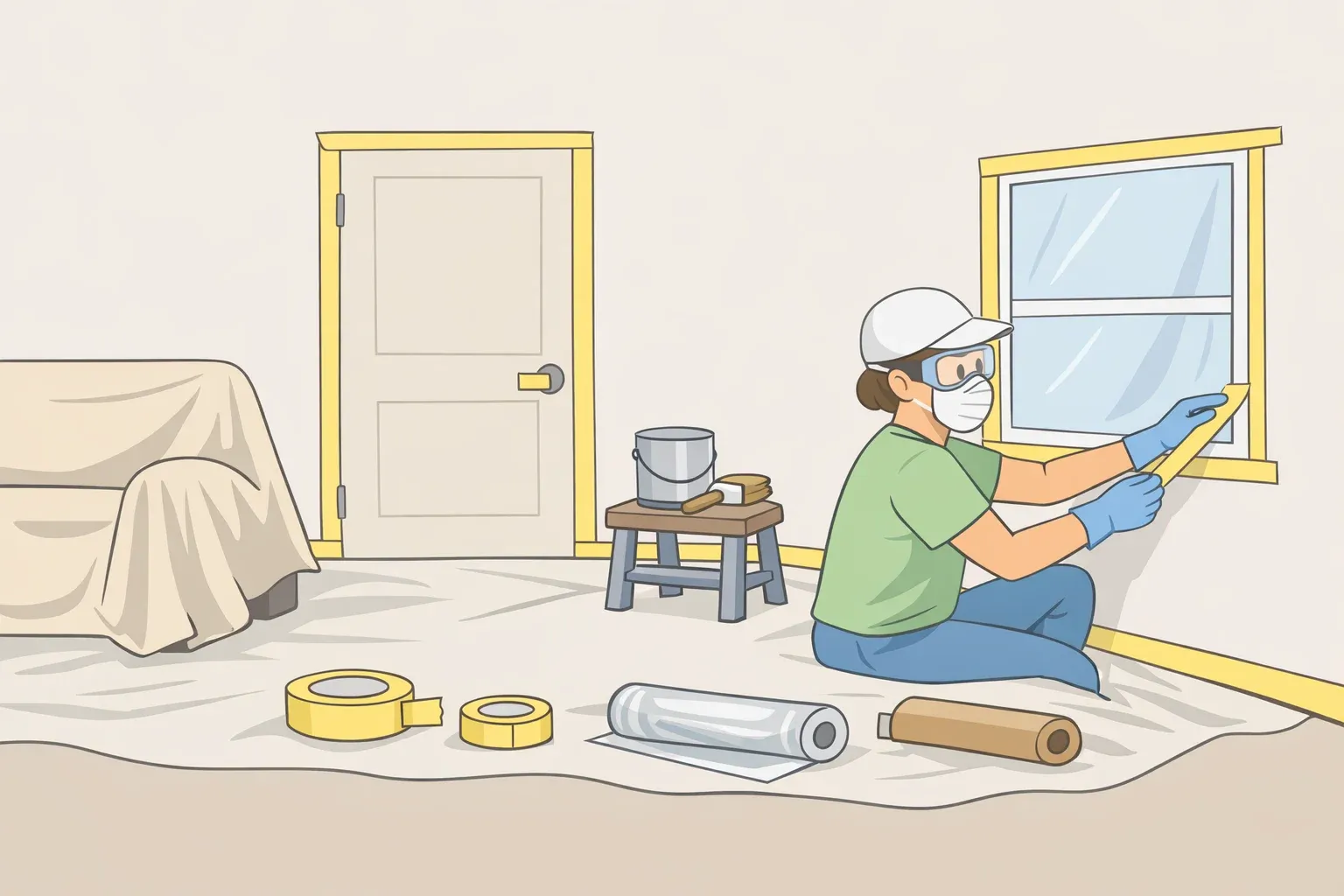
Step 2: Run your hand along the edges of exterior doors and windows. Feel for air movement. Apply weatherstripping to door bottoms and frames; use caulk for gaps around window frames and utility penetrations. Plan for about two hours of work.
Note on duct losses: In a typical house, 20–30% of conditioned air is lost through duct leaks and poor connections before it reaches living spaces, per ENERGY STAR (2024). Visible disconnected or crushed flex duct in an attic or basement is worth flagging to a technician. The system is working significantly harder than the cooling you're actually getting.
Reduce indoor heat and humidity generation
Running the oven, dishwasher, or clothes dryer during peak heat hours dumps both heat and moisture into the home. The AC has to remove both, not just lower temperature but dehumidify as well. In humid heat, this moisture load is a primary reason systems run continuously and struggle to keep up, per ENERGY STAR (2024) and Scientific American (July 2025).
Step 3: Shift oven cooking, dishwasher runs, and laundry drying to before 10 a.m. or after 8 p.m., outside the 2–7 p.m. peak heat window. Use a microwave or toaster oven if you need to heat food during the day.
On opening windows at night: Unless overnight temperatures drop reliably below 75°F, opening windows brings in warm, humid air that the system will spend hours dehumidifying the next morning, per the Akron Beacon Journal (June 2025). The benefit rarely outweighs the recovery cost.
Tip 4: Use fans strategically to let the AC work less
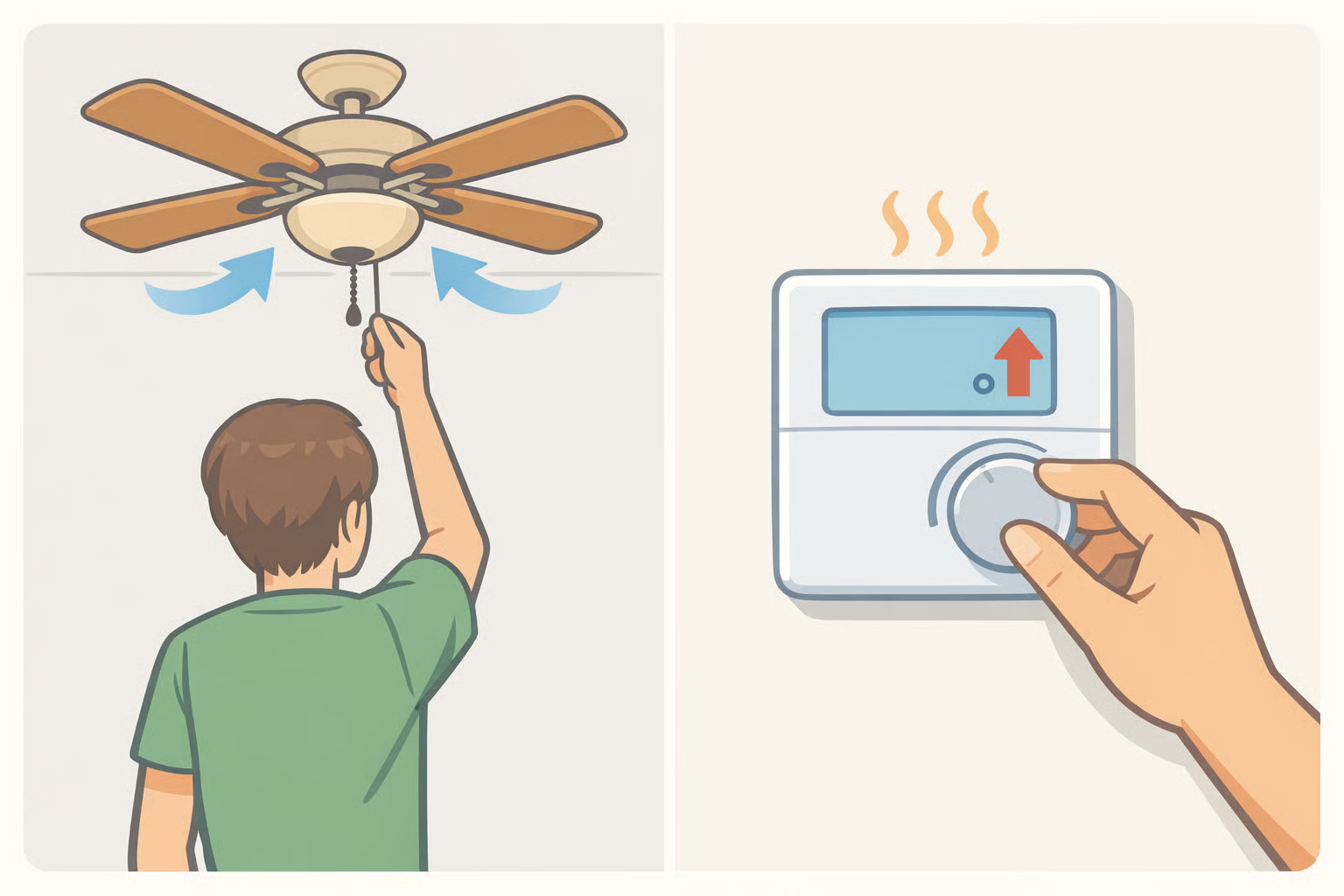
Do this today. Fans don't lower room temperature, but they make you feel cooler. That means you can tolerate a higher thermostat setting without sacrificing comfort, which is the whole mechanism here.
A ceiling fan can make a room feel up to 4°F cooler than it actually is, according to DOE data cited by Consumer Reports (updated July 2025). Cooling engineer Yunho Hwang of the University of Maryland told TIME (June 2025) that ceiling fans allow occupants to tolerate higher thermostat settings; less need to overcool means less strain on the system.
Step 1: Set ceiling fans to rotate counterclockwise in summer. This pushes air downward, maximizing the cooling effect at occupant level. Look for a small switch on the motor housing, Scientific American notes (July 2025).
Step 2: Turn fans off when you leave the room. Fans cool people through air movement, not spaces. Running one in an empty room wastes electricity and adds a small heat load, per the Akron Beacon Journal (June 2025).
Step 3: Use bathroom and kitchen exhaust fans during and after cooking or showering, and confirm they vent outside, not into the attic. These pull heat and humidity out at the source, before the AC has to deal with them, per ENERGY STAR (2024).
Window fans during extreme heat backfire: Placing fans in open windows when outdoor temperatures exceed 90°F draws hot air directly into the house, adding to the AC's load rather than reducing it, Scientific American reported (July 2025). Window ventilation only helps when outdoor air is meaningfully cooler than indoor air.
Tip 5: Clear the outdoor unit now and schedule a pro checkup before next summer
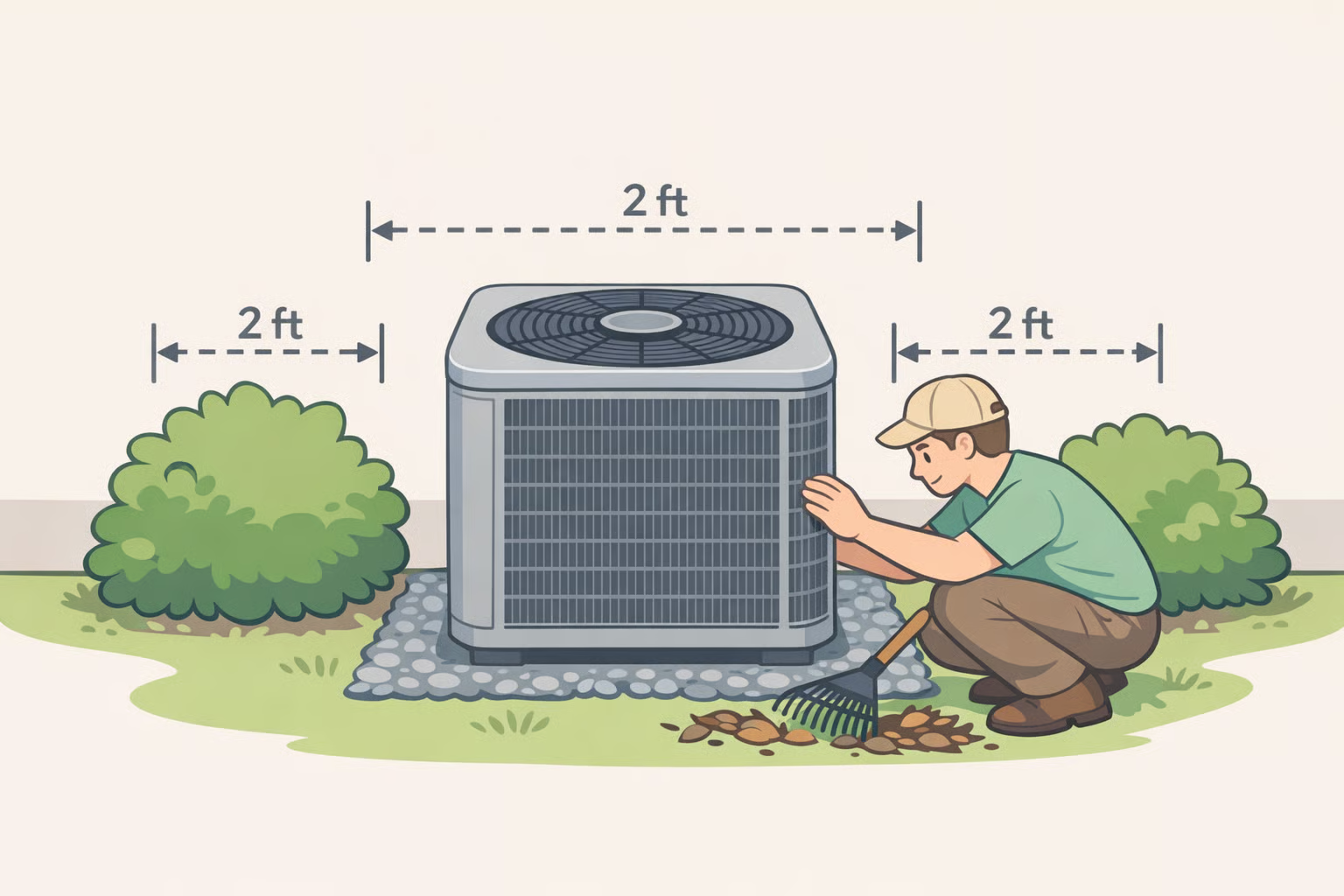
Outdoor unit clearance: do this today. Professional checkup: plan before next summer.
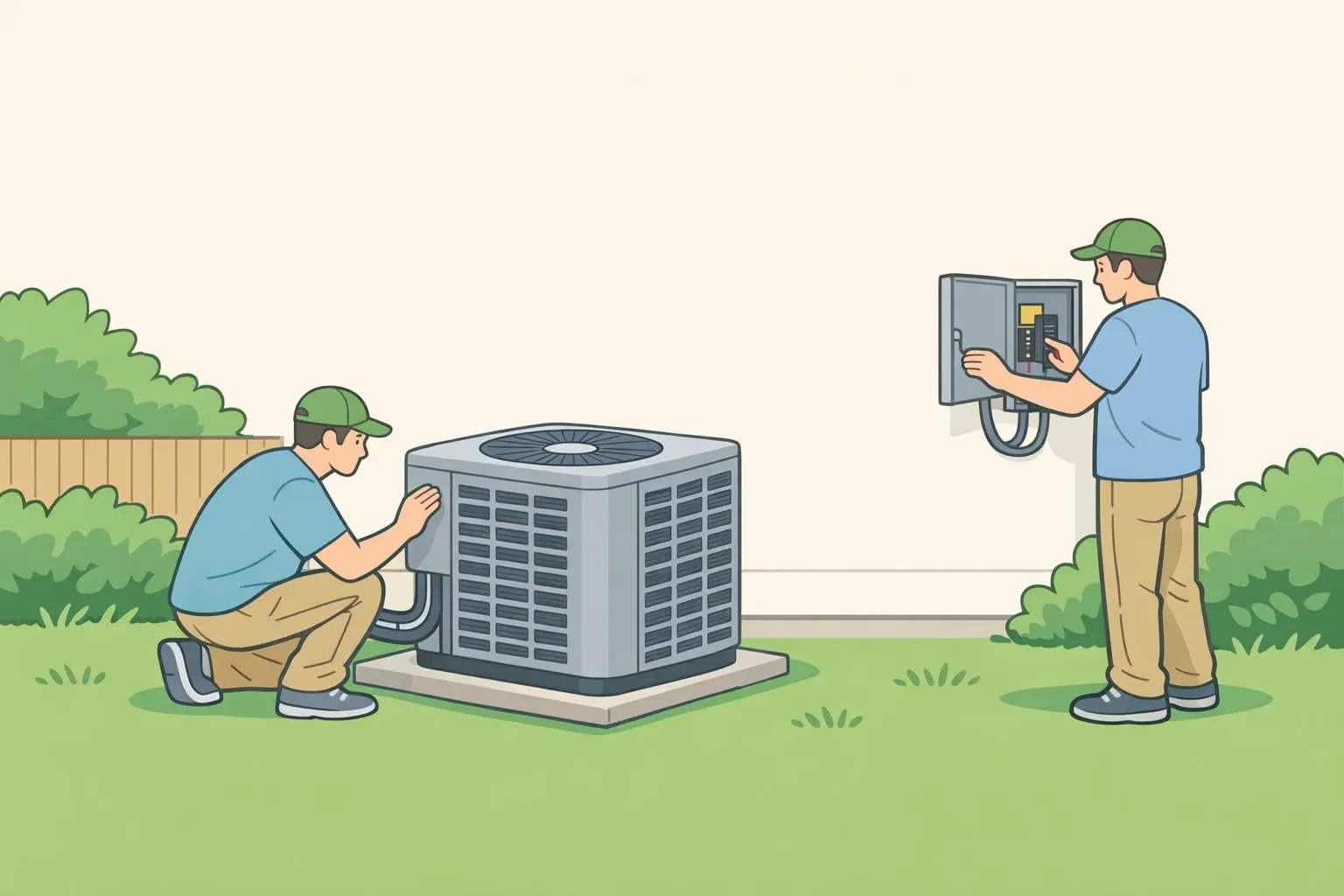
The outdoor condenser unit exhausts the heat your AC pulls from inside the house. If it can't discharge that heat efficiently because it's blocked by debris, vegetation, or bent fins restricting airflow, the entire system works harder and runs hotter.
Step 1 (do today): Visually inspect the outdoor condenser unit. Clear away leaves, grass clippings, and any accumulated debris from all sides. Maintain at least two feet of clear space on every side. If nearby shrubs have grown close, trim them back.
Step 2 (do today): Check that the unit is sitting level and that the metal fins around the housing are not bent or crushed. Minor fin damage can be gently straightened with a fin comb; anything more significant is worth noting for a technician visit.
Seasonal prep: schedule before next summer
ENERGY STAR (2024) recommends scheduling professional HVAC maintenance in spring, before peak cooling season, because technicians book up fast once summer arrives. A professional visit typically includes evaporator coil cleaning, refrigerant level check, drain line inspection, and blower inspection, all failure points homeowners can't easily assess on their own.
HVAC.com (2023) recommends an annual maintenance visit as the most reliable prevention for coil freezing caused by refrigerant issues, dirty coils, and blocked drain lines.
Note: This tip applies to central air systems. Window unit owners should clean or replace the filter monthly (covered in Tip 1) and inspect the unit's exterior fins annually.
Signs your AC is already in trouble: when to stop and call a pro
These five tips are preventive. If any of the following are happening right now, the system may have already crossed from stressed to failing:
- The unit is running but not producing noticeably cool air after 30 minutes
- Visible ice or frost on refrigerant lines, the indoor coil, or the outdoor unit
- Persistent moisture, pooling water, or unusual condensation around the indoor unit
- The system cycles on and off rapidly without the home temperature dropping
- Unusual sounds: grinding, hissing, or clanking from either unit
If you see any of these: switch to fan-only mode to let ice thaw, check and replace the filter, then restart. If the problem recurs, or the symptoms point to refrigerant loss or mechanical failure, call a licensed HVAC technician. Refrigerant handling requires certification, and misdiagnosis during a heat wave makes things worse, per HVAC.com (2023).
If power fails entirely: Move to the lowest level of the home, keep window coverings closed to block solar heat, and use battery-operated fans near shaded sides of the house. The solar-blocking and humidity-reduction habits from Tip 3 buy meaningful time before conditions become dangerous, Consumer Reports advises (updated July 2025).
What to do next: if the system is still struggling
Filter replaced, vents clear, thermostat steady, outdoor unit clean. If the AC is still failing to hold temperature after all five steps, that's a signal, not a mystery. The next move is maintenance, not more tinkering.
Schedule a professional visit now if you haven't had one this year. Technicians get booked quickly during heat season, so even booking a few days out is better than waiting. If the system is over 10 years old and still struggling despite these measures, replacement is worth pricing seriously. Replacing it with an ENERGY STAR-certified unit or heat pump can cut annual cooling costs by up to $500, per ENERGY STAR (2024).
For homes that still can't hold temperature even with a functioning system, the problem is usually the building itself. Air sealing and attic insulation save an average of 15% on annual heating and cooling costs, ENERGY STAR data shows (2024). That's a fall project, not a weekend task. But scheduling it before next summer is the difference between these AC heat wave tips being a yearly scramble and something you rarely have to think about. These five steps reduce the odds of failure when the system is near its limit; insulation and air sealing reduce how often it reaches that limit in the first place.
Dirt and neglect, not age, are ENERGY STAR's (2024) top-cited causes of HVAC failure. Most heat-wave breakdowns are preventable.


Comments
Be the first, drop a comment!