





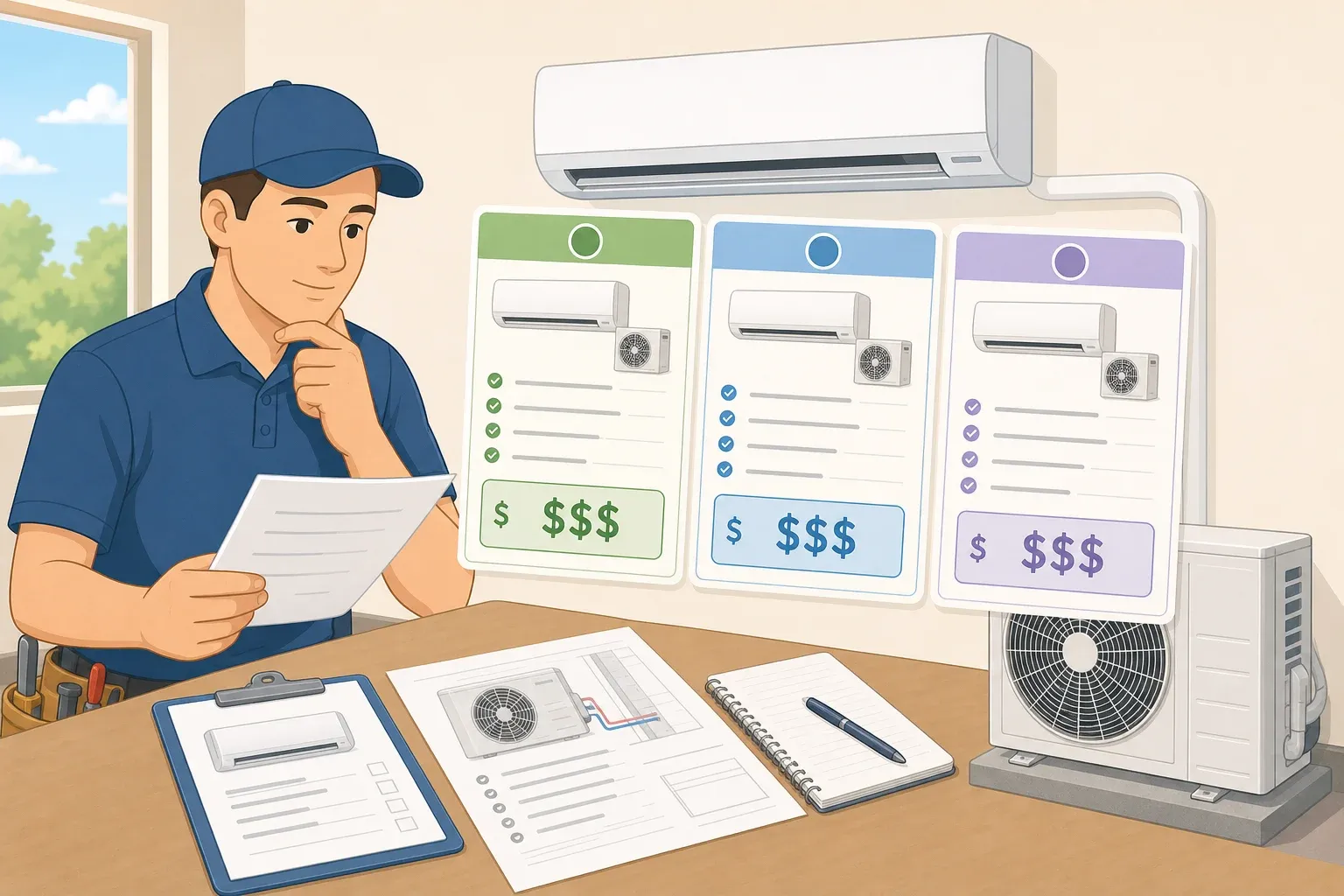
Suppose one contractor's quote for a Daikin system runs several thousand dollars above a competing bid for what looks like the same job: same square footage, similar tonnage, maybe even a neighbor down the street who's happy with a similar-looking setup. The brand name usually explains the gap. That's rarely where to start looking.
Why are Daikin air conditioners so expensive on a bid like that, and is it actually the equipment driving the number? A total price bundles several things together: the specific equipment tier quoted, the sizing and design work behind it, how much installation labor the job actually includes, and the warranty or service terms attached to it. The useful question is what the quote includes, not just which logo is on the outdoor unit.
Contractors size cooling and heating equipment using Manual J, the residential load-calculation standard published by the Air Conditioning Contractors of America, now in its eighth edition, formally Manual J8AE. A real Manual J calculates room-by-room heating and cooling load from measured windows, doors, insulation, infiltration, and orientation instead of a square-footage guess. Rule-of-thumb sizing without it routinely overshoots the real number by 20% to 50%, according to National AC Solutions.
Many reputable contractors already fold a Manual J calculation into their standard replacement quote instead of billing it separately, National AC Solutions reports. That matters for reading a bid: a quote without a visible sizing fee didn't necessarily skip the work, and one with a fee isn't automatically more thorough.
Why are Daikin air conditioners so expensive on some quotes?
Before assuming a Daikin quote runs high because of the brand, or that a cheaper competing bid is automatically the safer pick, break the total into four pieces.
Equipment tier. Even within one brand, price depends on the exact model: single-stage, two-stage, or variable-speed, and what controls it needs to run. Confirm this by model number directly with the contractor.
Design and sizing labor. A documented load calculation and equipment match take real time on-site and in software. It's a checkable cost, and the next section covers why it rarely explains a big gap on its own.
Installation scope. Ductwork changes, electrical work, new line sets, permits, and disposal of the old unit are each worth comparing between bids, regardless of brand. Two bids can list the same model number and still cover very different amounts of labor around it.
Warranty and service terms. Labor warranty length and whether startup and commissioning are included can differ between contractors even when manufacturer equipment coverage is identical.
The next two sections cover what to check in each of these, starting with sizing, since it's the piece most often misread as either the whole story or a non-issue.
What sizing and design work actually costs, and its limits
Manual J's output is a room-by-room load number, and that figure feeds two more steps: Manual S, which selects the actual equipment model and capacity, and Manual D, which governs duct design. A Manual J report on its own doesn't confirm a system is correctly matched to the home unless Manual S was also completed.
A real Manual J can't be rushed. For a typical 2,000 to 3,000 square foot home, a contractor should spend 45 to 75 minutes on-site taking measurements, then another 30 to 60 minutes in software producing the report, per National AC Solutions. If a contractor hands over a Manual J-labeled tonnage after ten minutes without walking the house, that source calls what's actually being handed over an estimate wearing a Manual J label. Treat that as a reason to ask more questions, not a verdict on every contractor who moves efficiently.
One example from that source shows how far a shortcut can drift. A 2,400-square-foot Atlanta home built to 2018 energy code calculated to roughly 2.5 to 3 tons of real cooling load. Sized instead with the common 500-square-feet-per-ton rule of thumb, the same home came out to 4.8 tons, nearly double the actual need, according to National AC Solutions. Oversized equipment short-cycles, controls humidity poorly, and wears out faster than correctly sized equipment, so a sizing miss shows up in comfort and utility bills, not just the sticker price.
That kind of miss isn't unusual. A frequently cited estimate, attributed by National AC Solutions to the DOE Building America program and ACCA-linked research, puts the share of existing central air conditioners that are oversized somewhere between 40% and 70%.
Sizing labor itself stays modest next to a full installation. National AC Solutions reports contractor-itemized Manual J work running roughly $150 to $450, and independent third-party calculations running roughly $300 to $700. Sizing work is real and worth confirming. It's rarely where a large gap comes from.
What to verify in equipment, installation scope, and service terms
Since sizing rarely explains a large gap, the equipment, installation scope, and service terms are the more likely places a price difference comes from. Send each contractor these questions before comparing totals:
Which indoor and outdoor models, by model number, are included in this price?
Is this pairing a certified matched system, and what is the rated capacity and efficiency for that specific combination, not just nominal tonnage?
Is the system single-stage, two-stage, or variable-speed, and what does that mean for the controls the home will need?
What work is excluded from this total: ductwork modifications, electrical panel or circuit work, new line sets, a thermostat, permit fees, disposal of the old unit?
Is a Manual J, Manual S, and Manual D available in writing?
What labor warranty length and startup or commissioning terms are included?
None of this is unique to Daikin. It's worth asking on any brand's quote before assuming a number reflects a fair comparison to another bid.
If a contractor claims ACCA Quality Installation certification, National AC Solutions notes the program requires documenting Manual J, Manual S, and Manual D on every replacement job, and that homeowners can check the certification through ACCA's own QI directory. Ask the contractor to include that documentation with the written proposal rather than treating the certification itself as proof the paperwork exists for this specific job.
Build a side-by-side bid worksheet
Get both quotes in writing in full before comparing anything. A verbal summary or a quick phone recap isn't enough to line up field by field. Evaluate using the following criteria:
Outdoor unit model
Indoor unit model
Matched-system documentation
Rated capacity at design conditions
Efficiency rating
Load calculation basis (if provided)
Ductwork/electrical scope included
Permits included
Disposal of old system included
Labor warranty length
Startup/commissioning included
Stated exclusions
Total price
Nominal tonnage, advertised SEER or SEER2 rating, equipment-only price, and total installed price can each look identical or better on a cheaper bid while a real difference sits somewhere else on the worksheet. These numbers are not enough to compare installed bids by themselves.
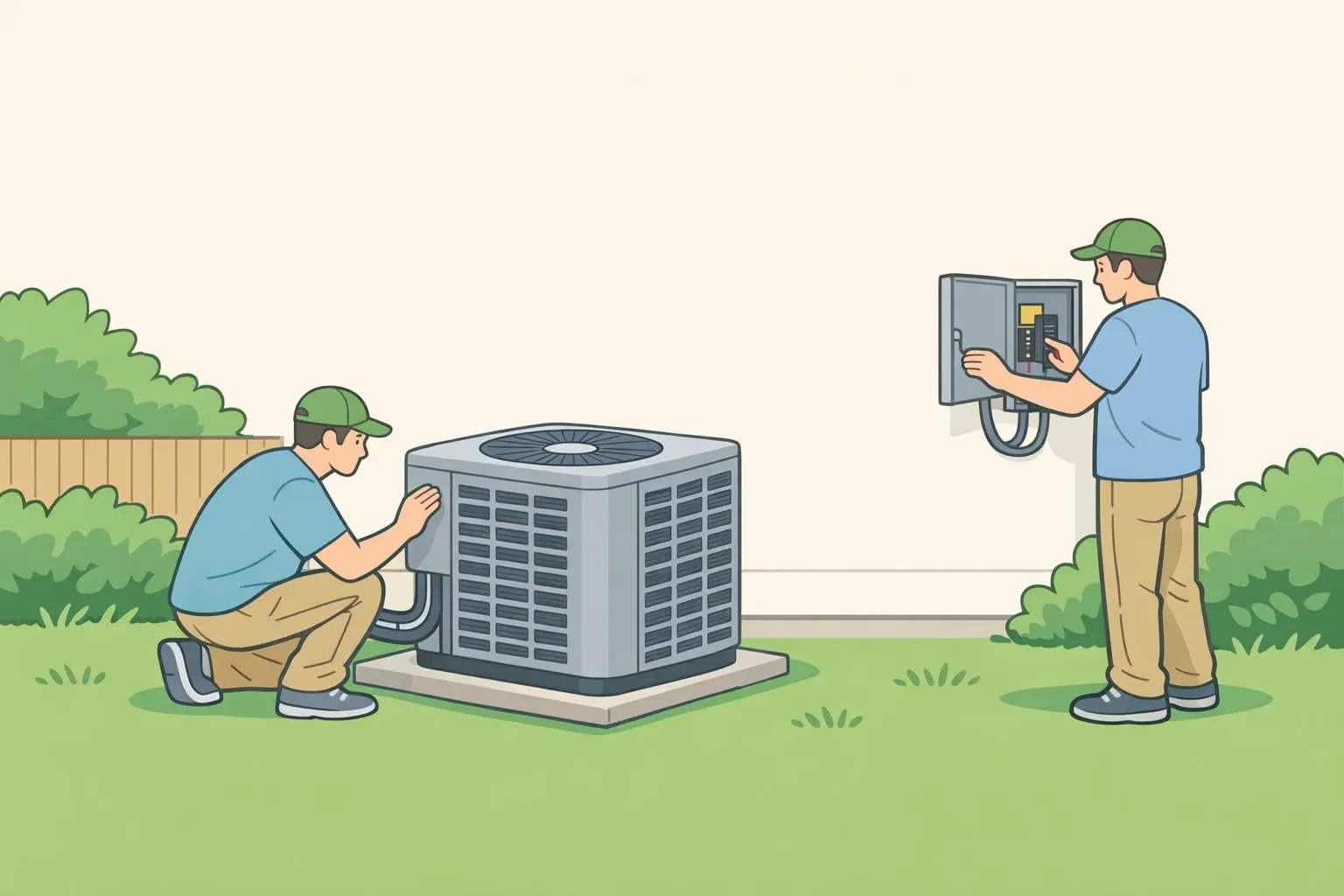
A homeowner can fill this out, ask pointed questions, and compare assumptions between two bids without special training. Choosing equipment capacity, approving duct modifications, or working with electrical panels and refrigerant lines stays with a qualified contractor, following local licensing and permit requirements. A free load-calculation tool is a sanity check on the numbers a contractor provides, not permission to pick a system size independently.
Step-by-step: working through the worksheet
Line up both quotes field by field. A price difference should map to something specific on the worksheet: a different equipment tier, a different scope, different warranty terms. If it doesn't map to anything on the list, ask the higher bidder to itemize further.
Don't treat the old system's tonnage as proof of correct replacement size, and compare the assumptions behind each bid's number, not just the tonnage itself. Since a large share of existing systems are estimated to run oversized, matching the old unit's capacity can repeat a prior mistake rather than confirm either new bid is right, National AC Solutions points out. Ask each contractor what conditioned square footage, insulation level, window area, duct location, and design temperature fed into their number. Two contractors can land on different figures with different inputs; sorting that out is a conversation to have with each of them, not a decision to make alone.
If the load numbers don't match and neither contractor can explain the gap, don't guess. Request a written explanation from both. An independent third-party load calculation, running roughly $300 to $700 per National AC Solutions, adds another professional assessment and can show which assumptions differ, though it won't necessarily settle which bid is right on its own. That source notes CoolCalc offers a free ACCA-approved web version and Wrightsoft has a homeowner-accessible version, though it's worth confirming current pricing and availability directly since software details change. Either is useful as a preliminary cross-check, not a substitute for a contractor's documented design work.
If a gap remains unexplained after asking, take one concrete step. Request revised, itemized bids from both contractors, bring in a third contractor for a comparable quote, or pause the decision until an independent load calculation is done. Don't sign based on price or brand name while the gap is still unaccounted for.
Are Daikin air conditioners worth the money?
Whether a Daikin system is worth the money on a specific bid comes down to what the worksheet shows, not the brand name on the outdoor unit. A few things this process can and can't settle:
A higher total doesn't prove the Daikin quote is overpriced.
A lower equipment-only price doesn't prove the cheaper bid is the better deal once labor and scope are counted.
A real brand comparison needs matched capacity, efficiency class, indoor/outdoor pairing, installation scope, location, and warranty terms, which the worksheet can confirm are present or missing but can't supply on its own.
The worksheet can establish whether two bids are actually comparable. It can't establish long-term reliability or operating cost without separate evidence on the specific equipment.
A higher bid deserves closer consideration when it comes with a documented load calculation and Manual S selection, exact model numbers tied to that load, ductwork or electrical scope a lower bid leaves out, and a labor warranty that runs longer or includes startup and commissioning the other bid doesn't mention. It's harder to justify when the model numbers and installation scope match a lower bid line for line and the price difference has no stated reason.
Before signing anything, request the load calculation and matched equipment selection in writing, get an itemized breakdown of duct, electrical, permit, and disposal work, and get a written explanation for any difference in quoted capacity between contractors. If the contractor cannot explain the capacity, included work, or warranty difference in writing, pause the purchase and get another comparable bid or an independent load calculation before deciding on price or brand alone.









Comments
Be the first, drop a comment!