



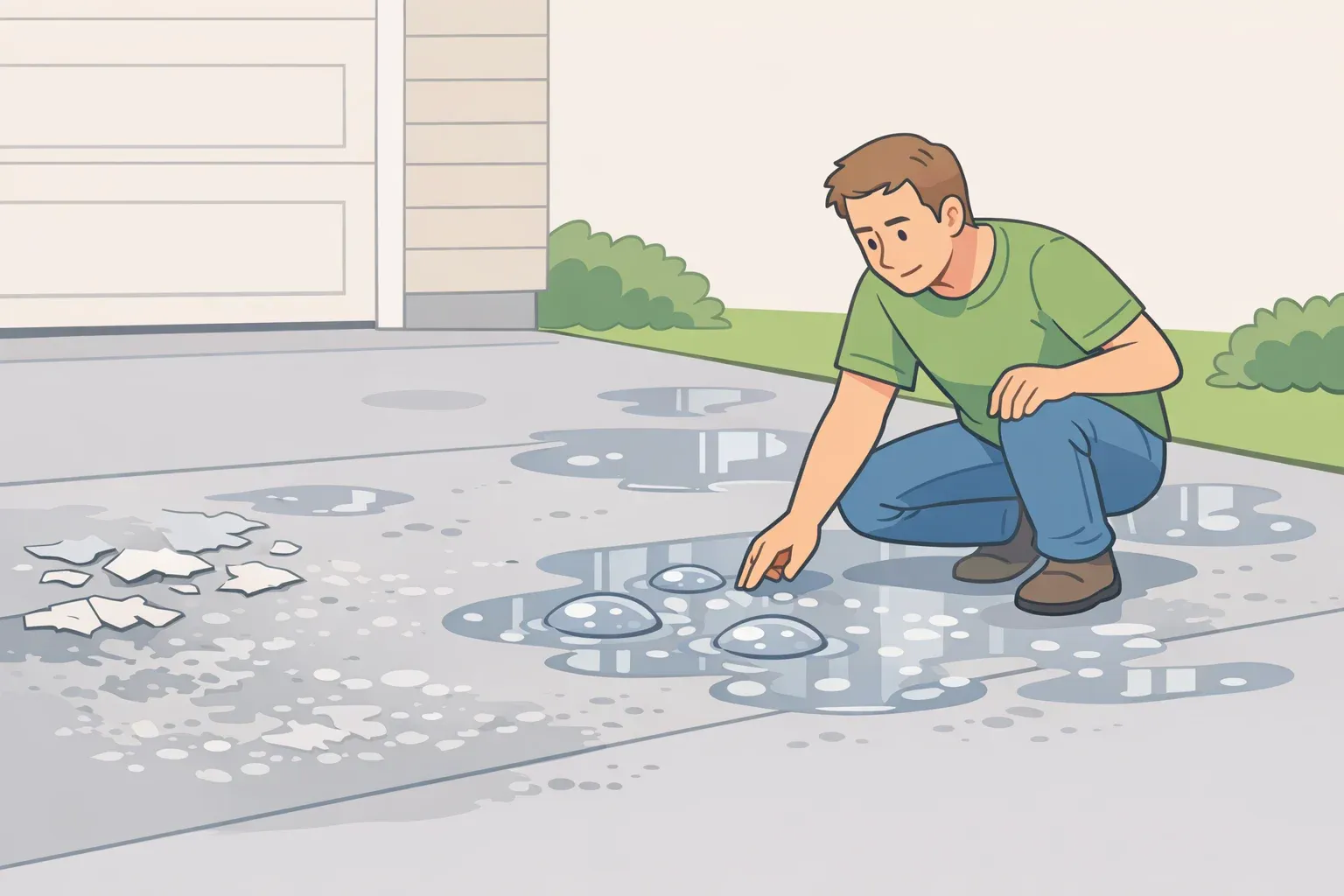
Downsides of Sealing a Concrete Driveway: Peeling & More
Walk down the concrete sealer aisle at any hardware store and the packaging is unanimous: protection, longevity, a wet-look finish that makes the driveway look new. Most of those products are film-forming sealers acrylics, epoxies, and similar coatings that cure into a thin plastic-like barrier on top of the concrete. On an exterior driveway, that barrier frequently peels, bubbles, whitens, or quietly loses adhesion within a few years. Sometimes within a few weeks.
The downsides of sealing a concrete driveway aren't a niche concern or a matter of bad luck. They're predictable, documented, and rooted in a structural mismatch between what film-forming sealers are designed to do and what exterior concrete actually does. The warning is specific: film-forming sealers on driveways, applied without rigorous prep and careful timing, are prone to failure in ways most homeowners won't see coming. Penetrating sealers products that soak into the concrete pores rather than coating the surface don't share most of these failure modes. But before choosing anything, it helps to understand why driveways are so hostile to coatings in the first place.
Why exterior concrete resists film-forming sealers
Concrete is porous and perpetually in motion. It absorbs and releases moisture depending on temperature, humidity, and whatever's happening in the ground beneath it. A film-forming sealer works by blocking water from getting in. The problem is that it also blocks moisture from getting out. When moisture is already present in the slab or enters through cracks or ground infiltration it becomes trapped beneath the film under pressure.
That's the core physics. A driveway adds more variables on top: direct sun, seasonal freeze-thaw cycles, temperature swings of 80°F or greater, and regular vehicle loads. Those conditions stress the bond between coating and concrete in ways that most product marketing doesn't acknowledge.
The expansion mismatch is one specific mechanism worth understanding. Concrete expands at roughly 5.5 millionths of an inch per inch per degree Fahrenheit. Polymer coatings like epoxy and polyurethane expand at five to ten times that rate, per the National Concrete Coating Authority (earlier this year). On an exterior slab going through large temperature swings, that differential generates stress concentrated at coating edges which is exactly where peeling tends to start.
The moisture-entrapment problem gets worse in cold climates. When impermeable film coatings trap water in concrete, that water freezes and thaws repeatedly through winter, generating microcracks that compound over time, according to a Saint Augustine's University analysis of waterproof sealants (earlier this year). The coating that was supposed to protect the slab can accelerate its deterioration.
There's also a fundamental product-design tradeoff that no label explains. No film-forming sealer simultaneously handles vapor tolerance and chemical impermeability well, per the National Concrete Coating Authority (earlier this year). A coating that excels at blocking chemicals is more likely to trap moisture and blister; a vapor-permeable primer reduces blistering risk but sacrifices barrier performance. Every product picks a point on that spectrum, and nothing on the retail packaging tells a homeowner where that tradeoff sits.
Moisture problems under concrete sealer and other failure modes
Sealer failures follow predictable patterns. The timing of failure is usually diagnostic.
Early failures, within 30 days, trace almost exclusively to prep errors, moisture, or application mistakes, per the National Concrete Coating Authority (earlier this year). The signature symptom is bubbling dome-shaped elevations in the film caused by gas or vapor pressure from beneath. Concrete is porous, and air trapped in those pores expands when temperatures rise, pushing upward into the fresh coating above it. In solvent-based acrylic sealers, over-application produces the same result: solvents that should evaporate become trapped under the forming film and push upward, per Ghostshield (earlier this year).
Blushing a milky or white cloudiness in the cured surface comes from the same place: over-application and incomplete evaporation, according to Ghostshield (earlier this year). Both problems are largely preventable with correct application, but "correct" has a narrower window than the packaging suggests. Ghostshield recommends applying acrylic sealer only in the morning or evening, in temperatures between 60 and 90°F, out of direct sun (earlier this year). That window eliminates most summer afternoons across a large portion of the country.
Surface preparation is the other early-failure driver most DIYers underestimate. Power washing the standard DIY prep leaves a surface roughness at or below CSP 1, the lowest classification in the ICRI surface profile scale. For high-build epoxy systems specifically, a profile below CSP 3 is associated with elevated delamination risk (earlier this year). A homeowner who pressure-washes and immediately seals has almost certainly under-prepared the surface for that class of product, regardless of which brand they chose.
Mid-life failures, from one to five years, are driven by UV degradation and thermal fatigue. Epoxy topcoats that lack UV stabilization chalk and yellow under sun exposure, and that surface breakdown accelerates peeling at coating edges, per the National Concrete Coating Authority (earlier this year). The UV-stable alternative aliphatic polyurethane or polyaspartic topcoats costs roughly 30 to 50% more per gallon than standard epoxy, a distinction that receives almost no attention at point of sale.
Hidden delamination is the failure mode homeowners are least likely to catch. A coating can appear glossy and intact while having lost adhesion across 40 to 60% of its area detectable only by tapping the surface and listening for a hollow sound, per the National Concrete Coating Authority (earlier this year). When those unbonded zones eventually fracture under a vehicle or foot traffic, they expose the concrete beneath and create open channels for water entry, restarting the damage cycle from below.
One more risk that rarely appears in consumer guidance: traction loss. Pavement preservation research from Michigan Technological University's Center for Technology & Training identifies texture and friction loss as a downside of spray-applied surface sealers, noting they can also be worn away more quickly than unsealed pavement (2022). A slick driveway after rain is a foreseeable consequence of a wet-look film coating not a defect, just the product working as designed.
Does regular sealing actually pay off?
Setting aside failure risks entirely, the assumption behind routine driveway sealing that it meaningfully extends the concrete's service life is less well-supported than most homeowners expect.
The strongest quantitative evidence comes from infrastructure research rather than residential driveways, which is worth acknowledging as a limitation. A peer-reviewed study published last year in MDPI Infrastructures, analyzing bridge deck maintenance data, found that resealing every two to four years may extend service life by only around one to two years a modest return on a recurring expense. The study also found that sealer's measurable effect on concrete condition was only observable before the first resurfacing, suggesting the protective window may be narrower than product marketing implies.
The cost picture is equally sobering. The only application schedule in that study that produced a meaningful reduction in life-cycle cost about 6% was resealing every 12 years, not the biennial reapplication most homeowner guidance recommends.
Add in the carrying costs of acrylic sealers specifically known for short service life, blushing, and bubbling, per Ghostshield (earlier this year) and a product that needs stripping and reapplication every two to three years has a very different real cost than its shelf price suggests.
None of this makes sealing irrational. In high-salt environments, on driveways regularly exposed to de-icing chemicals, or on concrete showing early surface wear, the math shifts. The point is that "seal your driveway every few years" isn't a universal truth it's a conditional recommendation that depends heavily on product type, climate, and how well the application is executed.
Choosing the right approach: three realistic options
The useful question isn't "should I seal my driveway?" It's "what do I actually want from this, and which option gets me there with the least risk?"
Penetrating sealer (silane, siloxane, or silane-siloxane blend) is the lower-risk protective choice. These products absorb into the concrete pores and repel water from within, without forming a surface film. No moisture-entrapment problem, no peeling, no bubbling, and no requirement for the surface profile precision that film-forming products demand. The tradeoff: no visible finish change, no wet-look gloss.
Best for: driveways in freeze-thaw climates, concrete exposed to road salt or de-icing chemicals, homeowners who want protection without a high-maintenance surface, and DIY applications.
Film-forming sealer (acrylic, epoxy, polyurea) is the right choice only if the aesthetic result matters enough to justify the maintenance commitment. That means surface preparation beyond power washing, careful timing within the 60–90°F temperature window, application outside direct sun, and a realistic expectation of reapplication every two to three years. Manufacturer technical data sheets typically cap substrate temperatures at 90–95°F per National Concrete Coating Authority guidance (earlier this year) a constraint that rules out many practical summer application days. Professional application is advisable.
Best for: decorative or stamped concrete where appearance is the primary driver, with proper prep and professional execution.
No sealer is a legitimate option, not a neglect default. A structurally sound driveway in a moderate climate with minimal salt or chemical exposure may perform perfectly well unsealed. A field study on pavement joints (via Academia.edu, 2001 noting this research addresses pavement joints rather than driveway surfaces directly) found unsealed concrete sections showed no signs of distress while some sealed sections had deteriorated within a year.
Best for: well-cured, undecorated concrete with no specific chemical or salt exposure risk, in moderate climates.
Quick self-assessment:
FactorPoints toward film-formingPoints toward penetratingPoints toward skippingWant a glossy/wet-look finish✓In a freeze-thaw climate✓Regular road salt or de-icing exposure✓Decorative/stamped concrete✓Willing to reapply every 2–3 years✓Moderate climate, no chemical exposure✓DIY application✓✓
What to check before buying anything
Concrete sealer isn't inherently a bad investment. Film-forming sealer on a residential driveway, applied by most homeowners under typical conditions, is a high-risk, moderate-return proposition and the risks are structural, not merely cosmetic.
Moisture vapor transmission, identified by the American Concrete Institute as the primary driver of adhesion failure, is invisible. The Portland Cement Association notes that slabs can continue emitting moisture for months after they appear fully cured (earlier this year). Most homeowners have no reliable way to test for this before applying a coating which means conditions that set up failure may already be present before the roller touches the surface.
Visible condition is a poor proxy for actual performance. A glossy, apparently intact coating can have lost adhesion across nearly half its area, per the National Concrete Coating Authority (earlier this year), creating safety hazards and water-entry points that aren't obvious until something fractures underfoot.
Before purchasing, compare penetrating silane-siloxane sealers against film-forming products for the specific use case. Read the manufacturer's technical data sheet not the marketing label and check what surface preparation the product actually requires. If the prep requirements aren't achievable with available tools and conditions, the product isn't the right one. The ICRI surface profile guidelines are a practical reference for understanding what "properly prepared" means for different coating types, and they're freely available.






Comments
Be the first, drop a comment!