



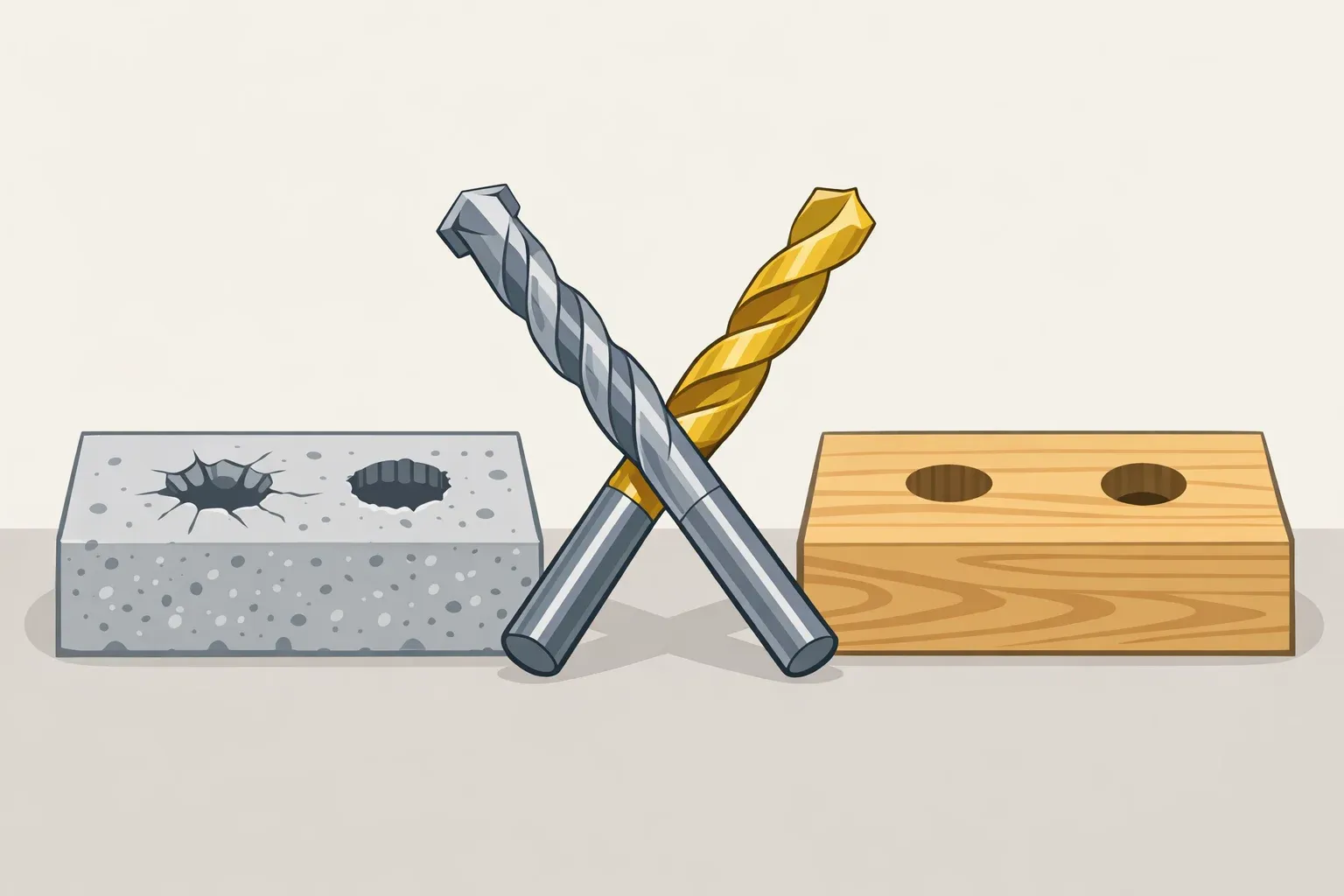
Most people own a drill and treat drill bits as broadly interchangeable. That works fine until you try to hang a shelf bracket in a concrete wall with a wood bit, or countersink a screw in oak with a masonry bit. At that point, the hole either refuses to progress or comes out rough enough to matter.
The problem is usually not technique. It is bit design: wood bits are shaped to slice fibers, while concrete bits are shaped to crush hard mineral material.
Wood bits use a sharp center point and cutting edges to slice fibers cleanly. Concrete and masonry bits use a hardened carbide tip to break into abrasive materials such as brick, stone, block, and concrete. One cuts; the other breaks.
Reaching for the wrong type has real consequences: the hole can stall, the bit can overheat, and the material can chip, splinter, or come out rough enough to affect the fastener.
Here is how to tell the bits apart, what happens when you use the wrong one, and which bit-and-drill setup to choose for wood, brick, block, and concrete.
How wood and concrete drill bits work
The difference starts at the tip, because the tip shows how the bit is meant to remove material.
Wood bits are built to slice. Many have a sharp center point that helps keep the bit from wandering before the outer cutting edges start cutting. Those edges sever wood fibers at the hole's perimeter before the body clears material from the center. That cutting sequence helps reduce tear-out and leaves a cleaner edge.
Subtypes within this category—such as brad-point, Forstner, and spade bits—optimize for specific tasks, including cleaner starts, flat-bottomed holes, or fast large-diameter bores. They all share the same basic logic: controlled cutting through wood fibers.
Concrete and masonry bits are built to break. A masonry bit does not shave concrete the way a wood bit shaves pine or oak. It uses a tough tip to chip, crush, and fracture mineral material while the flutes carry dust out of the hole. Bosch describes its masonry and concrete drill bits as using carbide tips for durability in concrete and stone, and its product filters distinguish materials such as brick, concrete, hard stone, and reinforced concrete.
That distinction matters because "masonry bit" is a broad category. A bit that works for a small hole in brick is not automatically the best choice for a deeper anchor hole in poured concrete.
Think of it this way: a wood bit acts more like a knife, while a concrete bit acts more like a chisel. The first needs a sharp edge and control. The second needs impact resistance and abrasion resistance.
What happens when you use the wrong drill bit
A masonry bit can make a hole in wood, but it usually makes a poor one. Because the tip is designed to crush, not slice, it can leave a rough, oversized, or splintered hole. That matters if the surface will be visible, if the screw head needs to sit cleanly, or if the fastener needs a tight fit.
A wood bit on concrete is worse. Wood bits are not built for abrasive aggregate or hammer action. The tip can dull quickly, heat can build up, and the hole may barely advance. Pressing harder usually makes the problem worse.
Universal bits can be useful for light-duty household jobs, especially when you are unsure whether a wall is plaster, brick, block, or another mixed material. They are still a compromise. If the hole needs to be clean, accurately sized, or strong enough for an anchor, use a bit made for the material.
The better question is not simply whether a bit can make a hole. It is whether the hole will be clean, correctly sized, and strong enough for the fastener.
How to tell wood and concrete bits apart
Start with the tip.
A wood bit usually has a sharp point, cutting lips, spurs, or a paddle-like shape designed to cut fibers. Brad-point bits have a clear center spur. Spade bits are flat and wide. Forstner bits have a circular cutting rim for clean, flat-bottomed holes.
A masonry or concrete bit has a wider, flatter carbide insert at the tip. The insert may look like a small paddle, wedge, or cross-shaped head, depending on the bit. It is usually visibly different from the steel body of the bit.
The quick visual rule: a sharp center point is usually for cutting wood; a blunt-looking carbide tip is usually for breaking masonry.
How to choose the right bit before you drill
Start with the material, then choose the fastener. The fastener matters because anchors, wall plugs, and masonry screws usually require a specific hole diameter and depth.
For wood, use a wood bit that matches the hole type. A brad-point bit is useful for cleaner pilot holes. A spade or auger bit works for rougher, larger holes. A Forstner bit is better for clean, flat-bottomed holes.
For brick, concrete block, or soft stone, use a carbide-tipped masonry bit. Check the anchor package for the correct bit size, drill depth, and installation method. Start with light pressure so the bit does not wander, then clear dust from the hole before installing the anchor.
For poured concrete, use a concrete-rated masonry bit. A hammer drill may work for small, shallow holes, but harder concrete, larger holes, and repeated anchor holes are better handled with an SDS Plus rotary hammer and an SDS Plus bit.
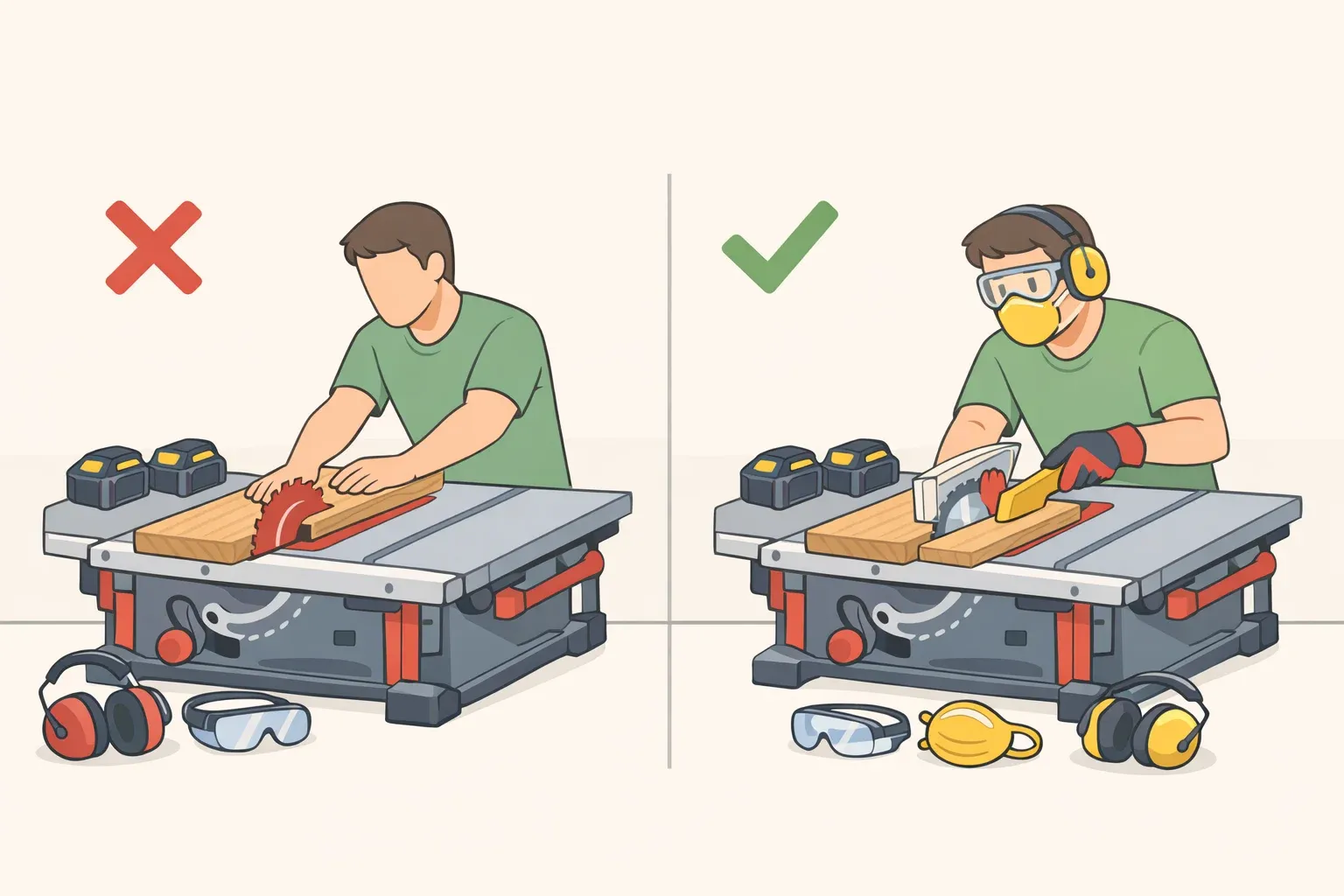
Before drilling into any wall, confirm what the wall is made of and check for hidden wiring, plumbing, or gas lines. Wear eye protection, and use hearing protection when hammer drilling. Concrete, brick, mortar, and stone can release fine dust when drilled; OSHA warns that drilling silica-containing materials can create respirable crystalline silica, so work with ventilation, collect dust when possible, and avoid repeated dry drilling indoors without dust control.
How to choose a concrete drill bit
Concrete is one of the tougher common household materials to drill, especially when it contains hard aggregate or embedded reinforcement. That is why choosing a "masonry bit" is only the starting point.
For a small hole in brick, block, or soft stone, a standard carbide-tipped masonry bit may be enough. For poured concrete, use a bit labeled for concrete. For reinforced concrete or rebar-likely work, look for an SDS Plus bit rated for reinforced concrete or a rebar-capable four-cutter design.
Do not overbuy for every job. A renter hanging a small bracket on a brick wall does not need the same setup as someone drilling repeated anchor holes into a concrete slab. Match the bit to the material, the hole size, and the fastener.
SDS Plus vs. a hammer drill
The drill matters as much as the bit.
A standard drill spins the bit. A hammer drill adds a rapid forward-and-back hammering motion while the bit rotates. That impact helps a masonry bit chip into brick, block, stone, or light concrete.
An SDS Plus rotary hammer is a heavier-duty tool with a special chuck and slotted bit shank. The bit locks into the chuck but can still move during hammering, which helps transfer impact energy into concrete. For hard concrete, larger holes, or repeated anchor holes, an SDS Plus rotary hammer will usually outperform a standard hammer drill.
These systems are not cross-compatible. An SDS Plus bit requires an SDS Plus rotary hammer, while standard round- or hex-shank masonry bits are made for regular drill chucks. Confirm both the shank type and the drill chuck before buying.
Which drill bit to use by job
For joinery, shelf parts, furniture, or other wood tasks, use a wood bit, such as a twist, brad-point, spade, Forstner, or auger bit, with a standard cordless or corded drill.
For wall plugs in brick, soft stone, or hollow block, use a carbide-tipped masonry bit with a hammer drill, or a regular drill with hammer mode if available.
For anchors or penetrations in poured concrete, use a concrete-rated masonry bit or SDS Plus bit. A hammer drill may work for small, light-duty holes, but an SDS Plus rotary hammer is better for harder concrete or repeated holes.
For rebar-likely or safety-critical concrete work, use a rebar-capable SDS Plus bit, often with a four-cutter head, and an SDS Plus rotary hammer.
The bottom line
Wood and concrete drill bits are not interchangeable if you want a clean, reliable hole.
Use a wood bit when the job depends on cutting fibers cleanly, such as pilot holes, countersinks, furniture hardware, trim, or joinery. Use a masonry or concrete bit when the job depends on breaking into brick, block, stone, or concrete. For harder concrete, larger holes, or repeated anchor holes, move from a standard hammer drill to an SDS Plus rotary hammer.
For most DIY jobs, the practical rule is simple: match the bit to the material, match the shank to the drill, and follow the fastener manufacturer's hole-size instructions.













Comments
Be the first, drop a comment!