



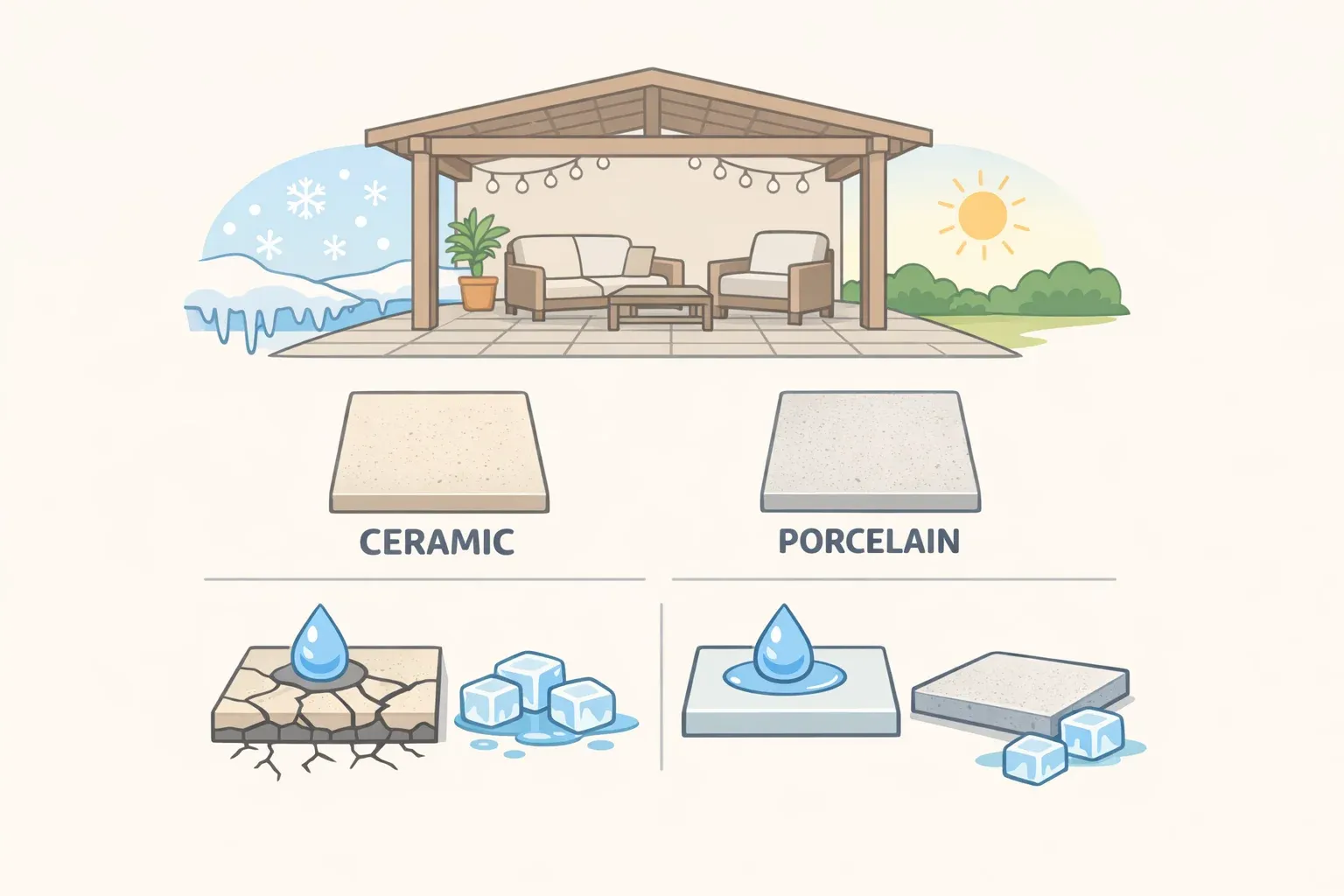
Porcelain is the safer outdoor patio tile in most exposed situations. That's the conclusion, stated upfront. The more useful question is why, and whether your specific patio is one of the cases where ceramic holds up fine and costs considerably less.
The decision comes down to four variables: climate, exposure, traffic, and budget. Every other detail, from firing temperatures to installation specs, feeds into one of those four. Understanding the performance gap between these two materials starts with a single number buried in the spec sheet: water absorption rate.
Glazed ceramic typically absorbs 3–7% of its weight in water; porcelain must come in at 0.5% or below to meet ASTM classification standards, according to Davies Decor and BuildDirect. That ratio determines whether a tile survives freeze-thaw cycling intact or fractures in cold conditions. Everything else follows from it.
One major home resource advises against ceramic for any outdoor installation regardless of climate, while others note that exterior-rated ceramic can survive in covered, mild-weather settings. Both positions are technically defensible; they're describing different tiles in different conditions. The line between them is what this guide maps.
Ceramic vs porcelain outdoor patio tile: which specs decide the outcome
Before comparing the two materials, it helps to know what separates a viable outdoor tile from one that will fail. These are the numbers to check on any spec sheet, in-store label, or product listing.
Water absorption is the single pass/fail criterion for freeze-thaw climates. Tiles going into those conditions need absorption at or below 0.5%; anything higher risks cracking when trapped moisture expands in winter. Tiles hitting that threshold are classified as "impervious." Porcelain reliably meets it; most ceramics do not.
PEI rating measures wear resistance on a scale of 0 to 5. Outdoor floor tile needs a minimum PEI 3; busier patios call for PEI 4 or 5. A PEI of zero is designed for wall installation only, and anything below 3 generally has no business on an outdoor floor.
Frost resistance should appear explicitly on the tile's specification, not implied by a textured surface or a low price point. Only tiles tested for freeze-thaw exposure belong on outdoor horizontal surfaces in cold climates.
Slip resistance is the spec most patio shoppers overlook. Wet outdoor surfaces are a hazard regardless of tile category. The relevant measure is the coefficient of friction, tested under standards including ASTM C1028. Textured or matte-finish tiles outperform smooth or polished ones here. Polished porcelain, despite its material advantages, can become dangerously slippery when wet, and that's a fixable problem only if you choose the right finish from the start.
One purchasing reality check worth knowing: in one study, close to 24% of tiles marketed as impervious porcelain failed to meet the 0.5% absorption standard, with some absorbing six times the maximum, according to Tile & Stone Journal. The PTCA Certification Mark on packaging confirms independent testing rather than a manufacturer's self-classification.
Is porcelain tile better than ceramic for outdoors? In most exposed patios, yes
The density difference is structural, not cosmetic. Porcelain is made from finer kaolin clay and fired at approximately 2,200°F–2,500°F, high enough to vitrify the tile body into a dense, near-glass structure. Ceramic fires at roughly 1,800°F–2,000°F, producing a more porous result. Ceramic's glaze adds surface protection but doesn't change the porosity of the tile body underneath, which matters the moment that glaze chips or cracks in an outdoor setting.
Freeze-thaw cycling is where ceramic fails most visibly. Water trapped in a porous tile body expands on freezing, cracking the tile or surrounding grout in regions with hard or frequent freezes. Porcelain's near-zero absorption rate largely prevents that cycle from starting. Properly installed porcelain in a mild, dry climate can remain serviceable for 30 or more years; in active freeze-thaw zones, a well-executed porcelain installation typically lasts 10 to 20 years.
Porcelain handles traffic, staining, and maintenance better, too. Its dense, non-porous surface resists scratches, stains, and wear; routine upkeep amounts to sweeping and occasional mopping. Ceramic's higher porosity means it absorbs stains more readily and typically requires more frequent sealing to maintain outdoor performance.
One honest limitation: porcelain's density works against it when the ground moves. Dense tiles don't flex, and if an underlying slab shifts or settles, porcelain is more prone to cracking than a more compliant material. This is a substrate issue, not a material deficiency, and it connects directly to why structural preparation matters as much as tile selection.
When can ceramic still work outdoors
Exterior-rated, frost-resistant ceramic installed on a covered patio, pergola floor, or balcony in a climate without hard freeze cycles presents a meaningfully different risk profile than standard ceramic on an exposed slab. Multiple sources treat these as distinct categories that shouldn't receive the same recommendation.
The key distinction is between standard ceramic, which should not go outdoors in any climate with real weather, and exterior-rated, frost-resistant ceramic specifically manufactured and tested for outdoor use. The latter can perform adequately in sheltered or mild settings when installation is executed correctly.
Where ceramic should not go:
Exposed horizontal surfaces in any climate with frequent freeze-thaw cycling
Areas with recurring standing water or inadequate drainage
High-traffic zones where heavy foot loads accelerate wear
Any application where the spec sheet doesn't include explicit frost and exterior ratings
If your patio is covered and your winters are mild, ceramic earns a look on price. Outside those conditions, porcelain is the practical choice.
Installation requirements that apply to both materials
Choosing the right tile is necessary but not sufficient. A properly rated tile on a poorly prepared substrate will fail just as surely as the wrong tile on a solid one.
Drainage and slope aren't optional. Outdoor tile surfaces need a slope of 1/8" to 1/4" per foot to carry water away from the structure. Standing water accelerates adhesive breakdown and promotes mold beneath the tile. In freeze-thaw climates, trapped water under a tile is as damaging as moisture inside it.
Movement joints prevent cracking. Control joints and perimeter movement joints filled with flexible silicone or polyurethane sealant allow the installation to absorb thermal expansion and substrate movement. Dense porcelain does not flex; without those joints, a shifting slab will crack it.
Polymer-modified thinset is the appropriate adhesive for outdoor tile on concrete. Standard indoor thinset doesn't handle moisture cycling or temperature swings the same way. The adhesive and grout are what translate tile quality into actual longevity in the field.
Grout needs ongoing attention regardless of tile type. Porcelain itself may not require sealing, but grout joints remain porous and vulnerable to moisture, staining, and freeze damage. Re-sealing every one to three years is a realistic commitment for any outdoor tile installation, Symboleo advises.
Porcelain vs ceramic tile for patio use: cost vs long-term durability
For most exposed patios, porcelain is the clearer choice in durability. The honest follow-up is whether the premium is always justified.
The price gap is substantial. Ceramic tile can run 60–70% less than comparable porcelain, according to BuildDirect; porcelain generally runs about double the price of ceramic. On a large patio, that difference is significant before labor is added. Porcelain also raises installation costs: its density requires specialized cutting tools and professional-level expertise, while ceramic is lighter, easier to work with, and accessible for capable DIYers.
Where the math shifts is over time. Porcelain's lower maintenance burden, less frequent sealing, greater stain resistance, and longer service life under adverse conditions narrow the real-world cost gap over a decade or two. Ceramic's higher ongoing maintenance commitment and shorter outdoor lifespan can close that initial price advantage faster than buyers expect.
A concise decision matrix:
Exposed patio in any climate with freeze-thaw cycles: Outdoor-rated, frost-resistant porcelain with a PEI rating of 4 or higher
Exposed patio in a mild climate with no hard freezes: Porcelain is preferred, though exterior-rated ceramic may work
Covered patio or pergola floor in a mild, low-traffic setting: Exterior-rated ceramic is a reasonable, cost-effective choice
High-traffic outdoor area in any climate or exposure: Porcelain with a PEI rating of 4 or 5
Outdoor wall, backsplash, or facade with no horizontal load: Exterior-rated ceramic is workable
What to verify before you buy
The outdoor patio tile durability comparison between ceramic and porcelain isn't a close call in most exposed applications. Porcelain wins on water resistance, freeze-thaw performance, traffic durability, and long-term maintenance load.
The buyer checklist that converts this into action:
Water absorption at or below 0.5%, confirmed on the spec sheet, not just implied by "porcelain" labeling; look for the PTCA Certification Mark
PEI 3 minimum for any outdoor floor; PEI 4–5 for heavier traffic
Explicit frost-resistance rating for any freeze-thaw climate
Textured or matte finish with adequate COF for wet-surface traction
Polymer-modified thinset, exterior-grade grout, movement joints, and proper drainage slope in the installation plan, regardless of which tile is chosen
Three rules sum it up: if you have freeze-thaw or full exposure, buy porcelain. If your patio is covered, mild-climate, and budget-sensitive, exterior-rated ceramic is still in play. In both cases, verify the spec sheet before the color.



Comments
Be the first, drop a comment!