



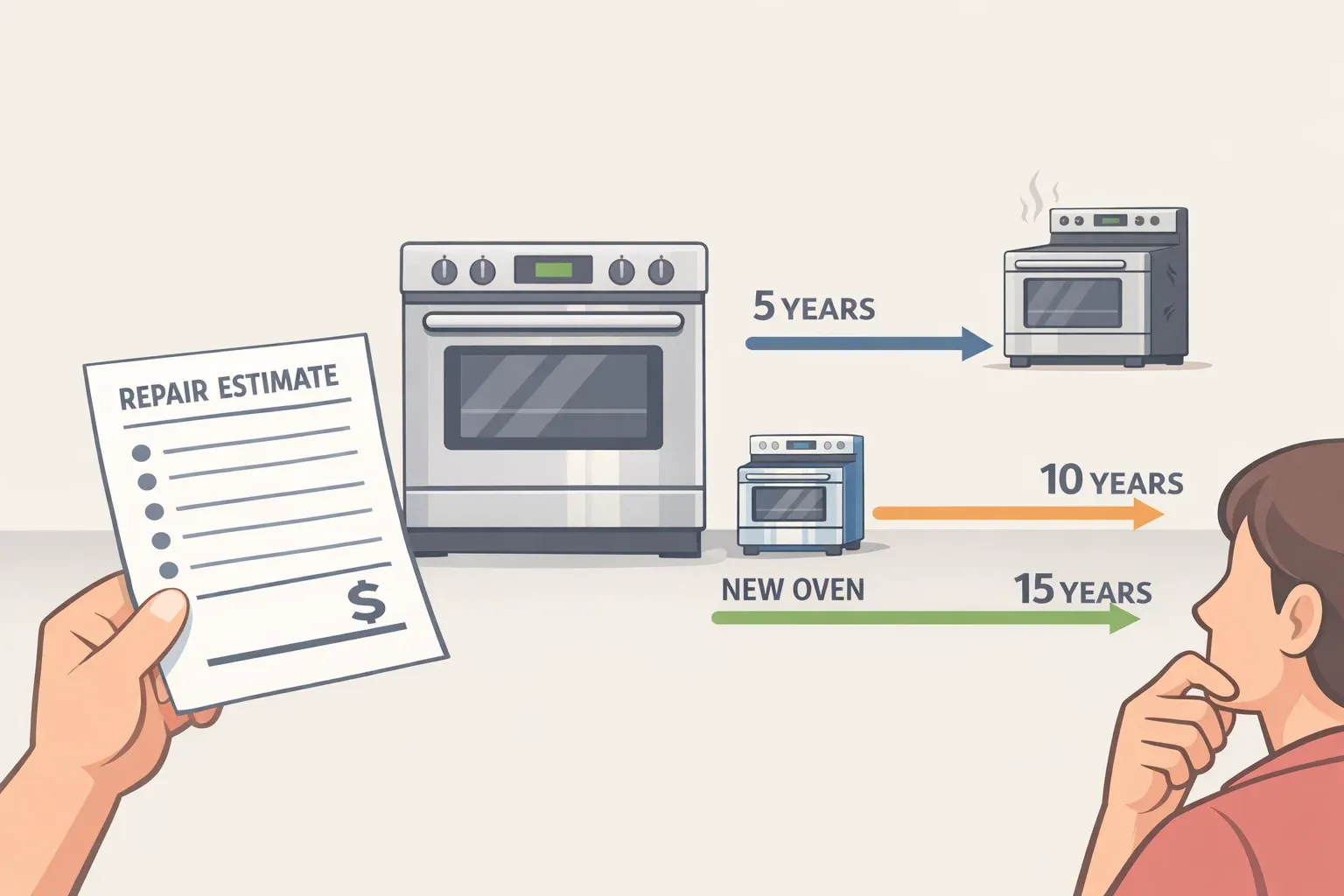
Average lifespan of an oven: when to repair or replace
Most ovens quit somewhere between 13 and 18 years. That number sits quietly in the background until a repair estimate lands on the counter then the average lifespan of an oven becomes the first input in a calculation that actually costs money. This article is built around that calculation.
The range holds up across sources. Same Day Appliance Repair Austin puts the full span at 13 to 18 years. Better Homes & Gardens pegs the average closer to 13; Angi says roughly 15. These figures come from appliance service companies and consumer editorial sources, not manufacturer lifecycle studies. Treat them as a reliable planning benchmark, not a precision spec.
The practical question is this: given your oven's age, the repair quote in hand, and how it's been used, does fixing it make financial sense? The sections below build toward a clear answer.
Gas vs. electric: why fuel type changes the oven lifespan equation
The gap between gas and electric is real. Electric ovens typically run 13 to 15 years; gas models commonly reach 15 to 18, according to Same Day Appliance Repair Austin. Part of that difference traces to heat-up speed. Some appliance pros attribute the longer gas range lifespan partly to fewer electronics, they spend less time sustaining high heat on each cycle, which reduces cumulative stress on components, as Angi notes.
Neither type gets through its lifespan without a mid-life repair. Gas igniters tend to weaken or fail between three and five years in, causing unreliable starts well before the oven is anywhere near end-of-life. Electric heating elements often need swapping out after seven to ten years. Both are documented failure patterns from Same Day Appliance Repair Austin.
Think of these like replacing brake pads on a car with 80,000 miles: expected maintenance, not a sign the vehicle is done. A gas igniter failing at year four or a heating element wearing out at year eight means one component needs replacing. The oven itself has years of useful life remaining. That distinction is what makes the repair-vs-replace framework below actually work.
The repair-vs-replace decision: three age zones and the 50% rule
Age is the first variable. Repair cost is the second. Neither one alone tells you much; together, they resolve most situations.
Under 8 years old
Beacon is direct on this: ovens under roughly eight years old are generally worth repairing, unless there has been major physical damage or the same component has failed repeatedly.
A six-year-old electric oven that stops heating is a useful example. The most common culprits are a failed bake element or a faulty temperature sensor, both considered straightforward repairs when parts are available, per Beacon. A typical repair runs $150 to $350, Angi reports. A replacement starts at $600 and can reach $2,000 before adding $100 to $200 for installation, according to Angi. At this age, repair wins clearly.
What changes that calculus even on a young oven: a cracked cavity, a door that won't seal, or a control board failure on a unit that has already had electronic problems. Those warrant a replacement conversation regardless of how new the oven is.
8 to 12 years old
This is where judgment takes over from defaults. The specific fault, overall condition, repair history, and cost estimate all factor in, as Beacon notes. No single variable settles it.
The 50% rule applies here: if a repair quote approaches or exceeds half the price of a comparable new oven, and the unit has had recurring issues, replacement typically delivers better long-term value, per Beacon. A 10-year-old gas oven that heats but won't hold temperature illustrates the range of outcomes. Temperature instability often traces to a sensor, a control issue, or a weakening element all potentially fixable causes, according to Beacon. A sensor replacement at $180 makes repair an easy call. A control board at $500 on a unit that has already had two service calls points firmly toward replacement.
Repeat failures carry their own weight here. Multiple unrelated repairs within a short stretch is a pattern, not bad luck, and that pattern strengthens the replacement case regardless of what any single repair costs.
12 to 15+ years old
Same Day Appliance Repair Austin puts it plainly: major repairs on ovens in this age range frequently fail the cost-benefit test. Angi adds the sharper version: once an oven passes 15 years, anything beyond a minor, inexpensive part swap generally makes replacement the smarter financial move.
What counts as minor at this stage: a small igniter swap or a door gasket. A control board replacement, a major element failure, or anything requiring significant disassembly on a 15-year-old oven is not minor, and the math rarely supports it.
Standard appliance warranties cover parts and labor for roughly one year, per Angi. By the time serious repair questions arise, that coverage has been gone for over a decade.
A quick decision tool
Before calling a technician or committing to a replacement, run through four questions:
How old is the oven? Under 8: lean toward repair. 8 to 12: apply the cost rule. Over 12: lean toward replacement.
What is the symptom? A single component failure reads very differently than something structural or systemic.
How does the repair quote compare to a comparable replacement? Over 50%: replace. Under 50% on a younger unit: repair.
Has this oven needed service before? Repeat failures at any age accelerate the replacement case.
What affects the average lifespan of an oven
The 13 to 18 year range is not fixed. How intensively an oven is used is the primary driver of where any particular unit lands within that window, according to Same Day Appliance Repair Austin. Heavy daily use shortens the timeline; lighter use with consistent maintenance can push both gas and electric models past the top of the range.
The self-cleaning cycle deserves specific attention. It pushes internal temperatures above 800°F, placing real stress on door seals and electronic control components, per Same Day Appliance Repair Austin. A feature marketed as convenient can quietly accelerate component wear if used frequently.
Sources confirm that usage habits matter, but none quantify exactly how many years proper maintenance adds. The honest framing is directional: good upkeep can extend lifespan meaningfully, without a fixed number attached.
This connects directly to the repair-or-replace decision. A well-maintained oven used lightly is worth repairing deeper into the 8-to-12 zone than one that has run on high heat daily for a decade. If an oven has been used hard, shift the age-zone calculus earlier than the defaults suggest.
Before you decide
The cost math is straightforward once a real number is in front of you. A repair under half the cost of a comparable replacement is almost always worth doing on an oven under 12 years old, per Beacon. Past 15 years, that logic reverses for anything beyond a minor fix, Angi confirms.
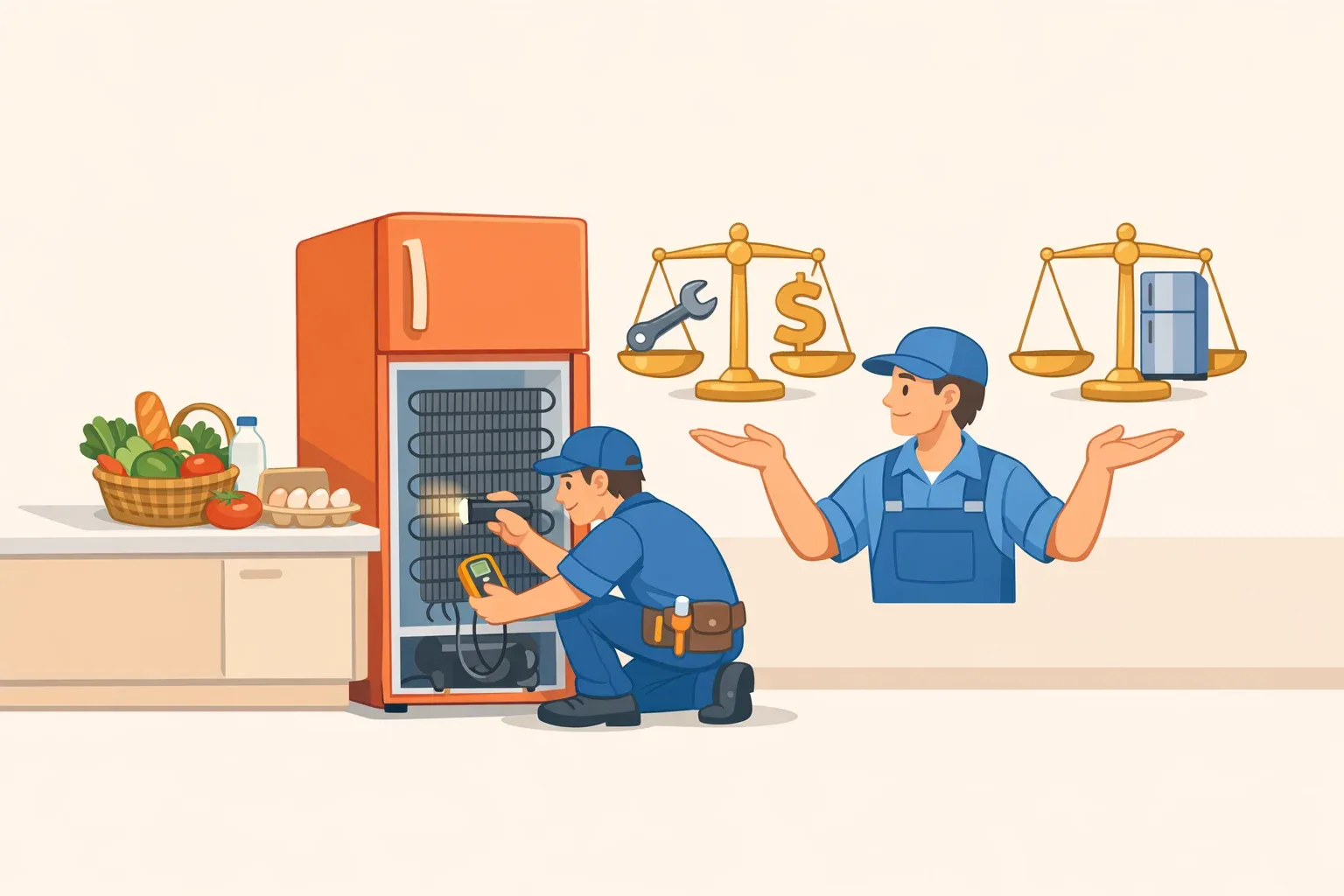
Get a diagnostic estimate before committing either way. The estimate typically costs little, turns an abstract 50% calculation into a concrete one, and usually makes the right call obvious. Set that number against the oven's age and repair history, and the answer tends to follow.
Quick reference:
Oven under 8 years + single component failure + repair quote under 50% of replacement cost: repair
Oven 8 to 12 years + repair quote over 50% of replacement cost, or repeat failures: replacement conversation
Oven over 12 to 15 years + anything beyond a minor part swap: replace
Any age + structural damage or repeated unrelated failures: replace
Readers who want brand-level reliability data or failure rates by model will find more detail in Consumer Reports' appliance reliability research, which tracks manufacturer performance over time and covers ground these sources don't.






Comments
Be the first, drop a comment!