



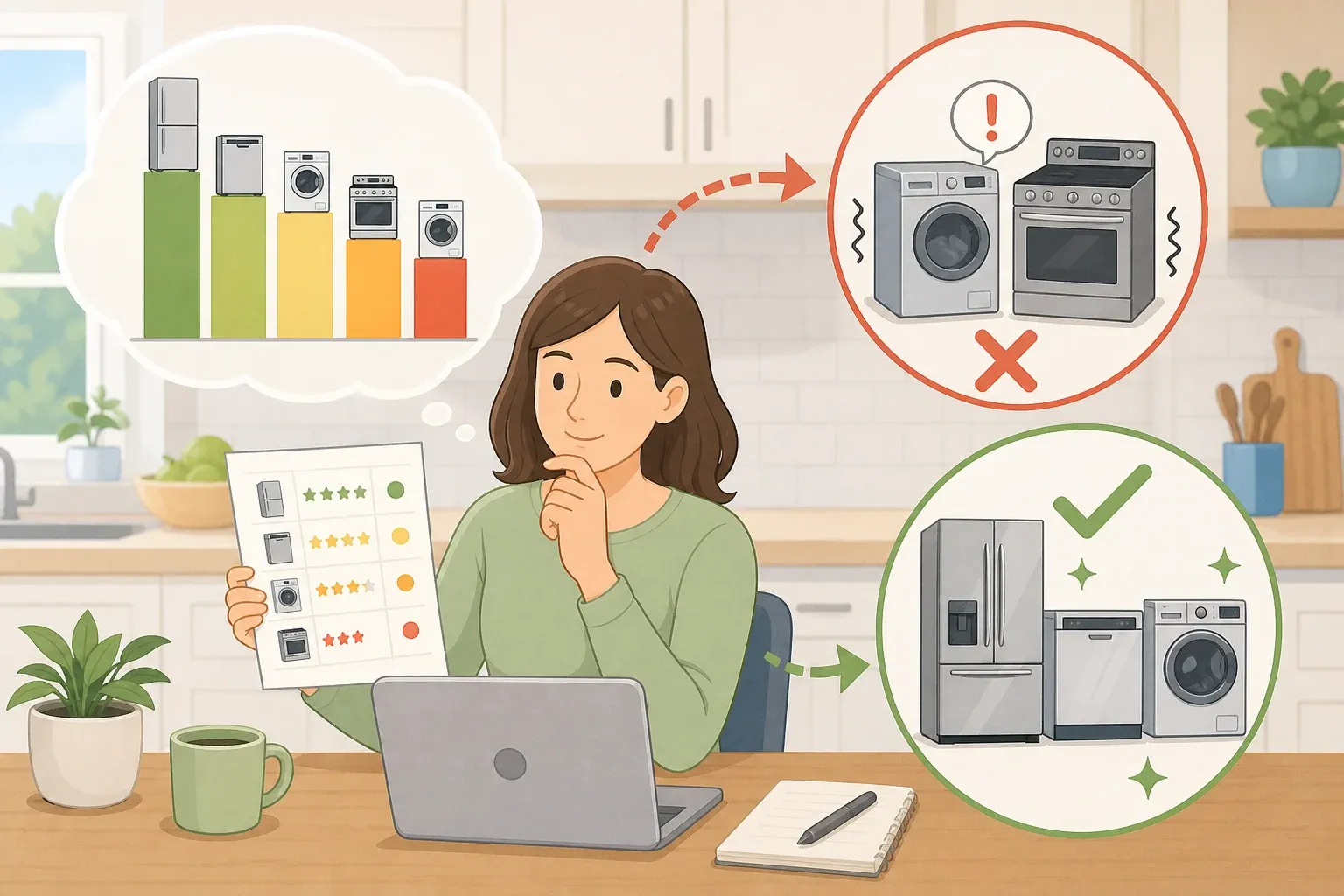
Search "appliance brands to avoid," and you'll find plenty of listicles naming five villains. Neither J.D. Power nor Consumer Reports actually publishes that ranking. They track reported problems, predicted long-term reliability, owner satisfaction, and repurchase intent, four different measurements that don't add up to a single "avoid this brand" verdict.
That doesn't mean the data has nothing to say. Among all new refrigerators purchased since 2015, 49% have developed a problem, such as an inability to make ice or a broken compressor, according to Consumer Reports. Separately, customers who run into any problem with their appliance brand are far less likely to buy that brand again: 52% of trouble-free owners say they'll definitely repurchase the same brand, versus 32% of owners who hit a problem, according to J.D. Power's 2025 Reliability & Service Study.
By the end of this guide, you'll know which specific configurations and features carry the most documented risk, which brands lead reliability within each category in that 2025 J.D. Power study, and how to compare two finalist models side by side, a more useful exercise than hunting for one brand name to cross off a list.
What the reliability data actually flags
One configuration shows up repeatedly in the research: Samsung French-door refrigerators. Many of the complaints in Consumer Reports' member survey trace back to that specific model type, which the organization rates poorly for both predicted reliability and owner satisfaction. Worth knowing before you shop that configuration specifically.
That's not a reason to write off Samsung appliances broadly, though. The same brand's side-by-side refrigerators ranked highest for customer satisfaction among all side-by-side models in J.D. Power's 2026 satisfaction study, scoring 750 out of 1,000 two months ago. Performance shifts by configuration inside the same brand, which is exactly why a five-name blacklist falls apart under scrutiny. The rest of this guide walks through what holds up instead.
Why there's no single list of appliance brands to avoid
J.D. Power's reliability study covers appliances bought within the past one to three years and scores them using problems per 100 units, or PP100, the average number of reported problems for every 100 appliances of that type. A lower PP100 means fewer problems. Its separate satisfaction study measures how owners feel about using the product, a related but different question than how often it breaks. Consumer Reports' refrigerator and dishwasher data come from member surveys covering purchases made between 2015 and 2025, and for icemaker-equipped refrigerators specifically, that survey produces a longer-range estimate of failure by the fifth year.
Those two lenses don't always agree. Samsung's French-door refrigerator ranked highest for satisfaction among French-door models in J.D. Power's 2026 study at 733 points, the same model line Consumer Reports flags for poor predicted reliability. Neither source is wrong. They're answering different questions: one about how buyers feel early on, one about how often the appliance actually fails over years of ownership. Keep that split in mind for every number in this article, since satisfaction and reliability measure two different things and neither substitutes for the other.
Refrigerators: where the least reliable refrigerator brands overlap with one feature
Consumer Reports estimates that 31% of refrigerators with icemakers will develop a problem by the end of the fifth year of ownership, based on responses covering more than 71,534 icemaker-equipped units purchased between 2015 and 2025. The organization calls that one of the least reliable outcomes it tracks for any product category, a finding specific to icemaker-equipped units rather than refrigerators generally.
The same survey identifies what's actually failing: icemakers and water or ice dispensers are the two most commonly reported refrigerator problems. Read that as "these features fail often," not "these features cause failure." Consumer Reports isn't comparing identical units built with and without an icemaker, so it can't isolate the feature as the cause, only flag where the complaints cluster.
Brand performance also shifts by configuration. J.D. Power's 2025 study measured three refrigerator types, and GE led all three:
French-door: GE (65 PP100); Whirlpool (68 PP100)
Side-by-side: GE (52 PP100); Whirlpool (60 PP100)
Top-mount freezer: GE (51 PP100); Frigidaire (56 PP100)
The runner-up changes with the layout: Whirlpool for French-door and side-by-side models, Frigidaire for top-mount freezers. A shopper choosing a French-door refrigerator with an icemaker should check both the brand's French-door reliability score and the icemaker problem rate above, since the data doesn't show how the two combine in any single model. Treat them as two separate things to verify, not one combined risk number.
Dishwashers and washers follow the same pattern
About 21% of dishwashers owned by Consumer Reports members have broken down or stopped performing properly, with failure to clean (9%), dry (7%), or drain (7%) as the leading complaints, from a survey of more than 66,000 members. The organization's separate predicted-reliability ratings draw on data from roughly 77,000 dishwashers across 27 brands.
J.D. Power's 2025 study ranked reliability leaders across these same categories:
Dishwasher: KitchenAid (63 PP100); Bosch (64 PP100); GE (64 PP100)
Front-load washer: GE (83 PP100); Samsung (84 PP100); Whirlpool (88 PP100)
Top-load washer: GE (60 PP100); Maytag (70 PP100); Whirlpool (71 PP100)
Consumer Reports separately found that Bosch, Miele, and Thermador dishwashers have shown strong reliability in its member surveys. Each of those three brands also sells several models priced above $1,000, according to Consumer Reports, so weigh reliability against sticker price rather than assuming the highest-rated option fits every budget.
Front-load washers carry the highest reported problem rate of any category J.D. Power tracks, at 89 PP100 overall. Whirlpool's own numbers make the case for checking configuration over brand name: it scores far better in top-load washers (71 PP100) than in front-load (88 PP100). Same badge on the front, different machine underneath.
Connected features carry a documented problem rate, not a guaranteed failure
Appliances with Wi-Fi or Bluetooth report an average of 87 problems per 100 units, compared with 63 PP100 for non-connected models. Among owners who actively use those smart features, the rate climbs to 92 PP100, versus 80 PP100 for owners who have the features but don't use them.
Michael Taylor, J.D. Power's senior managing director of retail practice, said modern appliances have grown far more sophisticated and packed with more technology than earlier generations, and that added complexity brings a greater chance of something going wrong. That's a documented association between connectivity and higher instances of reported problems, not proof that connectivity itself causes them. Still worth weighing before paying extra for an app-connected feature that might rarely get opened.
When you need a repair: service scores and repurchase intent
Reliability data shows how many problems owners reported during the study period. It says nothing about what happens after something breaks. GE leads J.D. Power's appliance service-experience ranking with a satisfaction score of 778 out of 1,000, followed by Samsung at 768 and Whirlpool at 765. Those scores come from customers who had an in-home technician visit coordinated by the brand, evaluated across six measures: scheduling ease, timeliness, quality of the work performed, courtesy, technician knowledge, and professionalism.
That's narrower than it sounds. It reflects the brand-coordinated repair experience for customers who used it, not local authorized repair availability, warranty terms, or parts cost in a given area. Check local coverage separately before assuming a strong national score applies in any specific zip code.
This is where the repurchase numbers matter most. A reliability score doesn't say how a brand handles a repair once something breaks, but the drop from 52% to 32% repurchase intent after a problem, cited earlier, shows the handling matters almost as much as the breakdown itself.
How to compare two finalist appliances
Once a purchase is narrowed to two or three models, run each one through the same checklist.
Match the exact configuration. French-door versus side-by-side versus top-mount, front-load versus top-load, standard versus premium-tier dishwasher. Scores don't carry over between these lines, even within the same brand.
Look up the closest available brand-and-category rating, either J.D. Power's PP100 score or Consumer Reports' predicted-reliability rating for that configuration. These are category-level numbers, not exact-model scores, so check model-specific reviews and the manufacturer's spec sheet for feature and warranty details the aggregate figure doesn't capture.
Check the satisfaction score separately. It measures how owners feel about using the product, not how many problems they report.
Weigh the expected ownership timeline. Consumer Reports' five-year icemaker estimate applies specifically to icemaker-equipped refrigerators, not every appliance category. Keeping something five-plus years makes that longer-window data more relevant; replacing appliances every couple of years puts more weight on J.D. Power's PP100 numbers.
Flag icemakers, dispensers, and Wi-Fi or Bluetooth as features with a documented association with higher reported problems, then decide whether the convenience is worth that risk given how the appliance will actually get used.
Compare warranty length and what's covered. This shapes repair cost exposure once the return window closes.
Confirm a brand-authorized repair option exists nearby before assuming a strong national service score applies locally.
Work through it in order: eliminate any model with a weak reliability record for the exact configuration wanted, decide whether features like ice makers or app connectivity are worth their associated problem rate for the household, then use satisfaction scores and confirmed local service support to break a tie between close finalists.
If two models land within a few PP100 points of each other, the score alone won't decide it. Check what each warranty actually excludes, not just its length. Count how many extra features each model adds, since more features generally track with more reported problems. Then look for model-specific reviews or owner reports on the exact unit, not just the brand average, before making the call.
What this means for the next appliance purchase
Three areas stand out across the data: icemaker-equipped refrigerators, where Consumer Reports estimates a 31% chance of a problem by year five; front-load washers, the highest reported problem rate of any category J.D. Power tracks; and connected appliances, at 87 PP100 versus 63 PP100 for non-connected models.
GE leads all three refrigerator configurations J.D. Power measures and both washer configurations, while KitchenAid leads dishwashers. None of that guarantees performance in a different product line from the same manufacturer. That's exactly why the checklist above, run against the two actual finalists, beats scanning for a brand name to rule out before shopping even starts.



Comments
Be the first, drop a comment!