





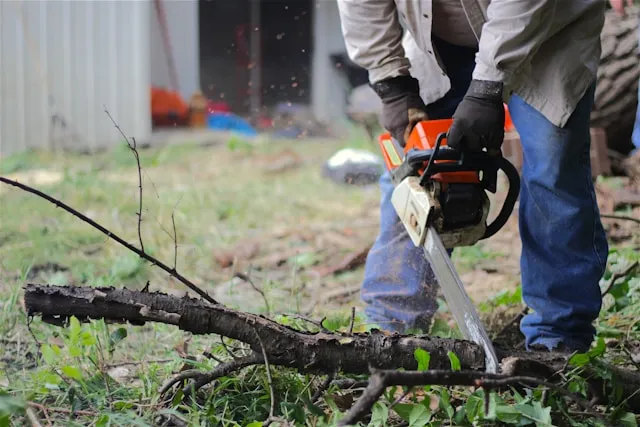
A mini chainsaw earns its keep on small, ground-level jobs you can see and control from the first cut to the last: brush, downed branches, logs already on the ground. Mini chainsaw safety starts with respecting what the tool isn't built for: anything overhead, unstable, or close to a power line. Tree-work injury data shows why that boundary matters.
A forensic review of 64 tree-related deaths in Connecticut between 2004 and 2019 found that 56 involved blunt-force trauma from a falling limb or tree, compared with a single death tied directly to a chainsaw blade. That's one dataset, but the pattern holds up: the real danger in tree work is usually what the cut piece does after it comes loose, not the saw itself.
These mini chainsaw safety tips walk through where a mini chainsaw actually fits, a pre-cut checklist worth running every time, which jobs call for a different tool or a professional, and how to confirm your saw's safety features are working before you pick it up. None of this requires special training. It just requires knowing where the line is before you start cutting.
What a mini chainsaw is actually safe to use for
A mini chainsaw is a small-material, ground-level tool. That's the whole job description, and it's worth keeping in mind before every single cut. This is beginner-friendly work as long as it stays inside that scope.
Stick to material you can reach standing on solid ground, no ladder, no stretching overhead. Small logs, brush, and branches that have already come down are the target use case. The wood should be sound and either living or recently cut, not split, cracked, leaning under tension, or damaged by a storm. Unstable wood moves unpredictably once it's cut through, and that kind of struck-by injury sits behind most fatal tree-work incidents.
Before the saw even starts, know exactly where the cut piece is going to land, and confirm that space is clear of people, pets, and property. If you can't answer that with certainty, don't make the cut yet.
Follow your specific model's manual for bar length, chain tension, and the materials it's rated to cut. Compact chainsaws are generally sized for brush and smaller-diameter wood, not sustained work on large trunks, so check the manual rather than assume your saw can handle more than it was built for.
What you'll need before you start
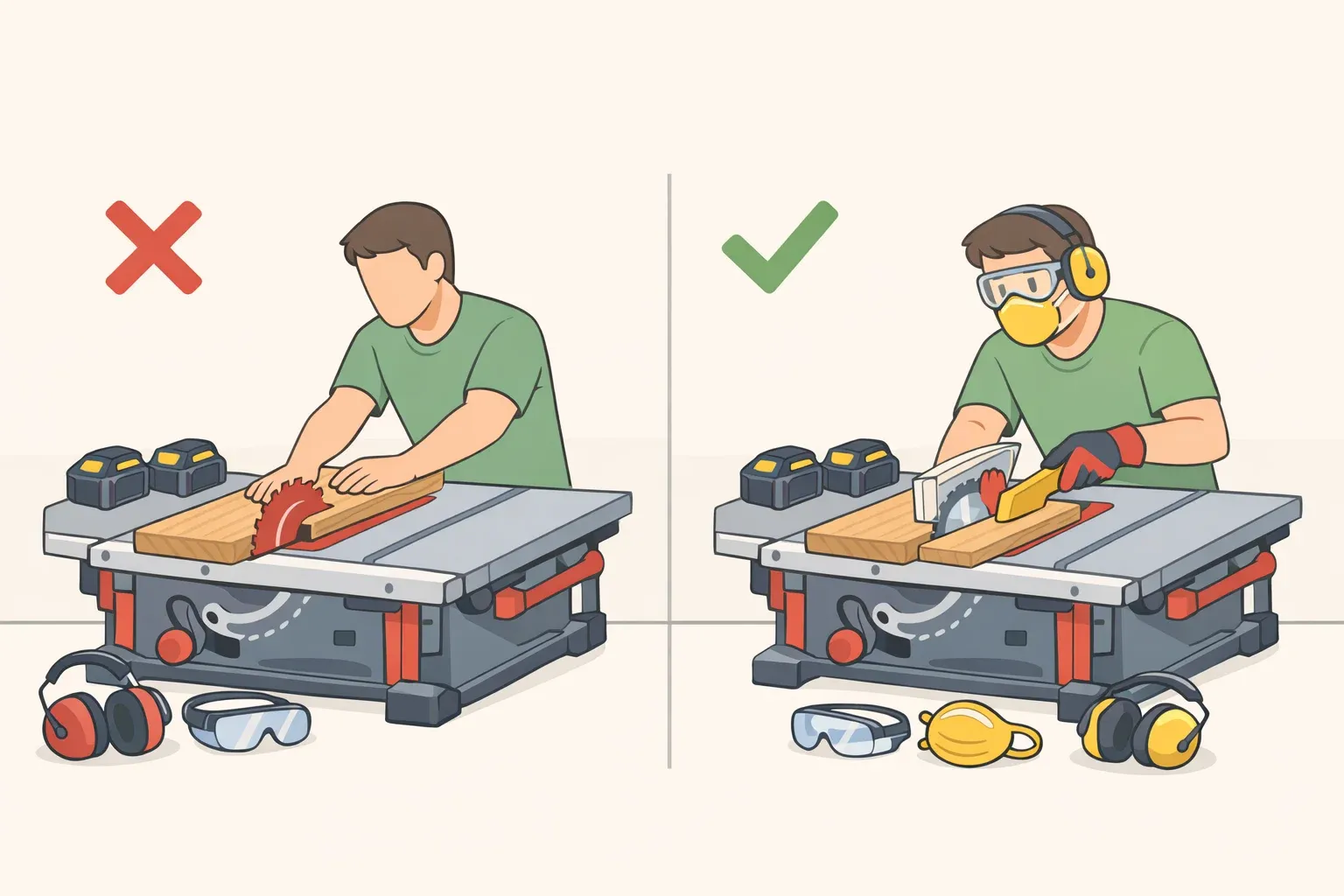
Basic PPE matters even for small jobs. Wear eye protection, gloves, long pants, and sturdy closed-toe boots at a minimum, and skip loose clothing that could catch on the chain. If the saw is loud enough that you'd want hearing protection for any other power tool, wear it here too.
Don't cut alone if you can help it. Have another adult nearby, or at least aware that you're out there cutting. That's not caution for its own sake: nonprofessional woodcutters who died in the Connecticut study were working alone 67% of the time, compared with 11% of professionals. Someone within earshot changes what happens if a cut goes wrong.
Run this pre-cut safety checklist before every cut
Falling or shifting wood, not the blade, is what kills people in tree work. In the same Connecticut review, being struck by a falling tree or limb accounted for 78% of fatal events among woodcutters. That's the reason this checklist exists, and it's worth running before every cut, not just the ones that feel risky.
Are you working at ground level, with no ladder and no reaching overhead?
Is the wood sound and stable, not dead, split, leaning, storm-damaged, or bound under tension?
Is your footing dry, flat, and stable, not a slope, wet ground, or a ladder?
Are you rested, sober, and cutting in decent light?
Can you stay completely outside the path the cut piece will fall or roll?
Is the landing area clear of people, pets, vehicles, and structures?
Are there no power lines anywhere near this branch or tree?
Is another adult present or aware that you're cutting?
If the answer to any of these is no, stop. The job has moved outside a mini chainsaw's safe scope, and pushing through anyway is where most preventable injuries happen. Fatigue and alcohol use are part of that pattern too: nonprofessional woodcutters who died were more likely to have alcohol in their system than professionals, 19% versus 11%.
When not to use a mini chainsaw
Every "no" on that checklist has a specific answer, not a workaround. Here's how to match the situation to the right response.
Small, ground-level growth, sound wood, clear landing area: The mini chainsaw is the right tool. For branches under about wrist thickness, bypass pruners or loppers give you more control without motor risk.
Light branches reachable from the ground, in an open area, where you can stay outside the fall path: Use a manual or powered pole pruner, but only when the branch is light enough that its fall is predictable. Cut material still passes overhead briefly, so this is not suitable for heavy limbs.
Any branch touching or growing near a power line: Stop completely. Contact your utility company or a line-clearance-qualified tree crew.
Dead, split, leaning, storm-damaged, bound-under-tension, overhead, or heavy limbs: Call a certified arborist or tree service.
You're alone, fatigued, impaired, cutting in poor light, or standing on unstable footing: Stop and reschedule, or have another person there before you start.
A bigger chainsaw doesn't fix any of these. The risk factor is height, instability, or proximity to power lines, not blade length or motor power. Swapping tools inside the same risk doesn't change the outcome.
Tools to use instead of a mini chainsaw
For anything that lands in the "use something else" column, a couple of tools cover most yard work.
Bypass pruners and loppers work well on live growth and small dead branches. Position the blade close to the trunk or main stem, keep the cut perpendicular where you can, and let the tool's design do the work instead of forcing it through. No motor, no chain, no kickback.
A pole pruner extends that same reach without putting you underneath the branch. Stand off to the side of where the branch will fall, keep both hands on the pole, and never use one to reach above shoulder height or from a ladder. If the branch is heavy enough that you're unsure where it's going to land, that's the signal to stop and call a professional instead of just reaching for a bigger tool.
Mini chainsaw tree trimming safety: when to call a pro
Power line work is where the stakes jump fastest, and it doesn't take a homeowner mistake to prove it. On May 20, 2024, an arborist trimming the lower branches of a 60-foot tree in Georgia was fatally electrocuted when the stabilizing line he was using made contact with a residential power line. A Department of Labor investigation, made public in late 2024, found the power line sat less than 10 feet from the worksite, and that the contact was preventable. OSHA issued four serious violations and proposed $29,035 in penalties against the tree service contractor.
That case involved a trained arborist, not a homeowner with a mini chainsaw, but the lesson carries over directly. Distance from a power line isn't something to judge by eye, and a stabilizing line, pole, or piece of equipment doesn't have to touch the wire on purpose to become dangerous. If any part of a branch, tree, or the equipment you'd use to cut it comes anywhere near a power line, that job belongs to your utility company or a line-clearance qualified crew, not a chainsaw of any size.
Check your saw's safety features and recall status before you cut
A saw that fits every item on the checklist still isn't safe to use if its safety features aren't working. Three recalls last year are worth knowing about, even if your specific model isn't on the list.
About 7,180 DR Power battery-powered chainsaws were recalled after 20 reports of fire, sparks, or smoke tied to motor controller overheating; no injuries were reported.
About 49,000 corded chainsaws and pole saws sold under the Hyper Tough, Worx, and Portland brands were recalled after a switch defect that could let the saw keep running even after the trigger was released.
About 90,860 Milwaukee M18 FUEL top-handle chainsaws, in 12- and 14-inch bar versions, were recalled over a chain brake that might not engage; the company logged two reports of the brake failing, including one lacerated finger.
Check your saw's exact model and serial number against the current CPSC recall list before you use it. Then follow the owner's manual to test whatever safety features your saw actually has, since not every mini chainsaw includes a chain brake, and switch behavior varies by model.
These recalls involve specific named products, including larger 12- and 14-inch top-handle saws, not a defect pattern across mini chainsaws as a category. Treat it as a reason to check your own model and serial number, not a reason to distrust compact saws in general.
Before your next cut
Run the checklist every time, even on a job that looks routine. If everything checks out — ground level, stable wood, a clear landing area, PPE on, someone nearby, and your saw's safety features tested — you're set to make the cut.
If the job fails on any point, that's not a job for a mini chainsaw at all. A branch near a power line goes to your utility company or a line-clearance qualified crew. A dead, leaning, storm-damaged, or overhead limb goes to a certified arborist. Everything else on that list is a reason to put the saw down until conditions change, not a reason to switch to a bigger blade.


Comments
Be the first, drop a comment!