



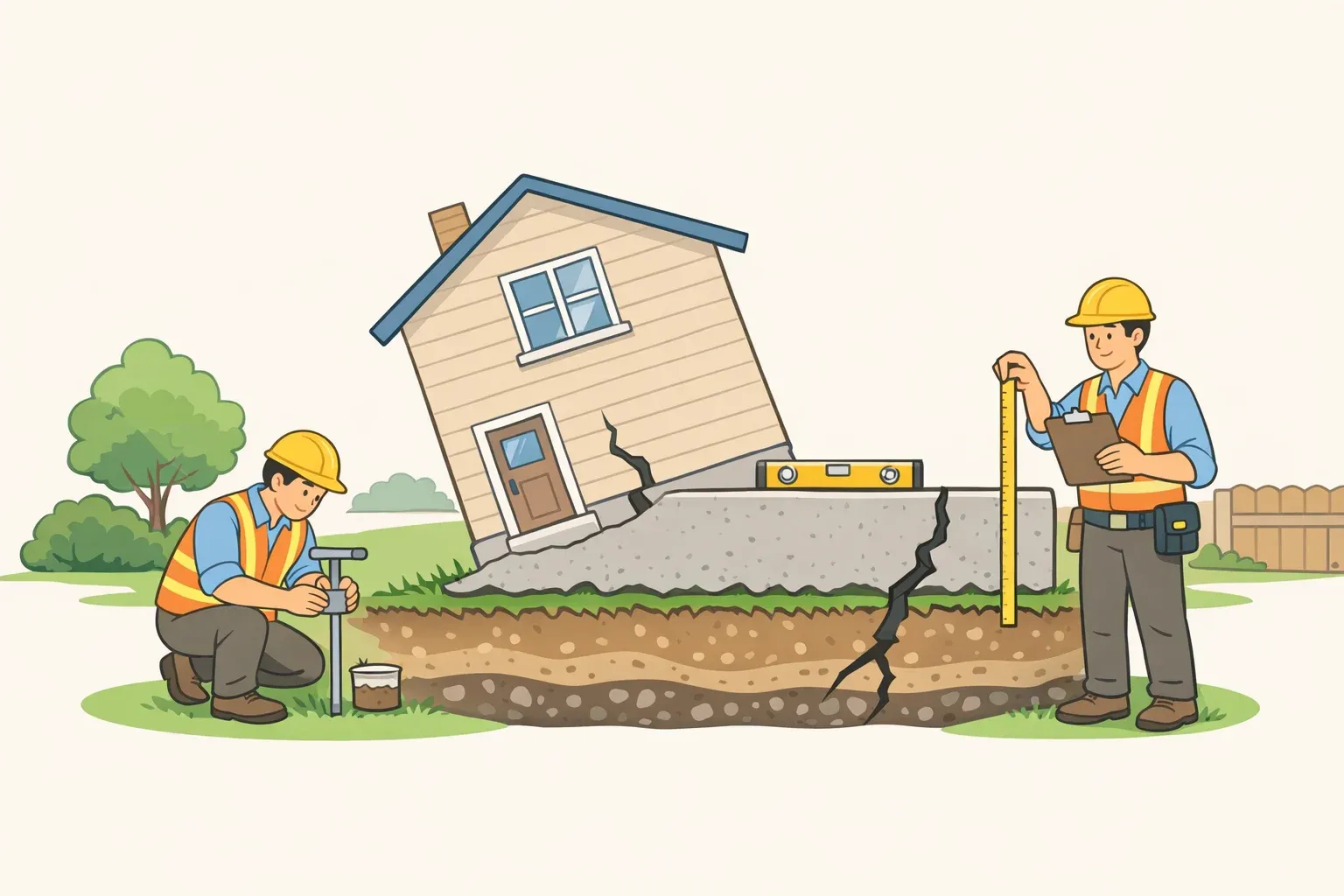
How to Protect Your Home From Foundation Damage Before You Buy
In North Las Vegas, a neighborhood called Windsor Park has been sinking for more than six decades. Built in the 1960s over geological fault lines, its homes and roads began subsiding after groundwater was pumped from an underlying aquifer. Residents have described sloping floors, walls splitting at the seams, doors that no longer fit their frames, and the daily fear that the structure around them might give way, according to Las Vegas Review-Journal reporting from October 2024. A Review-Journal article from 1988 shows residents were raising identical complaints nearly four decades earlier. The problem was not sudden construction failure. It was invisible, cumulative, and ground-driven from the start.
Windsor Park is an extreme case, but a clarifying one. The forces behind it unstable soils, aquifer depletion, fault proximity, and the compounding effect of nearby heavy construction are not unique to one neighborhood. They operate under houses across the Southwest and beyond, in places where buyers never think to ask. A separate North Las Vegas case, a fire station built in 2009 that began sinking within a few years of completion, shows the same risk applies to newer structures, not just aging housing stock.
This guide covers one argument from start to finish: ground-driven structural damage is almost never sudden, it always leaves early warning signs, and the most effective protection is the work done before the house is purchased, not after the walls start moving. It walks through how to recognize the signs of foundation damage in a house, how to conduct due diligence before buying in a geologically active area, and what to do and who to call if a house is already shifting. It also explains why insurance and legal recovery often fail to make homeowners whole, and why that makes front-end diligence the only reliable protection.
What causes a house to tilt: three ground conditions buyers should understand
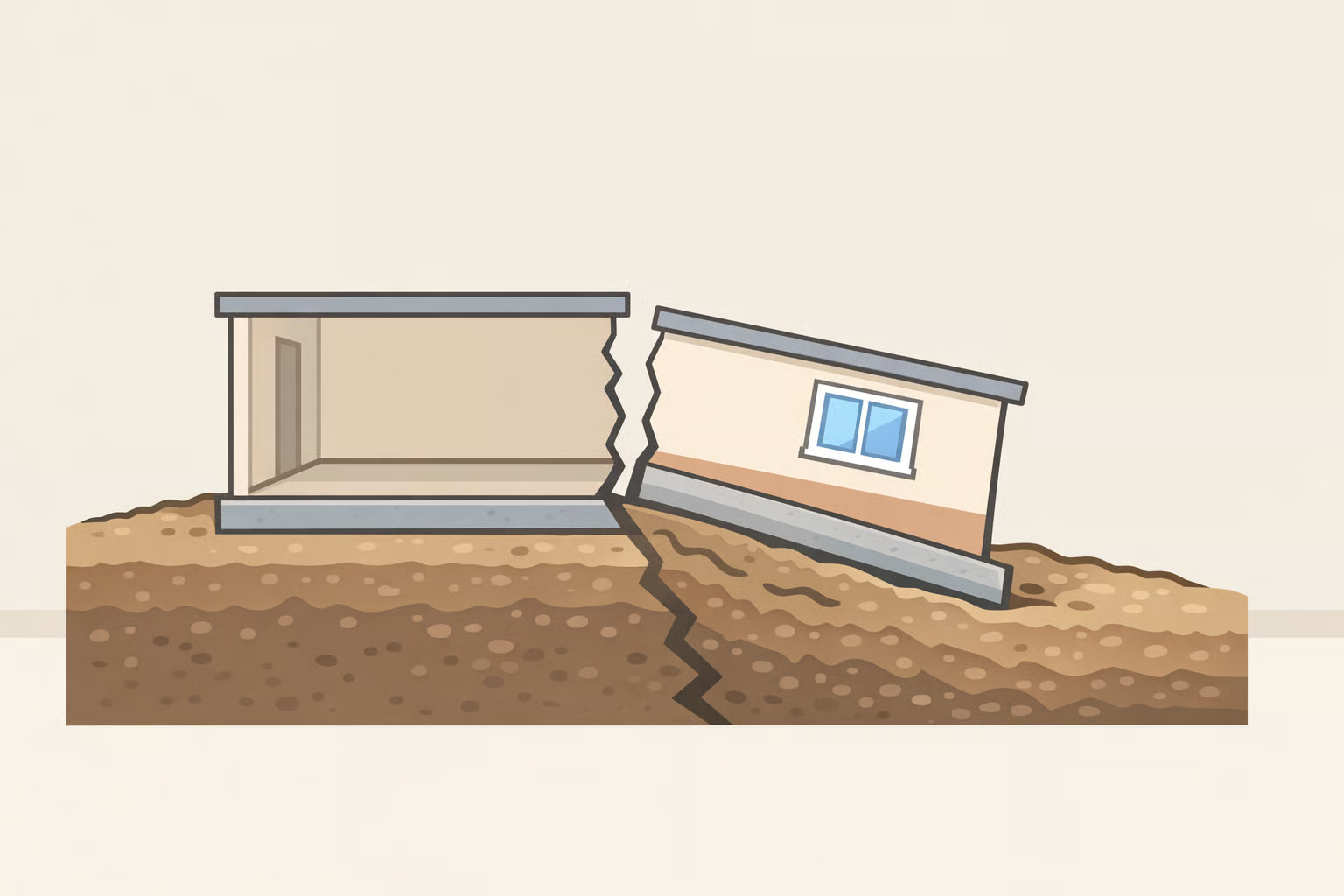
Foundation failure does not begin with the house. It begins with what the house is sitting on.
Windsor Park illustrates three distinct ground-level mechanisms that every buyer in a high-risk area should understand.
Geological faults and differential settlement. Windsor Park was built directly over fault lines. As the ground along those faults moved unevenly over decades, structures settled at different rates, a process called differential settlement. One side of a slab or foundation drops faster than another, which is why residents end up with visibly slanted floors and doors that bind in their frames, as Review-Journal reporting from October 2025 documents. The broader Las Vegas–Lake Mead region has documented active strike-slip faulting, according to USGS research published in April 2025. That finding suggests fault proximity is a relevant screening criterion for buyers in the region, even though parcel-level risk requires site-specific geotechnical assessment to confirm.
Aquifer drawdown and land subsidence. When large volumes of groundwater are extracted from underground aquifers, the soil layers above compact and sink, sometimes by inches, sometimes by feet, and rarely at a uniform rate. Windsor Park's sinking accelerated after regional pumping drew down the aquifer beneath the neighborhood, the Review-Journal reported in October 2025. This pattern appears across arid regions where water demand outpaces natural recharge, making aquifer history a reasonable pre-purchase research item in any desert metro.
Expansive soils. Fire Station 53 in North Las Vegas, built in 2009, developed wall cracks and slab fractures within just a few years of opening. After investigating, the city discovered the building was sinking into the ground. Officials attributed the cause to expansive soils, clay-heavy ground that swells when wet and contracts when dry, exerting cyclical pressure on any foundation above it, according to the Review-Journal reporting from October 2025. Repairing that single building cost more than $5.4 million. The structure was less than a decade old when the damage became severe.
Nearby construction as a risk amplifier. Windsor Park residents reported that a commerce park built in 2023 worsened existing structural problems and created new ones, the Review-Journal reported in October 2024. Heavy equipment vibration, changed drainage patterns, and altered soil loading from adjacent development can accelerate movement in ground that was already marginally stable. If large-scale construction is underway or planned near a property under evaluation, treat it as a compounding risk factor, not a neutral condition.
The useful lesson is simple: construction quality matters less than site conditions. A well-built house on unstable ground can fail faster than an aging house on solid bedrock. Soil and geological conditions are the variable most buyers never research, and the one that most determines long-term structural risk.
Signs of foundation damage in a house: from early signals to escalation thresholds
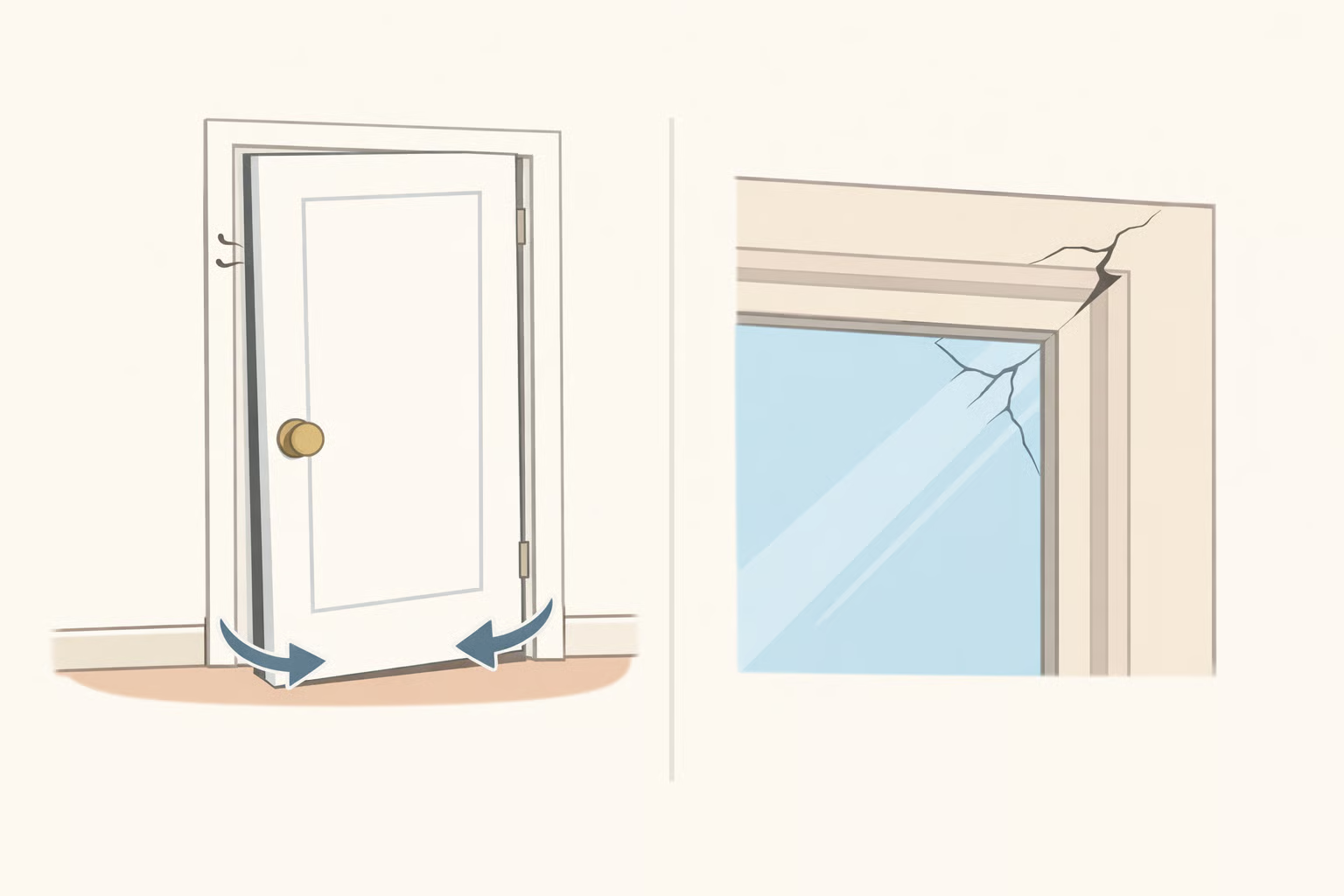
Foundation movement follows a predictable sequence. Early signs are easy to dismiss as cosmetic. By the time late-stage indicators appear, repair options narrow and costs rise steeply.
Early signals: monitor, but do not ignore
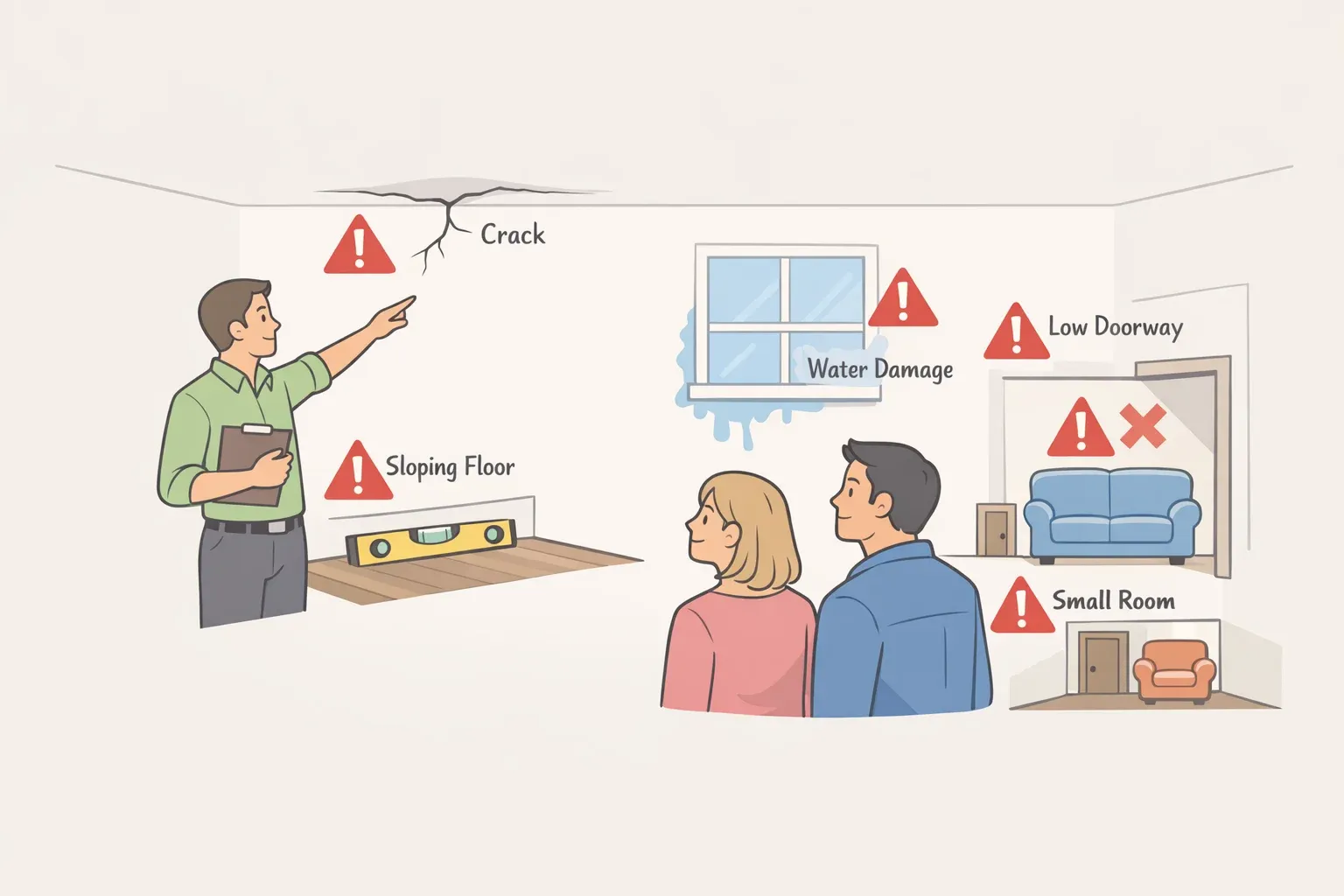
Start with interior doors and windows. Doors that stick, drag, or no longer latch, particularly those that previously worked fine, are among the earliest indicators of differential settlement. The door frame has racked slightly out of square. Windsor Park resident Eli Valdez noticed his door no longer fit its frame after buying in 2019; sitting in his living room, he could see the house had become slanted, the Review-Journal reported in October 2024. Do not replace the door and move on. Investigate the cause.
Look at floors across multiple rooms. Stand at one end of a long hallway and look down the floor plane. Place a level on the floor in several locations. Springy floors near exterior walls can signal foundation edge movement. A single sticking door or minor floor slope in an older home may be normal settling; the same signs appearing together, or worsening month to month, are not.
Hairline cracks in drywall near window and door corners are common in new construction. They move into warning territory when they widen over time, run diagonally from corners, appear at multiple locations simultaneously, or show displacement, meaning one side of the crack sits higher than the other.
Escalate immediately: do not monitor
Horizontal cracks in basement or crawl-space walls indicate lateral soil pressure and require professional review now, not at the next annual inspection. Stair-step cracking in brick or block veneer, gaps between the foundation and sill plate, and sections of the yard that have sunk relative to others are late-stage exterior signs.
At the neighborhood level, cracked roads, tilting utility poles, and uneven sidewalks were visible throughout Windsor Park for years before individual homes reached crisis stage, the Review-Journal documented in October 2025. That context matters when evaluating a block, not just a parcel.
The critical rule: Do not patch and move on. Spackling cracks, rehinging doors, or relaying floor tile without diagnosing the cause only delays the reckoning. If signs reappear within weeks or months, the ground is still moving.
Who to call
- Signs are new and isolated: document them with photos and dates, then re-examine in 60–90 days.
- Signs are multiple, worsening, or include horizontal cracking or displacement: call a licensed structural engineer. Not a foundation repair contractor. Engineers diagnose; contractors sell solutions.
- Signs include visible leaning, a sudden new gap at the roofline, or a door that jammed overnight: treat as a potential immediate safety concern and call an engineer the same day.
Understanding how to fix foundation settlement issues starts with getting the right professional on site. A structural engineer's written assessment tells you whether you have a maintenance problem or a site problem, and that distinction determines everything that follows.
How to prevent foundation problems before you buy: a practical checklist for high-risk areas
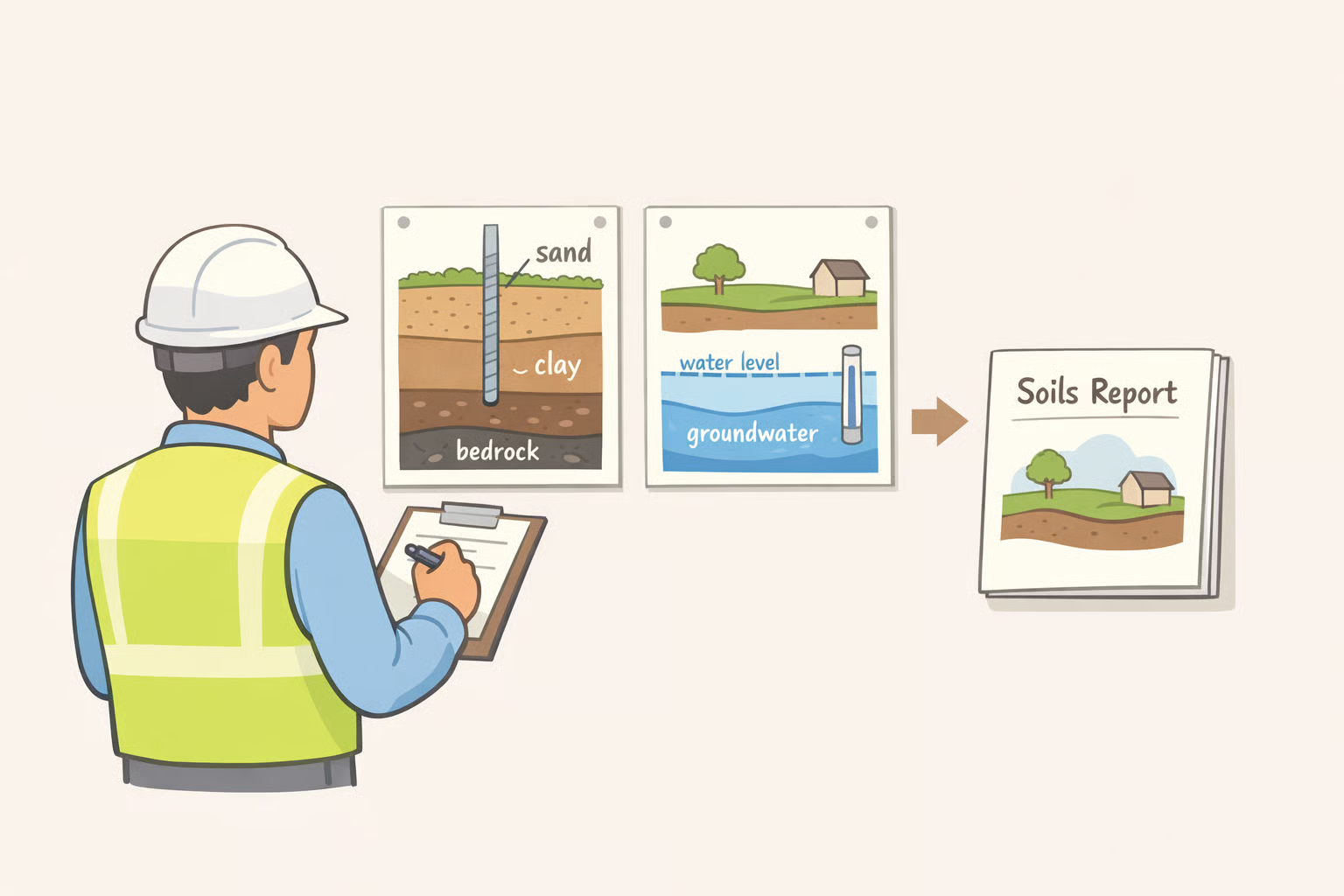
Most of the real protection happens before closing. The steps below apply to any buyer evaluating a property in an area with documented fault activity, expansive soil, or historical subsidence. They add cost and time to a transaction; they are also far cheaper than buying the wrong parcel.
Step 1: Pull and read the seller's disclosure statement in full. Nevada and most states require sellers to disclose known material defects, including prior foundation movement, drainage problems, and structural repairs. Ask explicitly, in writing, about settlement history, prior foundation work, and any insurance claims related to structural damage. "No known issues" is not the same as a clean foundation.
Step 2: Search permit records for the property and adjacent parcels. County and city building departments maintain permit histories. Look for permits related to foundation repair, grading, drainage modification, or structural remediation. Multiple foundation-related permits on a house under 20 years old is a clear trigger for deeper investigation. This search is typically free and takes under an hour.
Step 3: Check USGS hazard maps for fault proximity and landslide susceptibility. The USGS maintains publicly accessible interactive maps. For Nevada buyers specifically: the Nevada Division of Insurance puts the probability of a magnitude 5.0 or greater earthquake near Las Vegas within the next 50 years at 15 to 40 percent, based on USGS data, according to a Nevada Division of Insurance publication from January 2023. Nevada ranks third nationally for major earthquakes, behind only Alaska and California. Regional fault proximity does not determine parcel-level risk, but it tells you whether a geotechnical report is warranted.
Step 4: Commission a geotechnical evaluation when the threshold is met. A standard home inspection covers visible and accessible conditions. It does not assess soil type, groundwater depth, compressibility, or subsidence history. A geotechnical engineer's report, sometimes called a soils report, does. Expect to pay $500–$2,500 depending on scope and location.
When it's worth the cost: Order a geotechnical review if any of the following apply:
- The property is within a mile of a mapped fault
- The neighborhood has documented subsidence or expansive soil
- The permit history shows prior foundation work
- The home inspection notes any slope, cracking, or door/window binding
- The property is in a desert metro with a history of aquifer drawdown
Treat it the same way a standard inspection is treated: a prerequisite for closing, not an optional add-on.
What to ask the engineer for: A written report that identifies soil type and classification, any evidence of prior movement or differential settlement, groundwater depth and seasonal variation, and a professional assessment of foundation risk. Ask directly whether a standard slab or pier-and-beam foundation is appropriate for the site conditions.
Step 5: Price earthquake and earth movement coverage before closing. Standard homeowner's policies specifically exclude damage caused by settlement, subsidence, earth movement, and sinkholes. Earthquake insurance is available as a standalone policy or endorsement in Nevada and most states, but take-up rates remain low, according to the Nevada Division of Insurance. Get a quote before closing, not after moving in. If the premium is prohibitive, factor that into the purchase price negotiation.
Quick pre-purchase checklist:
- [ ] Seller disclosure reviewed; settlement and repair history confirmed
- [ ] Permit records pulled for subject property and immediate neighbors
- [ ] USGS fault and hazard maps checked for the address
- [ ] Standard home inspection completed
- [ ] Geotechnical report ordered if threshold criteria are met
- [ ] Earthquake/earth movement insurance quoted and evaluated
How to protect your home from foundation damage before warning signs appear
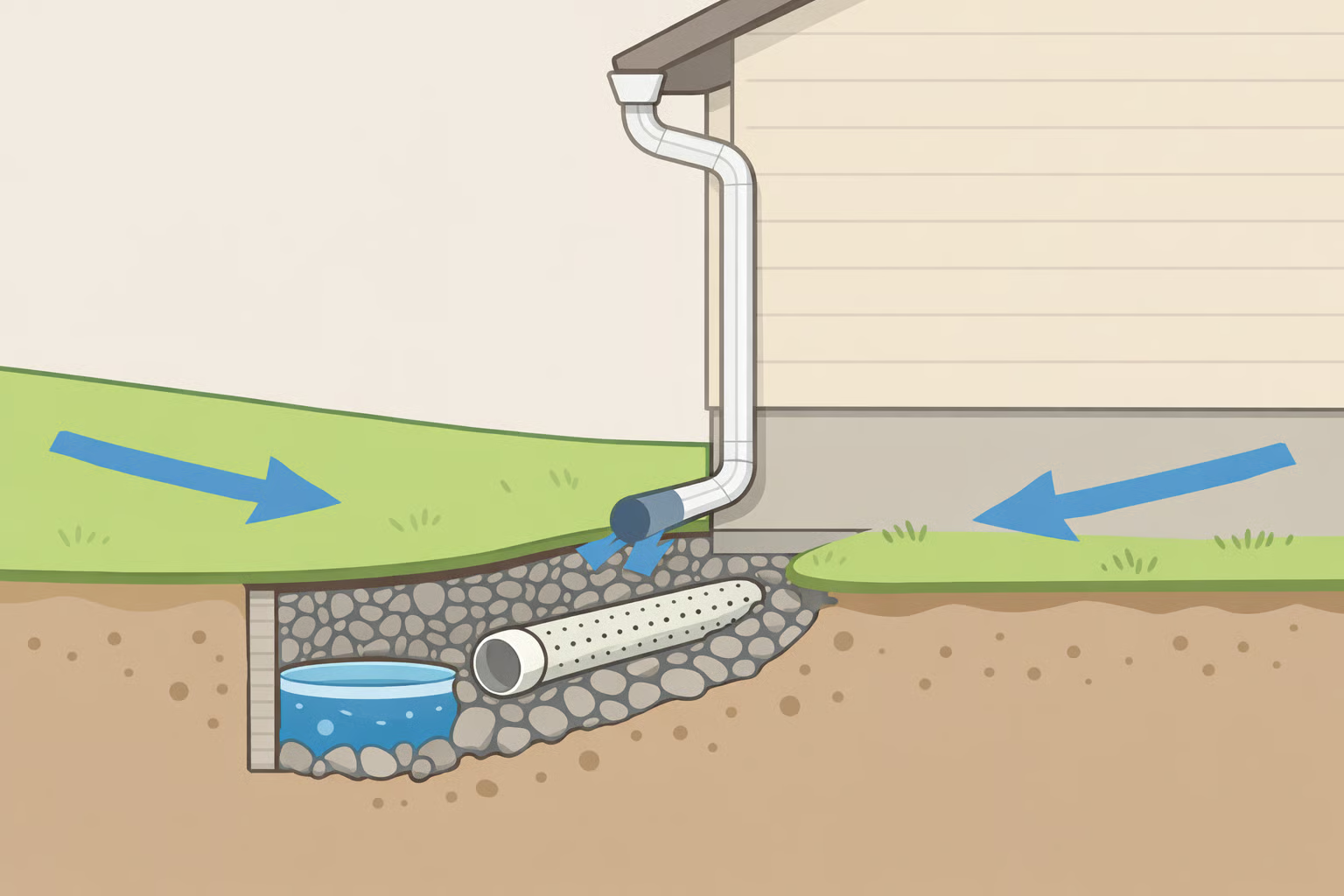
For existing homeowners, the goal shifts from screening to monitoring and maintenance. Some risk can be managed; the most severe site-driven failures cannot be prevented by upkeep alone. The steps below address what is actually within a homeowner's control.
Step 1: Manage drainage at the foundation perimeter. Keep gutters clear and extend downspouts at least six feet from the foundation. Water pooling against a foundation wall is the single most controllable driver of expansive soil damage. It costs almost nothing to fix and prevents the swell-shrink cycle that cracks slabs and stem walls season after season.
Step 2: Grade the yard away from the structure. The ground should slope away from the foundation on all sides, ideally dropping at least six inches over the first ten feet. Landscaping changes, mulch buildup, and settling soil can reverse this grade over time. Check it after any significant landscaping work.
Step 3: Water consistently near expansive soil. On clay-heavy soil, extreme swings between wet and dry are more damaging than either condition alone. During dry spells, a slow soaker hose run along the foundation perimeter a few feet out can keep the soil moisture relatively stable. The goal is not to saturate it is to prevent the dramatic shrinkage that pulls support from beneath a slab edge.
Step 4: Manage tree and large shrub placement. Tree roots seeking moisture will follow irrigation lines and foundation perimeters. Large trees planted within ten to fifteen feet of the foundation can exert enough root pressure and moisture extraction to cause differential settlement over time. This is especially relevant on clay soils. If mature trees are already close to the structure, monitor the adjacent foundation edges more frequently.
Step 5: Check for irrigation leaks near the foundation. A slow, steady leak from a drip line or in-ground irrigation system running close to the foundation can saturate soil unevenly over months, producing the localized swelling that tilts slabs. Walk the irrigation perimeter at the start of each season and look for soft or sunken ground.
Step 6: Establish a documented baseline and re-examine annually. Photograph the foundation and all visible exterior walls. Record the location and approximate width of any existing cracks. Note whether any doors or windows bind. Repeat the same survey every year. What matters most is not the presence of a crack but whether it changes, and by how much, between inspections.
None of these steps address fault proximity or aquifer conditions. Those are site characteristics, not maintenance problems. A homeowner in Windsor Park could not have controlled the aquifer drawdown that caused their neighborhood to sink. The protection against that category of risk is screening before purchase. For those already in a house with active ground movement, the question is not how to prevent it; it is how quickly to identify it and what professional intervention is appropriate.
If you already own: the financial and legal reality
Most homeowner's policies exclude earth movement and settlement entirely, the exact failure mode most relevant to geologically active areas. North Las Vegas spent over $5.4 million repairing the sinking Fire Station 53 and recovered nearly $3 million through years of litigation, only after the Nevada Legislature extended the construction defect statute of repose to 10 years in 2019, giving the city a narrow window to file suit, according to the Review-Journal reporting from October 2025. The city's own legal filings acknowledged that causation and evidentiary problems complicated the case. Private homeowners face the same legal bar with fewer resources.
Public relief is possible but slow. Nevada's 2023 Windsor Park Environmental Justice Act allocated $37 million for replacement homes, but as of October 2024, more than a year after passage, none of the funds had been spent, and administrators warned that the December 2026 deadline would be difficult to meet, the Review-Journal reported at the time. Site work on the 93-lot replacement subdivision finally began in late 2025, the Review-Journal confirmed in October 2025. By the time public remedies materialize, residents have typically spent years in damaged homes waiting for a solution.
Three actions worth taking this week
Ground-driven structural damage is almost never sudden. Windsor Park residents described decades of sloping floors and sticking doors before their homes reached uninhabitable condition. Fire Station 53 showed cracks within a few years before officials discovered the building was sinking. In both cases, the early signals were there. The response was deferred.
1. If you are buying: Run the five-step checklist above on any property in a geologically active area. The threshold for ordering a geotechnical report is lower than most buyers assume, and far cheaper than discovering expansive soil after closing. Nevada ranks third in the country for major seismic events, according to the Nevada Division of Insurance; treat ground risk as a standard line item in due diligence, not an edge case.
2. If you own: Work through the six prevention steps above, establish a documented baseline today, and call a structural engineer, not a repair contractor, at the first sign of progressive change. The Fire Station 53 case is instructive: what began as soil-related cracking became a $5.4 million structural failure because intervention came years after the early warning signs appeared, the Review-Journal reported in October 2025.
3. Review your coverage now. Check your homeowner's policy for earth movement and settlement exclusions. Price a separate earthquake policy if you are in a seismically active state. The time to understand what a policy covers is before filing a claim, not after the walls have started moving.











Comments
Be the first, drop a comment!