



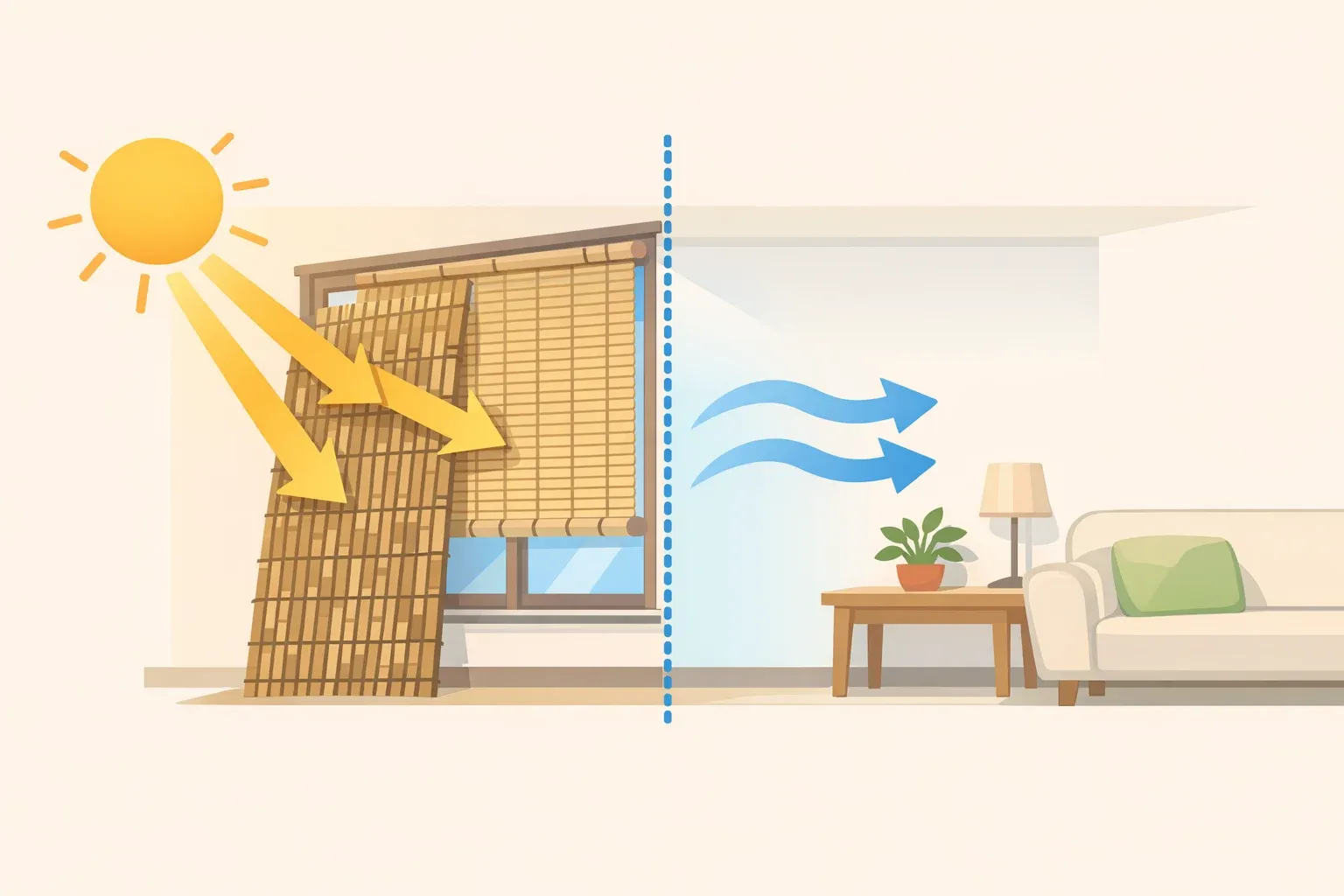
Indoor curtains are already too late. By the time solar radiation hits a blind or blackout curtain, it has crossed the glass. An exterior screen placed in front of the window intercepts that energy first, before it reaches the glass at all.
That is what makes exterior shading categorically different from anything you hang inside. This guide covers the technique specifically: exterior breathable shading using traditional Japanese woven reed panels, yoshizu and sudare, as one of the more practical natural ways to keep a house cool that building science has validated.
By the end of this guide, you'll be able to identify which windows are driving heat gain in your home, choose the right screen for the job, mount it correctly, and know what realistic improvement to expect.
Find the window causing the most heat gain
Before buying anything, spend one afternoon observing your home. The goal is to identify the primary heat source — the window or surface driving afternoon overheating.
Signs of direct solar gain:
Strong, sustained afternoon glare that tracks across a south-, southwest-, or west-facing window
The room becomes noticeably uncomfortable two to three hours after the sun first hits that glass
The area near the window feels distinctly warmer than the rest of the room
Signs of reflected heat gain (less obvious):
Lower windows overheat in the afternoon despite not facing the sun directly
A concrete balcony floor, tiled patio, or first-floor roof section sits below those windows, accumulating heat through the day
The problem worsens in the early to mid-afternoon, when those surfaces reach peak temperature and bounce radiation upward
One day of observation is usually enough. Note which window produces the most discomfort, and whether the heat source is direct sun or a reflective surface below. That answer determines whether you need a sudare, a yoshizu, or both.
What yoshizu and sudare actually do, and which problem each solves
The two screens handle different heat sources. That distinction determines which one you need.
Sudare are compact rollable panels, reed or bamboo strips bound with cord, designed to hang on hooks outside a window frame. Their job is direct solar radiation: sunlight aimed at the glass. That is the most common problem and the right starting point for most people.
Yoshizu are larger, heavier panels of woven wetland reed, traditionally positioned against exterior walls, balcony railings, and lower façades. Their job is reflected radiation, the heat that bounces off a concrete balcony slab, a tiled patio, or a first-floor roof section and travels upward into windows that may not even face the sun directly.
A J-STAGE study found that sudare and yoshizu helped keep a traditional Japanese house more than 5°C cooler than outdoors during summer days by blocking reflected heat. National Diet Library records show that people used the same method during the Edo period, opening doors for airflow while using screens to block direct sunlight.
The non-obvious takeaway for anyone with a balcony or patio: if your lower windows overheat in the afternoon despite not facing the sun directly, the problem is likely reflected heat from the floor below. A yoshizu leaned against the railing at an angle to intercept that upward radiation, which solves a different problem than a window-mounted sudare. Neither replaces the other.
Use this to decide:
South- or west-facing window receiving direct afternoon sun: sudare, mounted outside the glass
Balcony, concrete patio, or first-floor roof section reflecting heat toward lower windows: yoshizu, positioned to intercept both the reflective surface and the upward path to the glass
Both conditions present: both screens, which is how the approach was used historically
What makes both screens work is the same material property. Wetland reed grows with a hollow, straw-like stem, and that air pocket blocks direct sun heat before it reaches the glass. The woven structure, unlike a solid blind, stays open to the wind. Shade and airflow arrive at the same time, and that combination is the point.
Is this right for your home? A practical decision before you buy anything
Exterior reed screens work best when specific conditions are met. Check your setup honestly before purchasing hardware.
The setup that will benefit most:
A window or balcony exposure that receives direct sun during the hottest part of the day
The ability to open that window behind the screen, and ideally a window on the opposite side of the room to enable a cross-draft
Outdoor daytime temperatures that are hot but not in dangerous heat-wave territory, this approach helps delay and reduce overheating; it is not a safety solution when sustained outdoor temperatures themselves pose a health risk
The exterior surface is accessible for hook installation without scaffolding or landlord approval; you don't have
Where results will be modest, or this isn't the right tool:
Windows with little direct or reflected sun gain (ventilation still helps; the screen adds little)
Climates combining extreme heat with stagnant humid air and no prevailing breeze, where ventilative cooling offers limited relief when outdoor air itself is not cooler
Buildings with lease terms, HOA rules, or codes prohibiting exterior attachments
A dangerous, sustained heat event: exterior shading slows the rate of heat gain but does not replace mechanical cooling when outdoor temperatures are dangerous for extended periods
Honest expectation: One well-mounted exterior reed screen over a sun-facing window, with that window open and airflow possible, will slow how fast the room heats up during afternoon hours. It may reduce or delay AC use on moderate days. It won't cool a sealed, still room.
The 5°C indoor-outdoor temperature difference documented in the Tashibu house study came from a three-element system working together: night purge ventilation, deep roof eaves, and exterior shading with sudare and yoshizu. The screen is essential to that system. It is not the whole system.
In practical room terms, a correctly placed sudare means reduced afternoon glare without closing the window, less heat buildup near the glass, and a delayed onset of that point in the afternoon where the room becomes uncomfortable. Less heat accumulates in the walls and floor to radiate back at night.
How to cool down a room without AC: choose the right reed screen
Material: Reed sudare is the standard choice for windows. Quality tracks closely with stalk wall thickness. Thicker reeds provide a larger insulating air gap and hold up significantly better under sun and rain. Budget options at home improvement stores are typically made from thin imported reed that degrades faster. That's a useful heuristic rather than a guaranteed specification, but it tracks well with what separates durable screens from disposable ones.
In traditional yoshizu production for tea shading, craftspeople separate yoshi (resilient, thick, straight stalks) from ashi (thinner stalks with higher water content, unsuitable for construction). The same selection logic applies when buying quality sudare: look for uniform, thick-walled stalks and tight, even binding cord.
Bamboo sudare are denser than reed and outlast them in raw durability. If the installation gets full afternoon sun and you want a screen that holds up over multiple seasons with minimal maintenance, bamboo is the better investment.
Sizing: For a sudare, cover the full window opening width, not just the glass pane. The frame and surrounding wall absorb heat that radiates inward; shading only the glass leaves that source unaddressed.
For a yoshizu, size to intercept the reflective surface feeding heat toward the window: the concrete floor area below the balcony railing, the lower roof section, or the wall face that accumulates afternoon sun. Lean the panel at an outward angle from the railing so it blocks both the upward bounce off the floor and direct sun hitting the outer face of the railing.
Hooks for sudare: Hook type must match your frame material. Aluminum sash frames use clamp-on hooks, no drilling required, which suits renters. Magnetic hooks are another renter-friendly option where the frame material allows them. Wood frames accept screw-in hooks for a more stable hold. Adhesive-backed hooks work on smooth exterior surfaces; check the adhesive condition regularly in hot weather, as heat can soften some formulations. Check the weight rating before purchasing a full-size reed panel gains weight when wet, and a screen catching wind while damp places significant additional load on each hook.
How to install and maintain your screen
Prerequisites: Screen panel sized to your opening, hooks matched to your frame type, stepladder if needed.
Step 1: Mount hooks at the upper outer corners of the window frame. Position each hook so the screen rod hangs clear of the glass with a 2-5 cm gap between the screen and glass. That gap allows air circulation and lets rainwater drain without pooling against the frame. Confirm each hook is fully seated before loading any weight.
Step 2: Hang the rod and check that the panel hangs plumb and swings freely. A panel pressed flat against the glass loses its ventilation function and its ability to drain after rain. If it contacts the glass, move the hooks outward.
Step 3: Check clearance at the bottom edge. The lower edge should clear any sill hardware, crank, or latch without rubbing against it. Contact points can wear through the binding cord quickly.
Step 4: Open the window behind the screen. This step is not optional for the full effect. Exterior shading reduces heat entry; open ventilation is what prevents warm air from pooling in the shaded-but-stagnant zone. Where the layout allows, open a window on the opposite wall to pull a cross-draft through. The screen blocks outside eyes and filters glare while the moving air does its work, per MADE in JAPAN.JP.
Step 5: Roll and secure the screen before any forecast of strong wind or storms.
⚠️ Sudare catches the wind like a sail. If a hook pulls free under load, the panel can swing hard into the glass or fall from height. Bringing it inside for a day is inconvenient; a broken window is considerably worse. When the wind picks up, bring it in.
For a yoshizu on a balcony: Lean the panel against the railing at an outward angle and secure it to the railing with rope or cord through the weave. It should not be free-standing or able to tip outward onto the space below. On windy days, bring it in or secure it flat.
Maintenance: After rain, let the screen air dry completely before rolling it for any reason. Rolling damp reed traps moisture inside the hollow stalks and creates ideal mold conditions, per MADE in JAPAN.JP. Surface dirt responds to a gentle water rinse followed by complete drying.
At season's end, air the screen over several dry days before rolling for storage. Store flat in a ventilated space, not upright (which stresses the binding cord) and not in a sealed container.
Surface mold, light discoloration: brush off outdoors, wipe with diluted neutral detergent or rubbing alcohol, dry thoroughly. Deep mold means blackening of the binding cord or the interior of the stalks. At that point, spores are embedded past the surface layer; cleaning provides temporary relief, but the problem returns.
The system behind the screen
A well-mounted exterior reed screen solves a specific and tractable problem: it stops solar and reflected heat before it crosses the glass, which indoor curtains and blinds cannot do. That principle is both the oldest trick in Japanese summer architecture and what a peer-reviewed simulation study published in Building and Environment validates in building-science terms.
The study tested five passive cooling strategies across five climate zones. In projected long-term heat waves, solar shading was the top-performing single strategy, cutting peak effective indoor temperature by 4°C compared to an unshaded baseline.
Ventilative cooling reduced peak temperatures by up to 5.6°C in some scenarios; it was also the only strategy to consistently speed recovery from heat waves, though the study found this required careful design to capture favorable wind conditions.
Most other strategies could reduce the impact of a heat wave but could not accelerate recovery. An exterior reed screen supports the shading principle directly and can complement ventilative cooling when the window behind it is open, but the screen alone is not a substitute for the broader ventilation strategy the study modeled.
Start with the hottest window. Mount a sudare outside the glass, open the window behind it, and open a window on the opposite side of the room if the layout allows. If a concrete balcony floor or first-floor roof is bouncing heat toward your lower windows, add a yoshizu angled to intercept that reflected path, the problem the Tashibu house research specifically identifies. When outdoor temperatures drop in the evening, open the house fully to flush accumulated heat from walls and floors before the next day begins. Airflow is what makes the shading strategy pay off.





Comments
Be the first, drop a comment!