



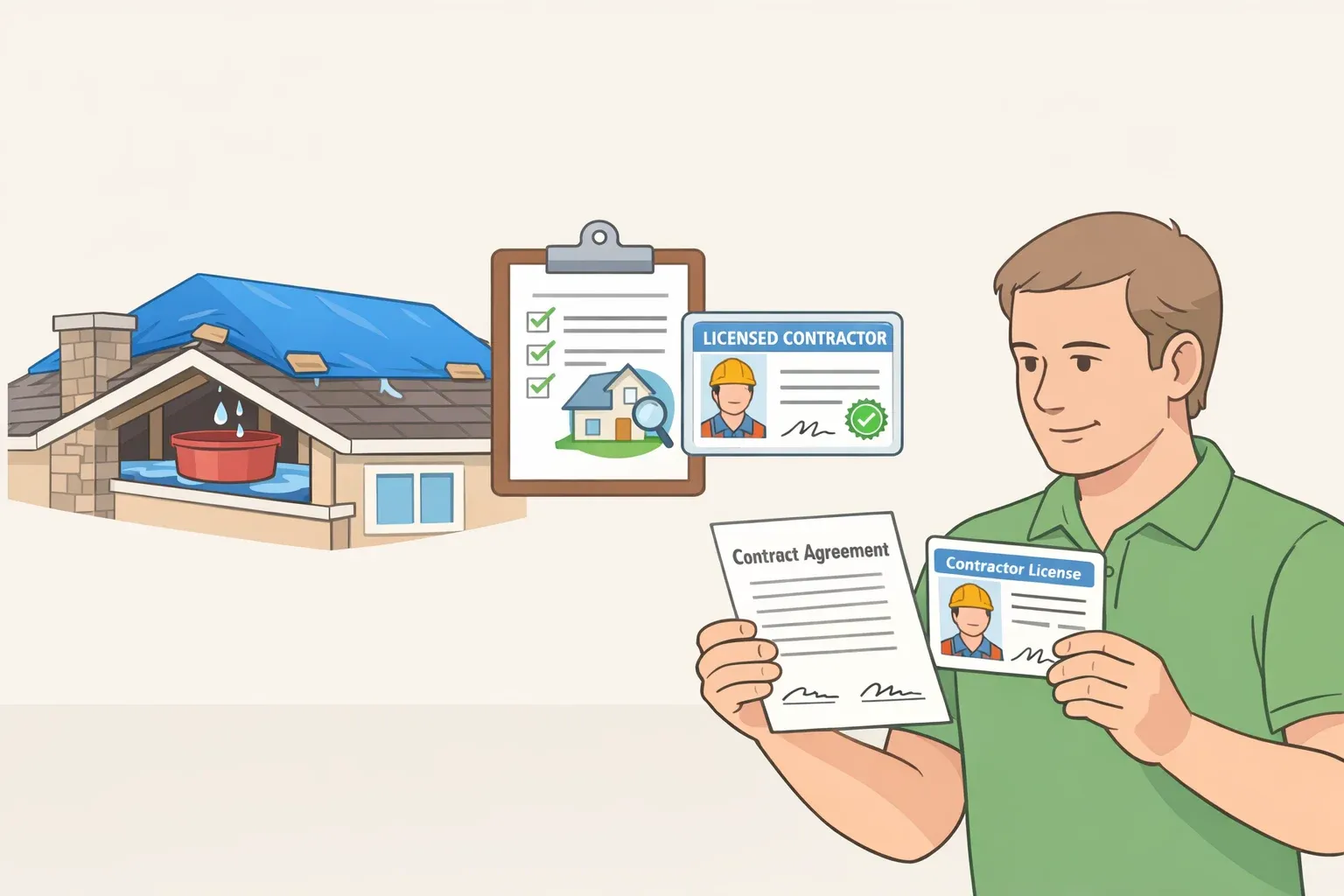
The roof is leaking, a contractor is at the door offering to start tomorrow, and you haven't had time to think. That's exactly the scenario this guide is built for. By the end, you'll know how to verify a licensed roofing contractor in Northern California, what to demand in writing before any work begins, and which red flags justify walking away even when the ceiling is dripping.
Before you call anyone: stop damage, document, notify
Three things need to happen before contractor selection begins, and the sequence matters.
1. Stop active water intrusion first. Emergency tarping or temporary dry-out work can be authorized immediately without a full contractor commitment or a signed contract. You do not need to choose your permanent repair contractor before protecting the property from further damage.
What you can approve right now:
Emergency tarping over breached areas
Interior dry-out and moisture mitigation
Debris removal from the roof surface
What to hold off on signing:
Full replacement contracts
Assignment of benefits language, which transfers your insurance claim rights to the contractor
Any deposit beyond a nominal emergency mobilization fee
2. Document everything before any repair work starts. Photograph and video the roof exterior, interior ceilings, walls, and any affected systems. United Policyholders advises storm-affected California homeowners to prioritize documentation and prevent further damage before making any repair commitments. The photos taken in the first 24 hours are often your strongest evidence if a claim dispute develops later.
3. Notify your insurer now, not after you've signed with a contractor. Many policies set deadlines of 180 days to one year to complete repairs and receive full payment, and that clock runs regardless of whether you've called. Review your policy to confirm whether you have Actual Cash Value (ACV) coverage, which deducts depreciation, or Replacement Cost Value (RCV), which covers full replacement minus your deductible.
Standard California homeowners' policies typically cover wind-driven rain and fallen tree damage but exclude flood, mudslide, and debris flow. Knowing this before talking to contractors tells you what scope you'll be funding through a claim versus out of pocket.
Why the timing problem is real: Major storms overwhelm local contractor capacity fast. When dozens of neighborhoods take damage simultaneously, licensed contractors are in short supply, and out-of-area operators fill the gap quickly. Post-storm contractor fraud is a documented pattern in California, not a theoretical one.
The FTC estimates that about 22% of roofing scams involve a contractor who collects a partial payment and disappears. California Insurance Commissioner Ricardo Lara has explicitly warned residents to watch for illegal contractor activity and verify CSLB status before signing anything. The steps below account for that reality.
Step 1: Verify the CSLB C-39 license before the first appointment
This is how to hire a roofing contractor in Northern California without getting burned, and it starts with a five-minute database check. Go to the CSLB license lookup tool and search by the contractor's legal business name or license number before they arrive for an estimate.
Check each of these fields:
License status: Must read "Active," not expired, suspended, revoked, or inactive
Classification: Make sure the license specifically includes "C-39 Roofing." A general B license does not cover roofing work in California
Bond status: California requires a $25,000 contractor license bond filed with the CSLB; confirm it's current
Workers' compensation: Must show active coverage, or a valid Certificate of Exemption for sole proprietors with no employees
Complaint and disciplinary history: A single resolved complaint may be unremarkable; a pattern is not
Business name match: Confirm the registered name on CSLB exactly matches the company you're dealing with. Some contractors present a valid license that belongs to a different entity
Request a Certificate of Insurance at the same time. California does not mandate general liability insurance by statute, but reputable roofing contractors carry it. Ask for a COI showing general liability coverage before work begins. This protects you if a crew member damages your property.
A few legal points worth knowing: under California Business and Professions Code Section 7028, any roofing job valued at $500 or more requires a licensed contractor, and operating without one is a misdemeanor carrying fines up to $15,000 and potential county jail time.
Homeowners who hire unlicensed contractors lose access to CSLB consumer protections, the contractor license bond, and the state's dispute-resolution programs, the same tools that become essential if a job gets abandoned or comes in substandard. California law also requires licensed contractors to display their CSLB license number on all contracts, vehicles, and advertising, including websites and social media. If it isn't visible anywhere, ask for it directly. If they can't produce it, stop.
No active C-39 on CSLB means do not proceed. An expired, inactive, or mismatched license is a disqualifier, not a starting point for negotiation.
Step 2: Questions to ask a roofing contractor before the estimate
Run a brief verbal screen by phone or before the estimator sits down. This filters out contractors who hold a valid license but have a problematic track record, or who are new to the region and unfamiliar with local permitting requirements.
1. What is your full legal business name and CSLB license number? You've already looked this up; now confirm they match. Asking the question tells an experienced contractor you've done your homework. A fumbled answer is worth noting.
2. How long has your company operated under this exact name? Contractors who rebrand frequently often cycle away from complaint histories. Five years is a low bar; ten or more years under a consistent name is a meaningfully stronger signal of stability, per contractor vetting guidance from Owl Roofing. Think of longevity as a practical filter, not a guarantee.
3. Can you provide two references from completed jobs in my area within the past year? A contractor with a genuine local presence should be able to name recent customers in your county without a long delay. Operators who've just arrived from out of state typically cannot. Inability to produce local references isn't proof of fraud, but it's a signal worth taking seriously.
4. Who pulls the permit? The correct answer is always the contractor. If they suggest you pull it yourself, they're likely unlicensed or trying to avoid inspection. California requires building permits for roof replacements in virtually all jurisdictions; any contractor claiming otherwise is either misinformed or misleading you.
Walk away from any contractor who can't name local references, who suggests you pull permits, or whose business history is too thin or fragmented to verify.
Step 3: Compare written estimates by scope for Northern California storm roof repair
When estimates arrive, read them line by line. A significantly lower bid almost always means something has been removed, downgraded, or omitted rather than negotiated more efficiently. Low-ball bids frequently conceal missing work or non-compliant materials, per RoofPredict.
A complete estimate must itemize:
Permits, listed separately and never bundled with labor. Bundled permits are a sign that costs are being obscured
Tear-off and disposal
Labor
Materials with specific product names or model numbers, not generic terms like "architectural shingles." Generic descriptions give the contractor room to substitute cheaper products after you sign
Underlayment type: #30 felt or approved synthetic, specified explicitly. California requires at a minimum one layer of ASTM D226 Type II or equivalent for slopes 4:12 or greater
Flashing type specified, and whether it's being replaced or reused. Reused flashing on a storm-damaged roof is a leak waiting to happen
Whether all components, ridge vents, drip edge, and ice-and-water shield at valleys and eaves are included or excluded
Full tear-off or roof-over? Ask this directly. A complete tear-off lets the crew inspect the decking, install fresh underlayment, and find hidden water damage common after the kind of sustained wet weather Northern California sees during atmospheric river seasons.
A roof-over installs new shingles over old ones, masking existing problems and shortening the new roof's lifespan. California also limits asphalt shingle roofs to a maximum of two layers; if the existing roof already has two, a tear-off is required by law.
Ask about change orders before work starts. Hidden damage discovered during tear-off is common after storm events. A credible contractor will communicate any additional scope in writing, get your approval, and document the change before proceeding. An estimate that gives the contractor open-ended authority to add charges without your sign-off isn't a real estimate.
One code point worth checking: California's energy code mandates cool-roof products on residential re-roofing projects, with the current 2025 Title 24 edition having taken effect in January. That specification should appear somewhere in a compliant estimate; its absence is a quick indicator of whether a contractor knows current state requirements.
One illustration of the risk from underbidding: a contractor offering a suspiciously low price might use ASTM D3161 Class D shingles instead of the Class F rating required in high-wind zones, a substitution that can produce repair costs roughly 30% higher within five years if the roof fails in a subsequent storm. Don't compare bids by bottom-line price until the scopes are actually equivalent.
Step 4: Lock in protections before signing
A verbal agreement or a one-page form provides essentially no recourse if work is abandoned or inferior materials get substituted. Read every line before signing.
The contract must include:
Exact materials: shingle product name or model number, underlayment specification, flashing type specific products, not categories
Project timeline: start date, estimated completion date, and weather contingency terms (Safeguard)
Payment schedule: a deposit, a progress payment tied to a defined milestone such as dry-in, and final payment only after a completed walk-through. Industry guidance puts 10–30% as the standard deposit range; verify California's current home-improvement contract rules before signing, as state law may set different limits
Permit responsibility: named explicitly as the contractor's obligation
Change order process: Written homeowner approval is required before any scope additions proceed
Final inspection window: a defined period of 72 hours is a reasonable term to request during which you inspect completed work before releasing final payment
Dispute resolution clause: how disagreements get handled before either party escalates to litigation
Warranties: get three things in writing. How long is the workmanship warranty, separate from the manufacturer's material warranty? What exactly does it cover: leaks only, all labor, consequential damage? Does it transfer to a new owner if you sell? A transferable workmanship warranty adds real resale value; one that's verbal or buried in boilerplate is worth almost nothing.
A 2022 BBB survey found that 60% of roofing disputes involved missing or incomplete contracts, with 40% of those resulting in liens or lawsuits. That's not a remote risk; it's the baseline when paperwork is thin.
Don't sign a contract that omits material specifications, assigns permit responsibility to you, or lacks a final inspection window before full payment releases. Any contractor who pressures you to sign before you've reviewed your insurance claim is also a problem. The contract and the claim process run in parallel; the contract shouldn't lead.
What to do right now
A contractor who clears this process is identifiable without guesswork: an active C-39 license with a clean CSLB record, local references they can produce promptly, a fully itemized written estimate naming specific materials, a contract with milestone payments and both warranties in writing, and a permit pulled in their name.
If the damage is happening now, the sequence is:
Stop further water intrusion with tarps or dry-out; no full contract required
Photograph everything before any work touches it
Notify your insurer and confirm your coverage type before committing to the scope
Verify the license at cslb.ca.gov before any estimate appointment
Compare estimates on equivalent scope, sign a complete contract, and confirm the permit is filed in the contractor's name
The homeowners who end up in disputes typically skipped one step, usually the CSLB check or the contract review, because the roof was leaking and the contractor was standing at the door ready to start. That pressure is real. It's also the exact condition that fraud relies on. Start the lookup before you schedule the estimate. It takes five minutes, and it's the one step that can't be undone after you sign.
If something goes wrong: File a complaint with the CSLB at cslb.ca.gov or 800-321-2752. For insurance claim disputes, contact the California Department of Insurance at 1-800-927-4357.



Comments
Be the first, drop a comment!