



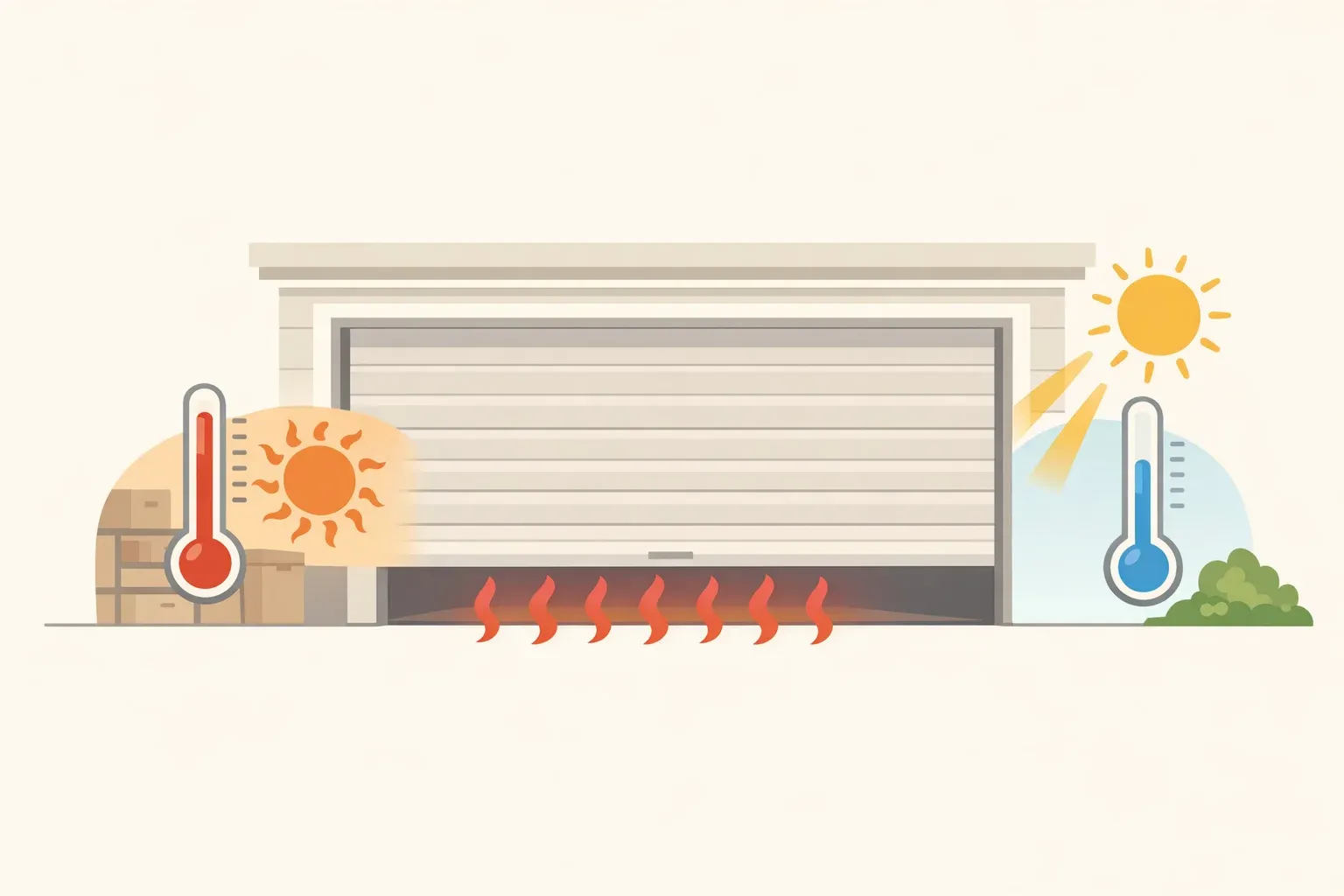
Walk into a Sunbelt garage at 4 PM on a June afternoon, and the thermometer will usually read 15 to 25 degrees hotter than the air outside, often landing somewhere between 105 and 120°F. In that environment, a lot of homeowners crack the garage door and wait for relief. Does opening your garage door cool it down? The honest answer is yes, but only under a narrow set of conditions. Outside them, the upside disappears fast.
In a dry climate, early morning or late evening, when outdoor air is genuinely cooler than what's accumulated inside, cracking the door flushes hot air and provides a real if modest benefit. During peak afternoon heat, or in a humid climate, it ranges from useless to counterproductive. The structure of the garage, not the lack of airflow, is the primary problem.
If the garage is attached to the house, there's a safety question to resolve before the ventilation question even applies. Negative air pressure inside a home can pull garage air, including carbon monoxide and combustion fumes, through shared walls and into living space, as the BPA Journal documented in early 2023. That's not a reason to avoid ventilation; it's a reason to approach it carefully.
This piece covers the three conditions that determine whether cracking the door is useful, the safety and code requirements specific to attached garages, and a decision-oriented list of what actually delivers summer relief.
Why ventilation alone can't win: the structural heat problem
The garage gets so hot because heat arrives from every direction simultaneously. Thin door panels absorb direct sun for hours. The concrete slab stores heat from morning through evening and keeps radiating it after the sun goes down. The walls carry far less insulation than the conditioned rooms just a few feet away. These aren't separate problems. They happen at the same time, continuously.
The clearest illustration of what goes wrong is the portable-AC scenario. A homeowner buys the biggest unit available, positions it next to a thin, uninsulated door, and the space still reads 88°F after three hours. The unit is doing its job. The building is undoing it. A cracked door runs into the same problem on a smaller scale. Moving air through an oven does not turn the oven off.
The DOE notes that heat moves through every component of a building's thermal envelope, walls, roof, floor, and doors, and especially through gaps where those components meet. A typical garage is an under-insulated envelope riddled with those gaps. Ventilation works on the air. It cannot remove heat that is still radiating inward from the structure itself.
Think of a car parked in full sun with the windows cracked. Moving air through the interior helps briefly. The roof and seats are still absorbing and re-emitting heat. You're perpetually running behind the load.
This is why the door-crack tactic has a ceiling. It addresses air temperature, not the heat source. The conditions that make it work are exactly the conditions where the structural load is already relatively low.
Does opening your garage door cool it down in summer?
For a detached garage, the answer comes down to three situations.
When it works: Early morning or evening, in a dry climate, when outdoor air is verifiably cooler than what's inside. This is the one scenario where the tactic earns its reputation. The temperature differential is real, fresh air replaces accumulated hot air, and the structural load has partially dissipated overnight. Open the door, let it flush, close it before outdoor temperatures climb.
When it doesn't: By mid-afternoon in many climates, outdoor air is at or near the garage interior temperature, sometimes higher. The door is exchanging hot air for equally hot air. You should not expect much cooling from that exchange.
When it backfires: Humid climates change the math entirely. Exhaust-only ventilation, including a cracked door, draws warm, wet outdoor air into a space that may actually be cooler and less humid inside. The result is condensation risk, higher conditioning costs, and a garage that becomes harder to cool, not easier, as the BPA Journal explained. What works in Phoenix can create a moisture problem in Houston.
The door crack is a timing and climate game. It's a narrow tool that works only when outside conditions are already doing most of the work. For an attached garage, there's an additional layer to consider before any of this applies.
The attached garage safety factor: what code requires before you ventilate
Attached garages are a different problem category.
When a home runs at negative pressure relative to the garage, a common condition when interior exhaust fans are running, air flows from the garage into the living space. Carbon monoxide and other combustion fumes travel that path. The BPA Journal identified this as the reason building codes specifically regulate attached garages as a separate problem from the rest of the house.
A strong air barrier between an attached garage and living space is mandatory. Shared walls must carry at minimum half-inch drywall on the garage side, ceilings under habitable rooms require 5/8-inch Type X drywall or the equivalent, and every penetration through shared walls must be air-sealed and fire-blocked. The only permitted connection between garage and house is a self-closing, fire-rated door with tight seals.
Connecting an attached garage to the home's forced-air HVAC system is both a code violation and a health hazard. The return-air setup that arrangement requires would route garage fumes directly through the ductwork and into the house. Ventilating the garage independently is appropriate; integrating it with the home system is not, per the BPA Journal.
The practical check costs nothing in equipment: verify the door to the living space is labeled fire-rated if required locally, confirm it's self-closing, and confirm the seals are intact before running any exhaust ventilation. That check is the precondition for everything else.
Cracking the main garage door in an attached structure isn't inherently dangerous. But it operates in a different safety context than a detached structure, and that context belongs first in the decision sequence, not last.
What to actually do: a decision ladder for a hot garage
What should you actually do? The answer depends on how quickly you need relief and how serious the problem is. Work down this list rather than jumping straight to equipment.
If you need a same-day temperature drop
Time any door-opening to early morning or late evening when outdoor air is genuinely cooler than garage air. A cheap indoor/outdoor thermometer confirms whether the differential is real. Skip peak-afternoon openings unless the outdoor reading is actually lower than inside.
In an attached garage, confirm the door to the living space is self-closing and well-sealed before running any exhaust ventilation.
If the garage is too hot every day, start with the building
Insulation is the single highest-use move before shopping for any cooling equipment, and can reduce required cooling capacity by 20 to 30 percent, often dropping the project into a cheaper equipment tier. The garage door is the priority target for anyone looking to insulate a garage door to reduce heat. It's the largest sun-facing surface in the room, and DIY insulation kits are available for a fraction of the cost of a door replacement.
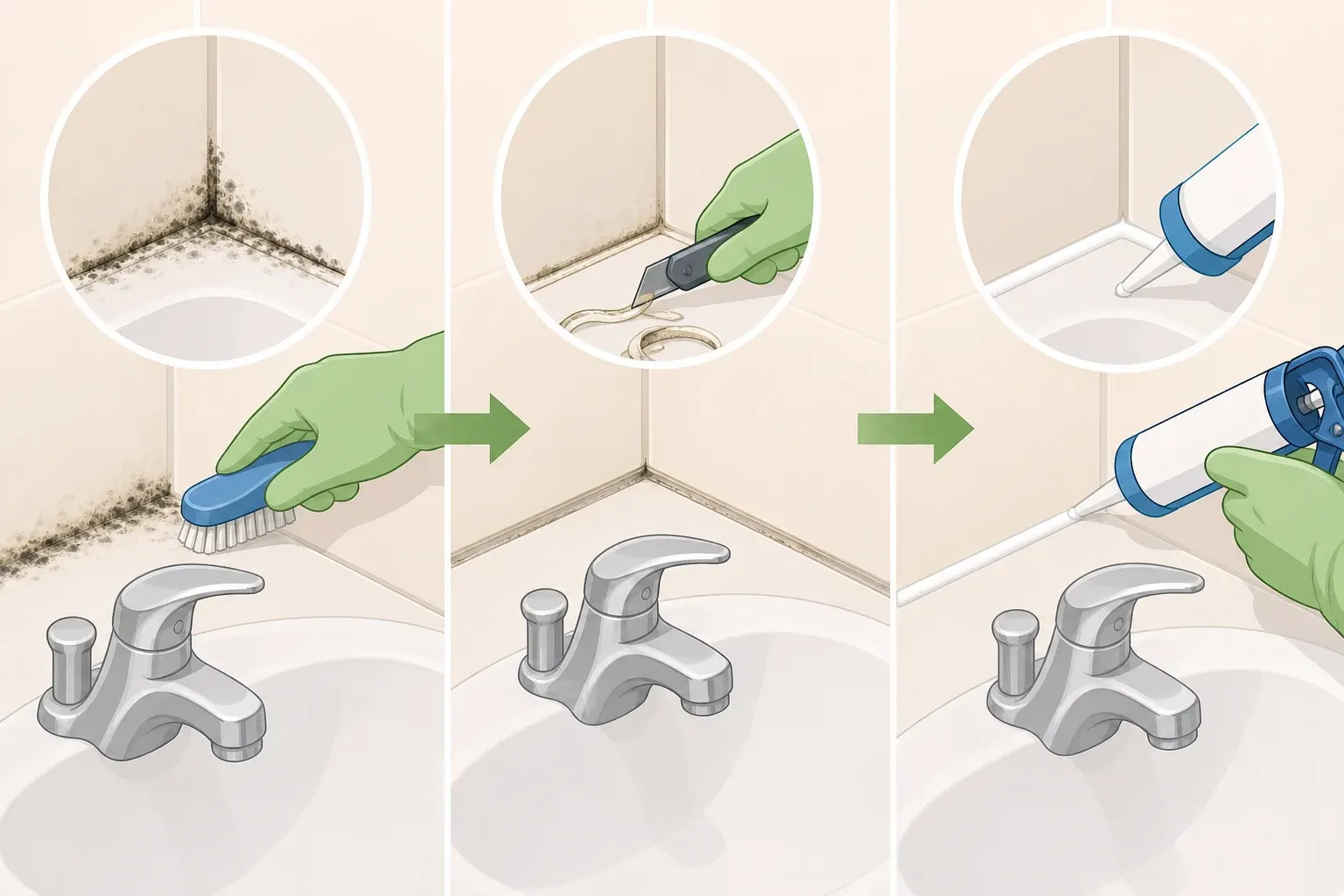
Caulking and weatherstripping are the fastest-payback air-sealing steps available, often recovering their cost within a year or less, according to the DOE. Construction gaps at wall-and-ceiling interfaces are sealed with foam backer rod, caulk, or low-expansion spray foam.
If you need regular garage ventilation for heat
Use a properly sized exhaust fan, not a cracked door. The starting point for sizing is 1 CFM of fan capacity per square foot of floor area: a 400-square-foot garage needs roughly a 400 CFM fan. A cracked door with no pressure differential and no clear exhaust path delivers a fraction of that airflow. A fan with a defined inlet is a functional tool; the door crack alone is not.
In humid climates, remember the BPA Journal's caution: exhaust-only ventilation draws warm, wet outdoor air into a potentially cooler space. If summer humidity turns out to be a problem after running exhaust ventilation, that's the point to evaluate dehumidification, not before.
If you want conditioned comfort, the best way to cool a hot garage
Do the envelope work first, then size the equipment. Most portable AC units are rated for spaces under 350 square feet, short of a standard two-car garage footprint before any adjustment factors. Skipping insulation and buying undersized equipment is the most common and most expensive mistake in this category. Skipping the adjustment for weak insulation, high ceilings, or strong south and west sun exposure is the single most common reason a brand-new system feels underpowered the first time a 95-degree day rolls through.
The decision, stated plainly
Before opening the door, ask three questions: Is the outdoor air actually cooler than the garage right now? Is this a dry climate? Is the garage detached, or is the air barrier confirmed? Yes to all three, crack the door. No to any one of them, the door isn't the tool the situation calls for.
The envelope is the use point. Sealing and insulating the building can cut heating and cooling energy use by 10 to 50 percent, depending on starting conditions. The garage door and perimeter gaps are the practical first targets: accessible, inexpensive to address, and they change what equipment you need downstream.
For attached garages, the IRC's air-barrier requirements exist because the pressure relationship between garage and living space creates a real fume pathway, as the BPA Journal documented. Verify that barrier before running any ventilation. Everything else follows from there.






Comments
Be the first, drop a comment!